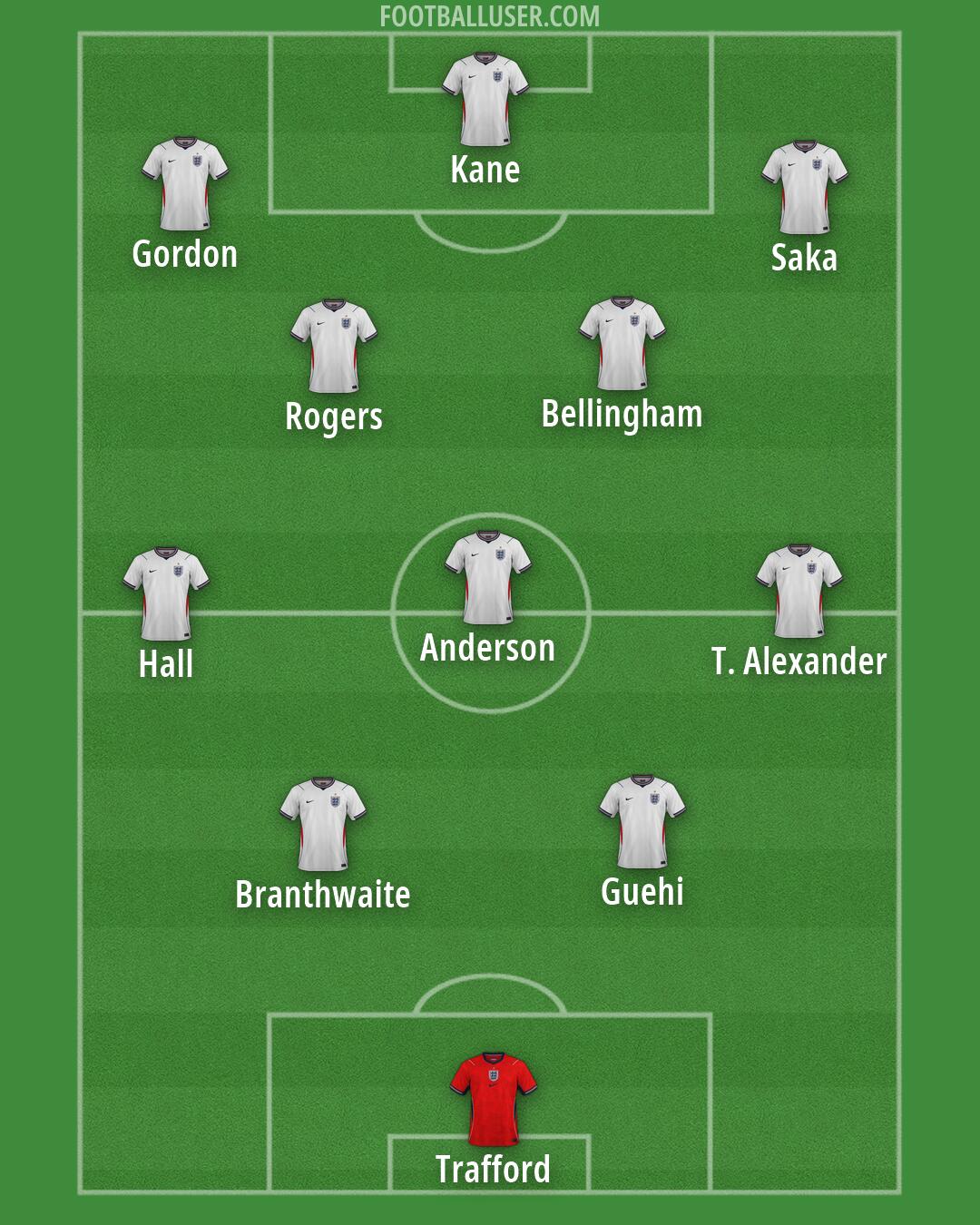
England National Football Team Formation
 September 26, 2026


Starting Lineup
Hall · Branthwaite · Guehi · T. Alexander · Kane · Saka · Gordon · Rogers · Bellingham · Anderson · TraffordEngland looks to dominate through a high press and rapid verticality with a 5-2-3. This formation is built to squeeze the pitch and use wide players to stretch the opposition during transitions. The team aims to win the ball high up the pitch and immediately find the front three to punish retreating defenders.
Trafford sits between the posts to manage the back line. The defensive unit operates with a back three consisting of Anderson, Guehi, and Branthwaite. Guehi acts as a ball playing defender while Branthwaite provides cover and strength in the air. Hall operates as an attacking wing back on the left to provide width, whereas T. Alexander pushes forward on the right flank to overlap. This five man line can drop into a low block to protect the middle when under pressure.
The midfield relies on a double pivot to manage the center of the pitch. Bellingham drives forward with the ball from deep, using his physical presence to carry the ball into the final third. Rogers connects the defensive and attacking lines, looking to find pockets of space between the lines. This pair must stay compact to prevent opponents from playing through the middle and to ensure they can transition quickly when possession is regained.
England uses three attackers across the front to pin the opposition back line. Kane operates as a lone striker who can drop deep to link up play with the midfielders. Saka plays as an inverted winger on the right, cutting inside to find shooting lanes, while Gordon stays wide on the left to whip it in and stretch the defense. These forwards press from the front to force mistakes, often creating runs in behind or isolating defenders in one on one situations.
A major strength of this England lineup is the ability to create wide overloads. When Hall and Gordon push high, it forces the opposition to defend deep. The team also benefits from the speed of transition, as Bellingham and the front three can hit in behind on the transition before the opponent can reset. This allows the team to exploit spaces left by attacking opponents.
This formation provides a heavy attacking presence while maintaining a solid defensive base through the back three. It is best suited for games against teams that play a high line and can be caught out on the break.