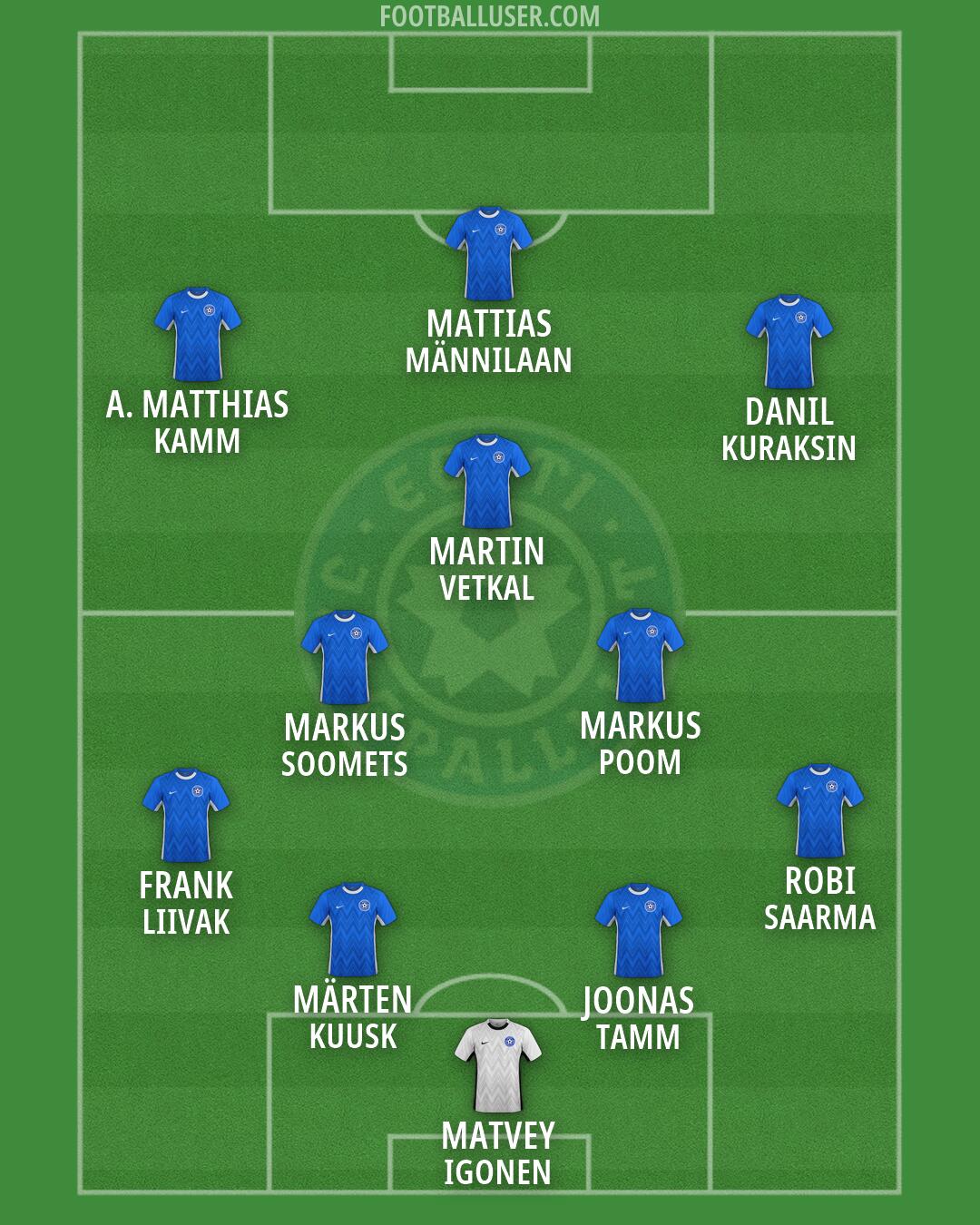

Estonia National Football Team Formation
 Today, September 27, 2026
 lucaosantos85


Starting Lineup
MATVEY (IGONEN) · ROBI (SAARMA) · JOONAS (TAMM) · FRANK (LIIVAK) · MÄRTEN (KUUSK) · MARKUS (SOOMETS) · MARKUS (POOM) · MARTIN (VETKAL) · DANIL (KURAKSIN) · A. MATTHIAS (KAMM) · MATTIAS (MÄNNILAAN)Estonia aims to play a high press and vertical game through a 4-3-3. This formation is built to win the ball high up the pitch and move quickly towards the opponent goal. The team seeks to stretch the defence by using width and directness to catch the opposition out of position.
MATVEY sits between the posts to command the area. The defensive unit operates with a flat back four where ROBI and FRANK act as full backs. ROBI provides width on the right while FRANK looks to overlap on the left. In the middle, JOONAS and MÄRTEN form the central pairing, with JOONAS covering the right side and MÄRTEN acting as the left central defender. This unit works to hold the line and defend zonally to keep the team compact.
The midfield consists of a three man midfield with a carrier and a creative presence. The two central midfielders, both named MARKUS, work to control the middle of the pitch. One MARKUS looks to shield the defence and win the second ball, while the other MARKUS drives forward with the ball to break the line. MARTIN plays as an attacking ten behind the striker, finding space between the lines to connect the midfield and the attack. This group is tasked to press aggressively to win the ball back high up the pitch.
Estonia utilizes three attackers across the front to pressure the opposition back line. MATTIAS leads the line as a lone striker, looking to hold up the ball and find the feet of his teammates. On the wings, DANIL and A. MATTHIAS act as wide wingers who hug the touchline to create space in the middle. They look to cut inside and create chances or deliver crosses into the box. The movements of the front three are designed to create runs in behind and isolate defenders in one on one situations.
One major advantage for Estonia is the ability to press high in coordinated waves, using MARTIN and the front three to force long balls from the opposition. The team also benefits from the width provided by FRANK and ROBI, which creates wide overloads when they push up to support the wingers. This setup makes it difficult for opponents to play out from the back without facing intense pressure.
This 4-3-3 formation relies on intense pressing and quick transitions to bypass the midfield. It is best suited for games against teams that struggle to play under pressure or fail to defend the wide areas effectively.