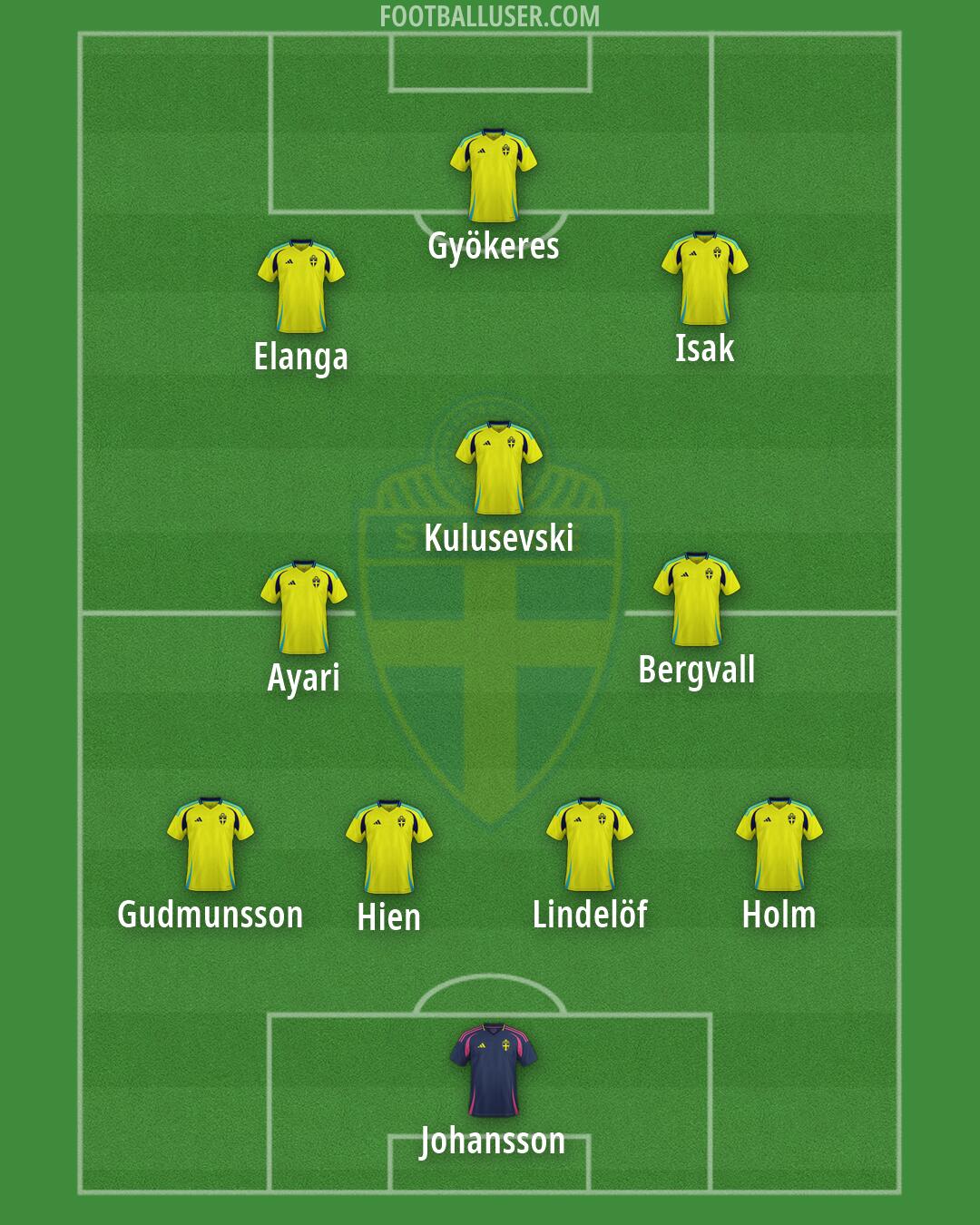

Sweden National Football Team Formation
 Today, September 27, 2026


Starting Lineup
Johansson · Elanga · Gyökeres · Bergvall · Gudmunsson · Kulusevski · Ayari · Isak · Lindelöf · Holm · HienSweden aims to control the tempo of the game through a high press and rapid transitions in a 4-3-3. This lineup relies on quick ball movement and verticality to stretch the opposition. The team seeks to win the ball high up the pitch and move forward with speed to catch the opponent out of position.
Johansson stays between the posts to organize the defensive line. The back four plays with a high line to squeeze the space in the middle of the pitch. Lindelöf acts as a ball playing defender who can find teammates with long passes, while Hien provides cover and is dominant in the air. Holm operates as a full back to provide stability, while Gudmunsson pushes forward to offer width. This unit works to hold the line and manage the offside trap to keep the play in the opponent's half.
The midfield works as a three-man midfield with a carrier to progress through the thirds. Ayari and Bergvall occupy the central spaces to shield the defence and win the second ball. Bergvall can carry the ball forward to link the lines, while Ayari helps to recycle possession. Kulusevski plays in the space behind the striker, acting as an advanced playmaker who can find pockets of space to create chances. This trio connects the defence to the attack by playing short from the back and quickly looking to break the lines.
Sweden utilizes three attackers across the front to maintain constant pressure. Gyökeres acts as a pressing centre-forward who holds up the ball and pins the last defender. Isak plays as an inverted winger who cuts inside from the right to create central threats, while Elanga stretches the defence on the left by hugging the touchline. The forwards press from the front to force a long ball from the opposition. This attacking group uses runs in behind and combinations in tight spaces to find the back of the net.
This formation offers significant advantages through its ability to press high in coordinated waves. The presence of Kulusevski behind the striker creates numerical superiority in the final third. Sweden can also use the speed of transition to hit in behind on the transition when the ball is won back. The wide players allow the team to spread wide and move the opposition block apart.
The 4-3-3 allows Sweden to dominate games through high intensity and rapid attacking movements. This setup is best suited for facing teams that play with a high line or struggle to manage quick transitions.