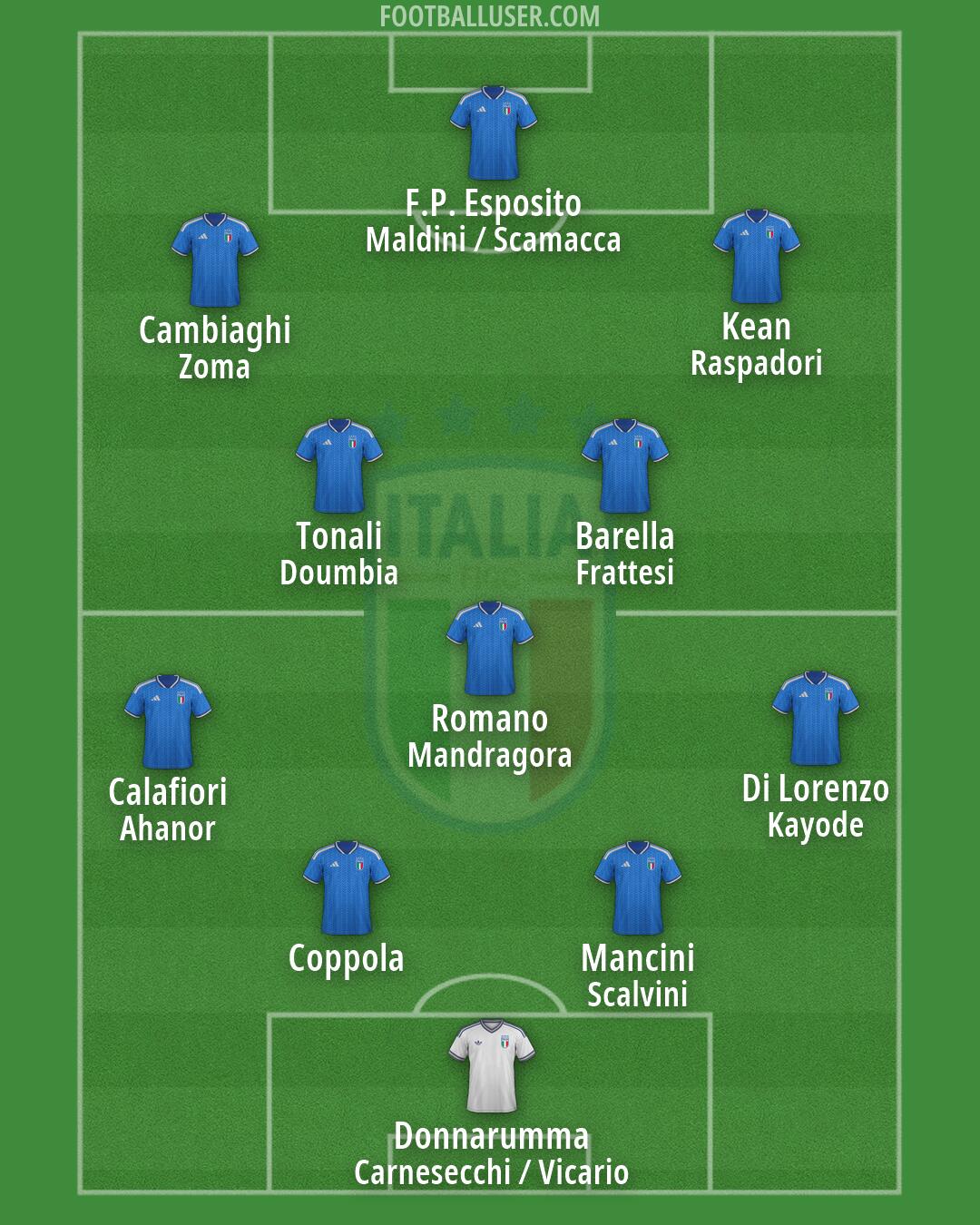

Italy National Football Team Formation
 September 27, 2026
 Spugn
Spugn


Starting Lineup
Donnarumma (Carnesecchi / Vicario) · Di Lorenzo (Kayode) · Mancini (Scalvini) · Coppola · Calafiori (Ahanor) · Romano (Mandragora) · Barella (Frattesi) · Tonali (Doumbia) · Kean (Raspadori) · Cambiaghi (Zoma) · F.P. Esposito (Maldini / Scamacca)Italy aims to be defensively solid while looking to hit opponents in transition using a 5-2-3. The lineup relies on a deep defensive base to absorb pressure before using the speed of the front three to break the line. This formation is built to play with a mid-block that stays compact and waits for the right moment to strike.
Donnarumma sits between the posts to command the area and act as a sweeping goalkeeper for the back line. Italy uses a back three composed of Mancini, Romano, and Coppola to defend the central zone. Mancini and Coppola act as the central defenders, with Mancini often looking to win the header and Coppola providing cover. Di Lorenzo operates as an attacking wing back on the right to provide width, while Calafiori plays as the left wing back to help build play from the back. This defensive unit functions to stay narrow and protect the middle of the pitch.
The midfield functions as a double pivot to protect the back three. Tonali and Barella operate in the center, with Tonali working to shield the defense and Barella using his high pressing intensity to win the ball back high up the pitch. Tonali looks to connect the defensive and attacking lines by recycling possession, while Barella drives forward with the ball to create tension. These two must stay close together to ensure they do not get bypassed in the middle.
In the attacking third, Italy utilizes three attackers across the front to stretch the opposition. F.P. Esposito acts as a pressing centre-forward to pin the last defender, while Cambiaghi and Kean operate as wide wingers. Cambiaghi plays as an inverted winger who will cut inside to find space, whereas Kean stays wider to deliver crosses. The front line works to press the opposition back line in pairs to force a long ball. This allows the team to attack in combinations through quick passes to find the feet of the striker.
Italy gains a tactical advantage through the width provided by Di Lorenzo and Calafiori, which creates wide overloads. The presence of Tonali and Barella allows for compactness when defending, making it difficult for opponents to play through the lines. The setup also offers speed of transition, as the three attackers can immediately sprint into space the moment the midfield wins the ball.
This 5-2-3 formation provides a reliable way to defend deep while maintaining the threat of a quick counter. It is best suited for matches against possession heavy sides that leave space behind their high defensive line.