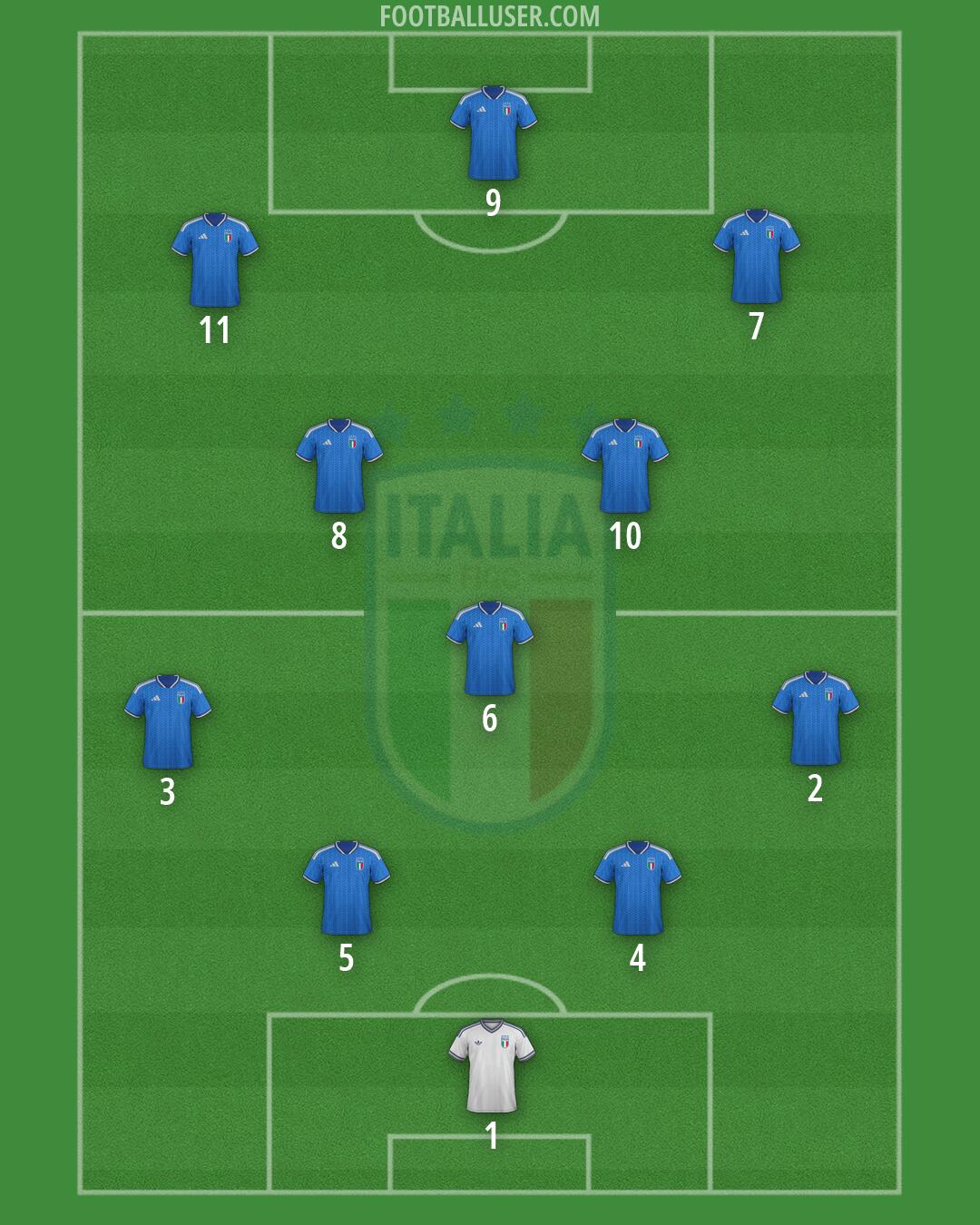

Italy National Football Team Formation
 Today, September 27, 2026
 Spugn
Spugn


Starting Lineup
12
4
5
3
6
10
8
7
11
9
Italy focuses on a hard to beat identity through a 5-2-3 formation. This lineup is built to sit deep and absorb pressure before hitting opponents in transition. The team looks to stay compact and use the width of the pitch to stretch the opposition once they win the ball back.
The goalkeeper, number 1, acts as the last line of defense in a narrow defensive block. Ahead of him, the back five consists of 6 as the central leader, with 4 and 5 acting as wide centre-backs to cover the channels. The wing backs, 2 and 3, are tasked with providing width and must track back to form a five man line when defending. Number 4 and 5 need to be dominant in the air to clear the lines when crosses come in. The defensive unit works to stay close together to deny the turn to any attacking midfielders.
In the middle of the pitch, Italy employs a double pivot consisting of 8 and 10. These two players must work tirelessly to shield the defense and intercept passes. Number 8 often acts as the carrier to move the ball from the defensive third into the middle, while 10 looks to connect the defensive and attacking lines. They are responsible for winning the second ball and ensuring the team does not get bypassed in the center. This pairing is crucial for recycling possession and starting the move toward the front three.
The attacking structure uses three attackers across the front, featuring 11 and 7 as wide wingers and 9 as a lone striker. Number 11 and 7 are expected to hug the touchline to spread the defense wide, while 9 acts as a pressing centre-forward to disrupt the opposition build up. When Italy breaks quickly, the wingers look to cut inside to create space for the wing backs to overlap. The goal is to create runs in behind the opposition back line or find 9 to hold up the ball for the oncoming runners.
Italy offers several tactical advantages through this setup. The formation allows for great compactness when defending, making it difficult for opponents to find gaps between the lines. There is also a high potential for speed of transition when 8 and 10 can quickly find the wingers. By using 2 and 3 as attacking wing backs, the team can create wide overloads to overwhelm the opposition full backs.
This 5-2-3 formation is designed for a team that wants to be defensively solid and dangerous on the break. It is best suited for facing teams that dominate possession but struggle to deal with quick vertical movements.