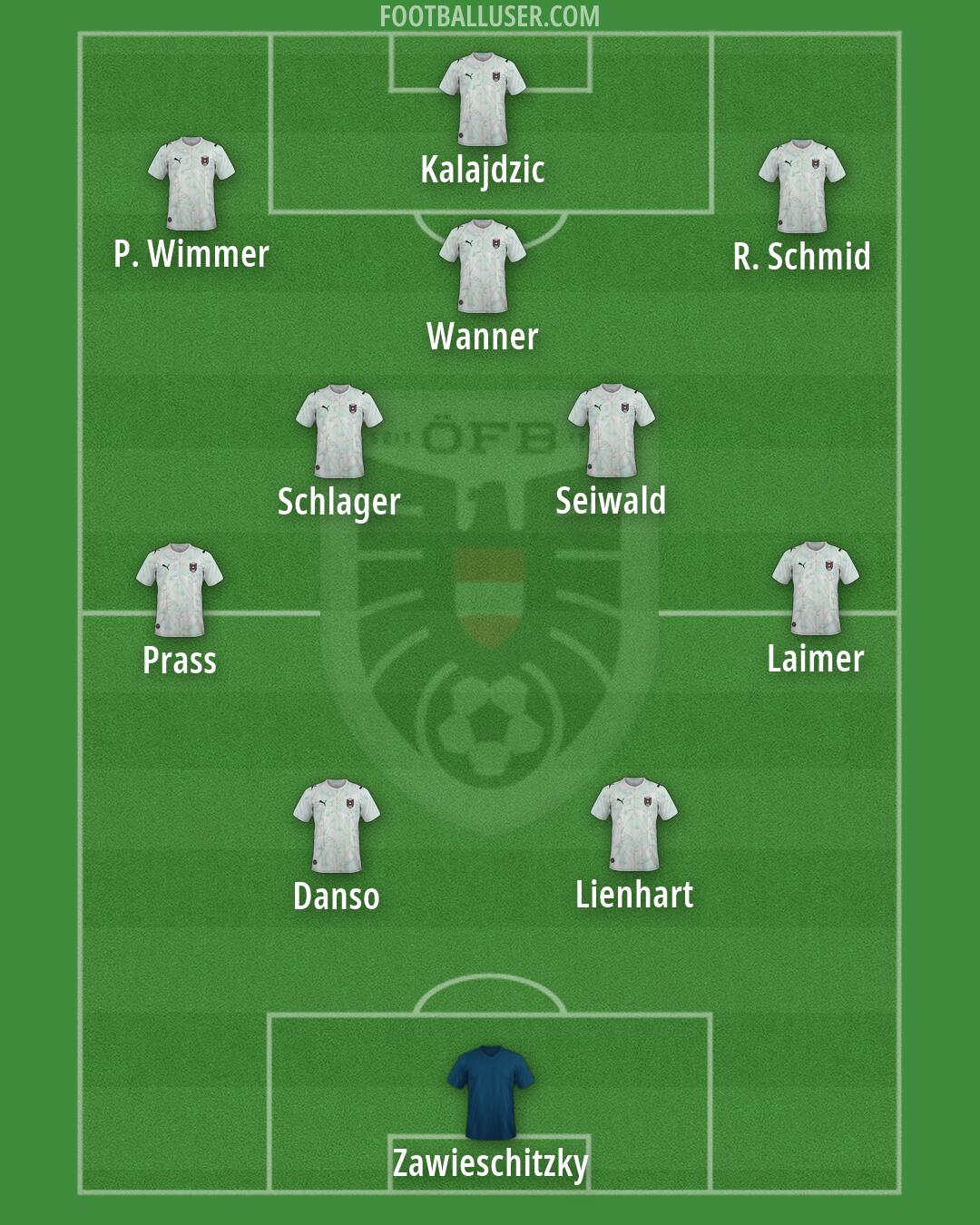

Austria National Football Team Formation
 Today, September 28, 2026


Starting Lineup
Danso · Lienhart · Laimer · Prass · Kalajdzic · P. Wimmer · R. Schmid · Wanner · Schlager · Seiwald · ZawieschitzkyAustria looks to dominate through high pressing and rapid verticality with a 2-5-3. This formation is built to squeeze the pitch and win the ball back high up the pitch, using intense pressure to force mistakes in the opposition half. The lineup aims to disrupt the opponent's build play and launch quick attacks through a congested central area.
Zawieschitzky operates as the lone goalkeeper behind a very narrow back line. Danso and Lienhart form a two man central defensive unit that must stay alert to cover large spaces behind them. Since there are no wide defenders in the base lineup, Danso and Lienhart must be prepared to defend one on one or slide across to cover the flanks when the opposition switches play. They act as ball playing defenders to start attacks, often looking to find the midfield quickly to bypass the press.
The midfield is the engine of this Austria lineup, utilizing a heavy five man block. Prass and Laimer act as a double pivot to shield the two center backs and protect the central zone. Schlager and Seiwald operate as two inverted eights in the half spaces, looking to win the second ball and carry the ball forward. Wanner plays as an attacking ten behind the striker, tasked to find pockets of space and play through the lines. This group works to compress the midfield and deny the turn of any opponent trying to build from deep.
In the final third, the team uses three attackers to stretch the defence. P. Wimmer and R. Schmid act as wide wingers who stay high to pin the last defender and provide width. Kalajdzic serves as the lone target man, tasked to hold up the ball and wait for the midfielders to arrive late into the box. The forwards press from the front to force a long ball, while the wingers look to cut inside and create central overloads. This attacking group works in combinations to hit in behind on the transition.
A major tactical advantage for this setup is the ability to press high in coordinated waves, making it difficult for opponents to find rhythm. By flooding the middle with five players, Austria can create numerical superiority in midfield and win the ball back quickly. The formation also allows for speed of transition, as the distance between the midfield block and the front three is minimal, allowing for instant direct attacks once possession is regained.
This setup relies on intense physical output to maintain a high line and squeeze the opposition. It is best suited for games where the team wants to dominate territory and exploit an opponent that struggles to play out from the back under pressure.