
FC Groningen Football Formation
 Today, September 28, 2026


Starting Lineup
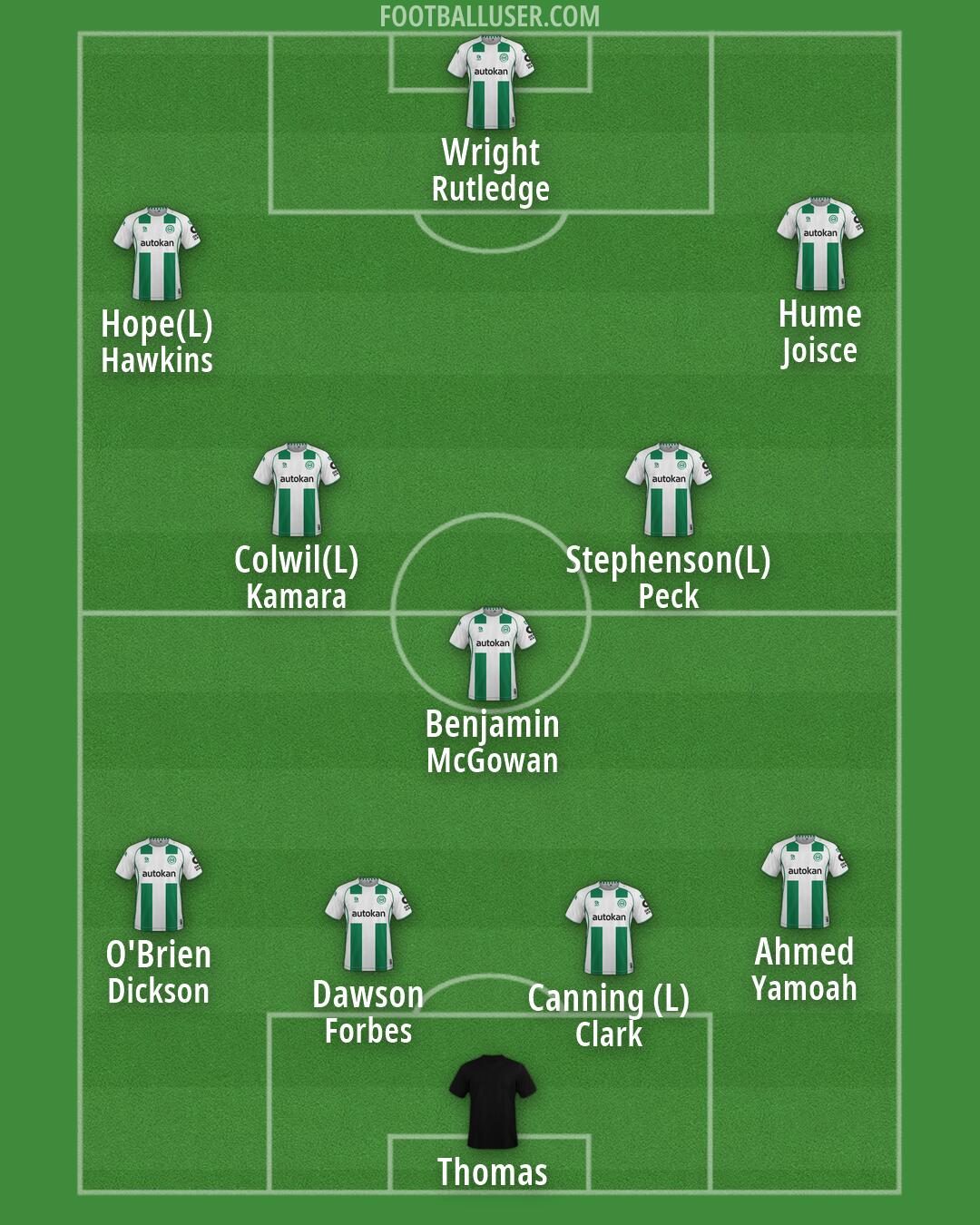
Thomas · Dawson (Forbes) · Canning (L) (Clark) · O'Brien (Dickson) · Ahmed (Yamoah) · Benjamin (McGowan) · Colwil(L) (Kamara) · Stephenson(L) (Peck) · Hume (Joisce) · Hope(L) (Hawkins) · Wright (Rutledge)FC Groningen focuses on a high press and fast attacking transitions using a 4-3-3 formation. This lineup is built to win the ball high up the pitch and quickly move it into the final third. By using a high line and aggressive movement, the team looks to pin the opposition in their own half and create chances through quick combinations.
Thomas stays between the posts to manage the defensive line. The back four consists of Ahmed at right back and O'Brien at left back, while Canning and Dawson act as the central defenders. Ahmed and O'Brien provide width by pushing up the pitch to support the wings. Canning and Dawson must hold the line and cover space if the team is caught on the break. The defensive unit works to squeeze the space and trigger a press as soon as the ball enters their half.
The midfield operates as a three-man midfield with a carrier and a single pivot. Benjamin sits in front of the defense to shield the back four and recycle possession. Colwil and Stephenson work in the half-spaces to connect the defense and attack. Colwil looks to drive forward with the ball while Stephenson makes late runs into the box to support the striker. This midfield trio aims to win the second ball and ensure the team can play through the lines during the buildup.
Up front, FC Groningen utilizes three attackers across the front. Wright acts as the lone striker, tasked to hold up the ball and find the feet of the midfielders. Hume and Hope play as wide wingers who stretch the defense. Hume tends to cut inside to create goalscoring opportunities, while Hope stays wide to deliver crosses. The forwards press from the front to force a long ball and create turnovers in dangerous areas.
One major strength of this formation is the ability to create wide overloads. When Ahmed and O'Brien overlap the wingers, they create two on one situations against the opposition full backs. Another advantage is the compactness when defending, as the midfield and defensive lines stay close together to deny the turn. This allows the team to transition at pace once they win the ball back.
This 4-3-3 setup relies on aggressive pressing and quick vertical movements to break down opponents. It is best suited for matches against teams that struggle to play out from the back or leave large spaces behind their defensive line.