Scotland National Football Team Formation
 Today, September 28, 2026


Starting Lineup
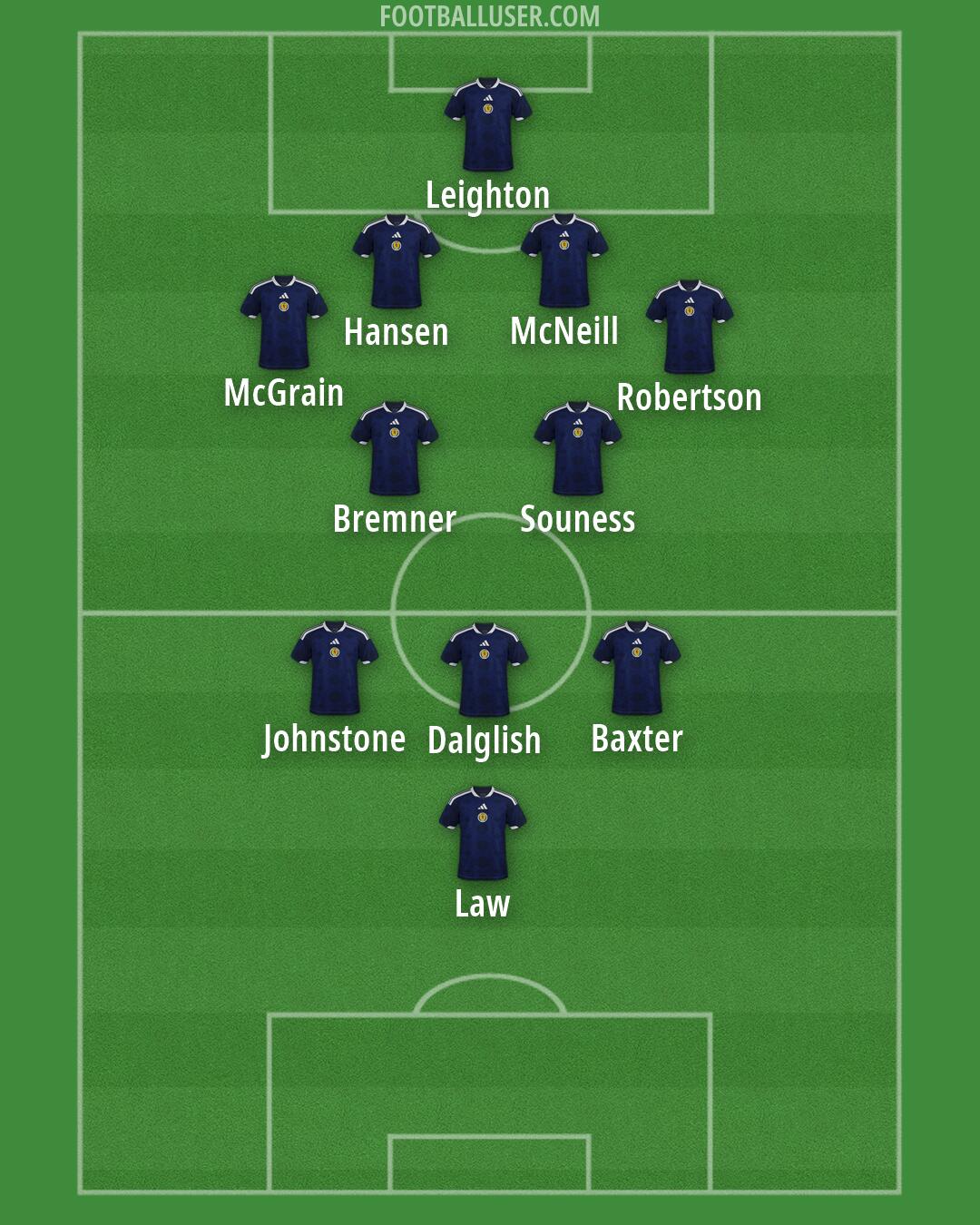
Dalglish · Law · Leighton · Souness · Bremner · Robertson · Hansen · McNeill · McGrain · Johnstone · BaxterScotland looks to win the ball high and hit in behind on the transition using a 4-2-4. This lineup focuses on verticality and rapid movement to catch the opposition out of position. The goal is to spread the pitch wide and use the front four to pin the last defender.
Leighton starts between the posts to organize the defensive line. A flat back four sees Robertson acting as an attacking full back to provide width. McGrain stays more disciplined to cover the flank while Hansen plays as a ball playing defender. McNeill works alongside Hansen to defend zonally and clear the lines when the opposition pushes forward. The unit aims to hold a high line to keep the team compact.
The midfield relies on a double pivot to control the center of the pitch. Souness acts as a driver to carry the ball forward and break the line with his passing. Bremner works to win the second ball and connects the defensive and attacking lines. This pairing must be ready to track back and cover the space left by the advancing full backs. They serve as the engine that allows Scotland to transition from a defensive block to a heavy attack.
The attack is built around a two forwards in a partnership consisting of Dalglish and Law. Dalglish often drops deep to link up play between the lines, while Law looks to run in behind the defense. On the flanks, Baxter and Johnstone act as wide wingers who hug the touchline to stretch the defence. This creates space in the middle for the central attackers to work in tight spaces. The front four press from the front to force a long ball from the opposition.
One major advantage of this formation is the ability to create wide overloads when Robertson and McGrain push up. Scotland also benefits from the speed of transition, using the passing range of the midfield to find the wingers quickly. The heavy presence in the final third makes it difficult for opponents to defend the box against such a direct lineup.
This 4-2-4 formation is built for aggressive, high tempo football that seeks to overwhelm opponents. It is best suited for games where the team can exploit space behind a high defensive line.