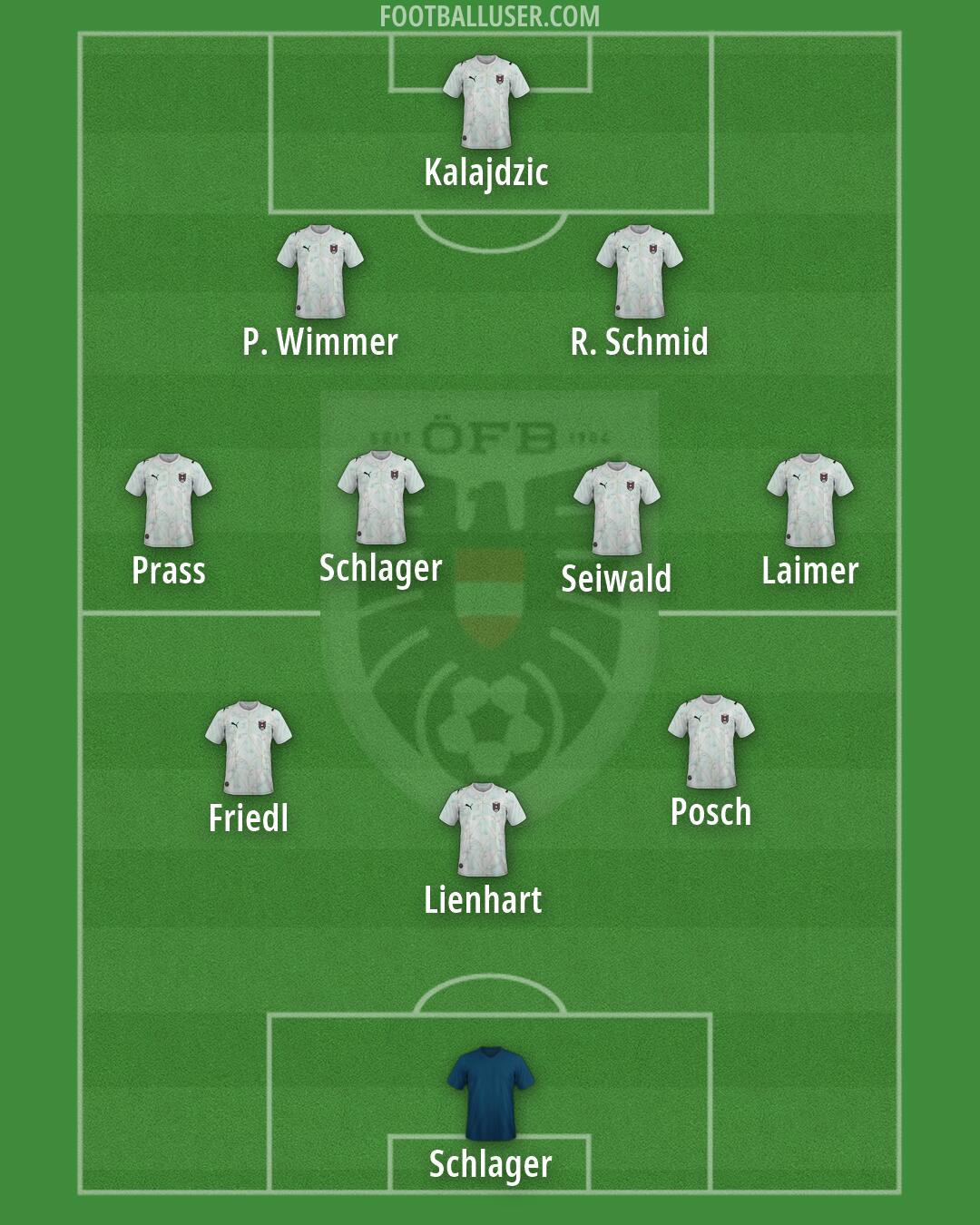

Austria National Football Team Formation
 Today, September 30, 2026


Starting Lineup
Kalajdzic · R. Schmid · Lienhart · Friedl · Posch · Laimer · Prass · Schlager · Seiwald · P. Wimmer · SchlagerAustria plays with a high press and a heavy emphasis on verticality using a 3-4-3. This formation is built to win the ball back high up the pitch and move the play forward with speed. The goal is to squeeze the space in the opposition half and create chaos through quick transitions and aggressive movement.
Schlager operates between the posts to provide security for the back line. The defensive unit functions as a back three consisting of Lienhart, Friedl, and Posch. Lienhart acts as the central figure to organize the line and cover behind his teammates. Friedl and Posch play as wide centre-backs who can step up into midfield to disrupt play or track runners in wide areas. This three man unit works to maintain a high line and catch opponents offside.
The midfield operates with two central players and two wide players to control the tempo and width. Seiwald and Schlager act as a double pivot to shield the defense and win the second ball in the middle of the pitch. Laimer and Prass play as wide midfielders who provide the engine for the team. Laimer uses his high pressing intensity to harass opponents, while Prass helps to stretch the defense by providing width. These four players work together to connect the back three to the attacking front line.
Austria uses three attackers to pin the opposition back. Kalajdzic plays as a lone striker and serves as a target man to hold up the ball and win headers. On the flanks, P. Wimmer and R. Schmid act as wide wingers to create goal scoring opportunities. P. Wimmer looks to cut inside and create space, while R. Schmid pushes wide to deliver crosses into the box. The forwards press from the front to force a long ball and win possession back quickly in the attacking third.
This lineup offers the advantage of being able to press high in coordinated waves to suffocate the opponent. The presence of Laimer and Prass allows for wide overloads when they push forward to support the wingers. Austria also benefits from a compact defensive block when they drop back, making it difficult for teams to play through the middle.
Austria relies on a high energy system that demands constant movement and physical output. This formation is best suited for games where the team can exploit a high line or overwhelm a mid block through quick transitions.