England National Football Team Formation
 September 30, 2026


Starting Lineup
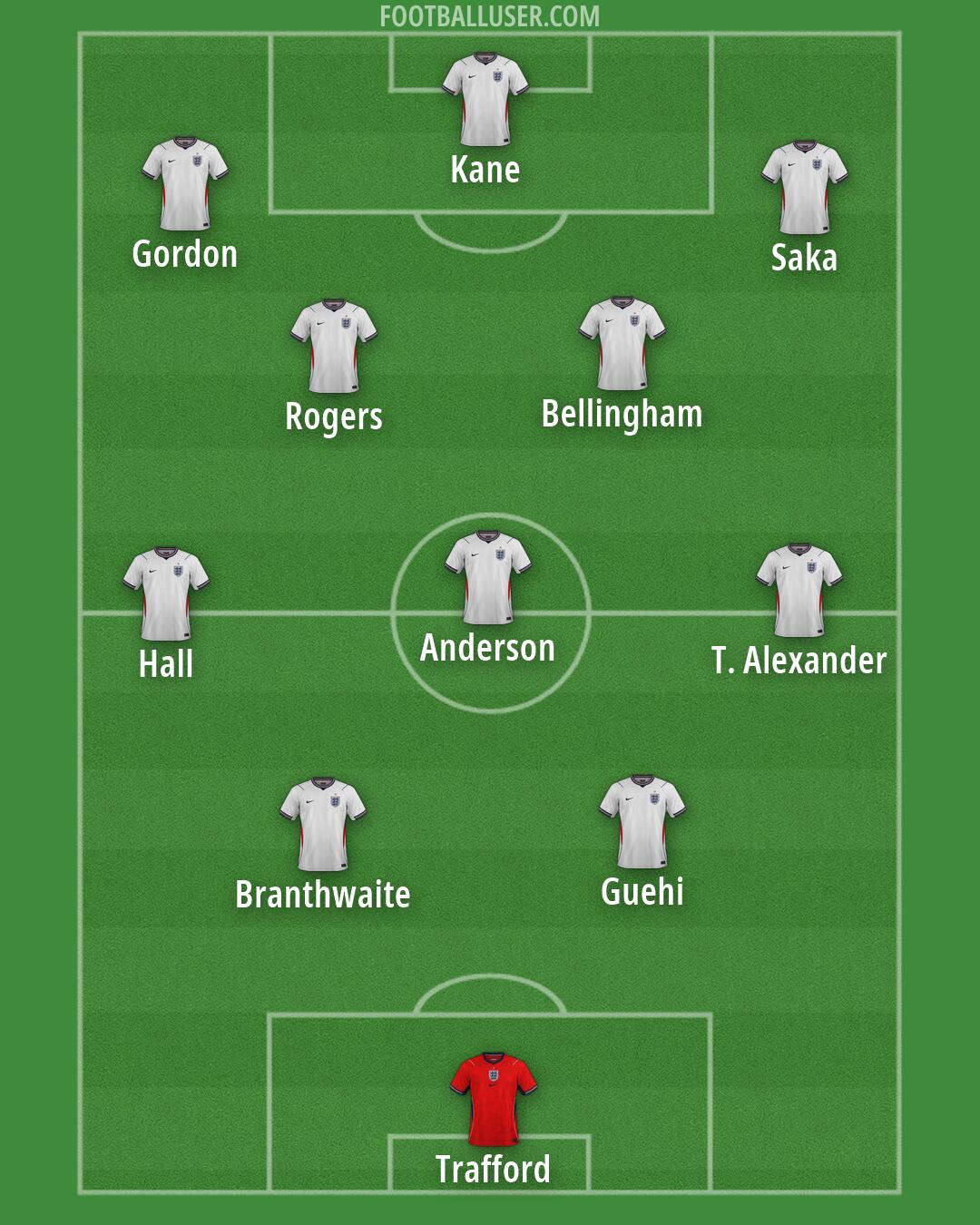
Hall · Branthwaite · Guehi · T. Alexander · Kane · Saka · Gordon · Rogers · Bellingham · Anderson · TraffordEngland focuses on rapid transitions and direct verticality through a 5-2-3 formation. This lineup is built to absorb pressure before hitting opponents with speed in the channels. The tactical identity relies on a strong defensive base that allows the front three to stay high and threaten the back line.
Trafford acts as the last line of defense behind a compact back five. Anderson and Guehi form the central core, where they work to win the second ball and clear the lines. Branthwaite operates as a wide center back to cover the space when the wing backs push up. T. Alexander and Hall act as attacking wing backs, providing the width needed to stretch the opposition. This unit works to stay narrow when defending, forcing play wide and protecting the central zone.
The midfield utilizes a double pivot consisting of Rogers and Bellingham. Bellingham is a powerful carrier who drives forward with the ball to link the defensive and attacking lines. Rogers plays to connect the play, working to recycle possession and find the attackers. This pair must remain disciplined to avoid leaving the center of the pitch exposed when the wing backs overlap. They work to squeeze the space in a mid-block and intercept passes before the opposition can progress through the thirds.
England employs three attackers across the front to pin the opposition defense. Kane operates as a lone striker, using his ability to hold up the ball and find the feet of his teammates. Gordon and Saka act as wide wingers who hug the touchline to create width. Both Gordon and Saka look to cut inside to create goalscoring chances or deliver crosses. The front three press from the front to force a long ball and win possession high up the pitch.
The main advantage of this lineup is the ability to launch sudden attacks in transition. By using T. Alexander and Hall to provide width, England can create wide overloads that pull defenders out of position. The combination of a deep defensive block and three high attackers makes the team very difficult to play through. This setup allows the team to shift between a defensive five and an attacking three very quickly.
England is a side that thrives on catching opponents on the break with pace and directness. This formation is best suited for games against teams that commit many players forward and leave space behind their defense.