Custom Team Football Formation
 Today, September 30, 2026


Starting Lineup
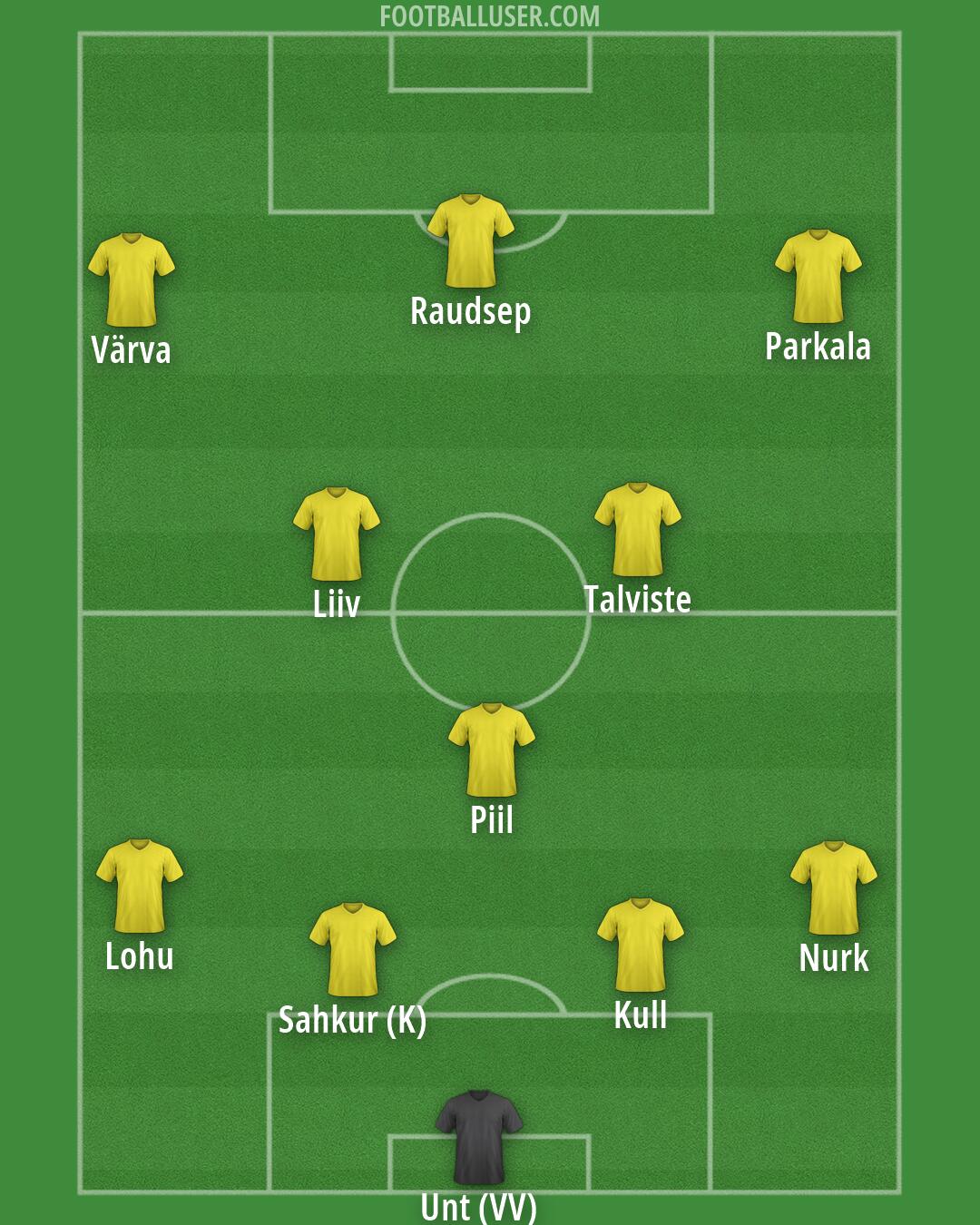
Raudsep · Parkala · Värva · Liiv · Talviste · Piil · Lohu · Sahkur (K) · Kull · Nurk · Unt (VV)A focus on rapid transitions and defensive density defines this team, operating within a 5-2-3 formation. This lineup is built to absorb pressure and strike quickly once the ball is won. By utilizing a back five, the team seeks to control the central zones while leaving plenty of space behind the opposition for quick breaks.
Unt (VV) stays between the posts to manage the defensive line. The back five consists of Piil as the central anchor, with Sahkur (K) acting as the left centre-back and Kull occupying the right centre-back spot. As captain, Sahkur (K) organizes the unit to ensure they hold a compact shape. Lohu acts as the left wing back to provide width on the flank, while Nurk operates as the right wing back. This system allows the wing backs to push high when in possession, but they must track back to form a five man block when defending deep.
In the center of the pitch, the team employs a double pivot to manage the transition from defense to attack. Liiv and Talviste occupy the two central midfield roles. Liiv works to shield the defense and recycle possession, while Talviste looks to carry the ball forward to bridge the gap between the lines. This pair must work hard to cover the space left behind when the wing backs push up, ensuring the midfield does not become bypassed by the opposition.
The attacking unit relies on three players to stretch the opponent. Raudsep operates as a lone striker, tasked to hold up the ball and find the feet of his teammates. Värva occupies the left wing to provide width, while Parkala plays on the right wing to cut inside and create chances. This front three presses the opposition back line to force mistakes. The team looks to attack in combinations, often using the space created by the wing backs to isolate wide players in one on one situations.
One major advantage of this lineup is the ability to create wide overloads through the movement of Lohu and Nurk. When they overlap the wingers, they force the opposition to defend more space. Additionally, the team offers great compactness when defending in a mid-block, making it difficult for opponents to play through the middle. This defensive solidity allows the team to wait for the right moment to hit in behind on the transition.
This 5-2-3 formation provides a reliable base for teams that want to defend deep and use pace on the break. It is best suited for matches against dominant sides where winning the second ball and staying compact is the priority.