
Japan National Football Team Formation
 October 1, 2026


Starting Lineup
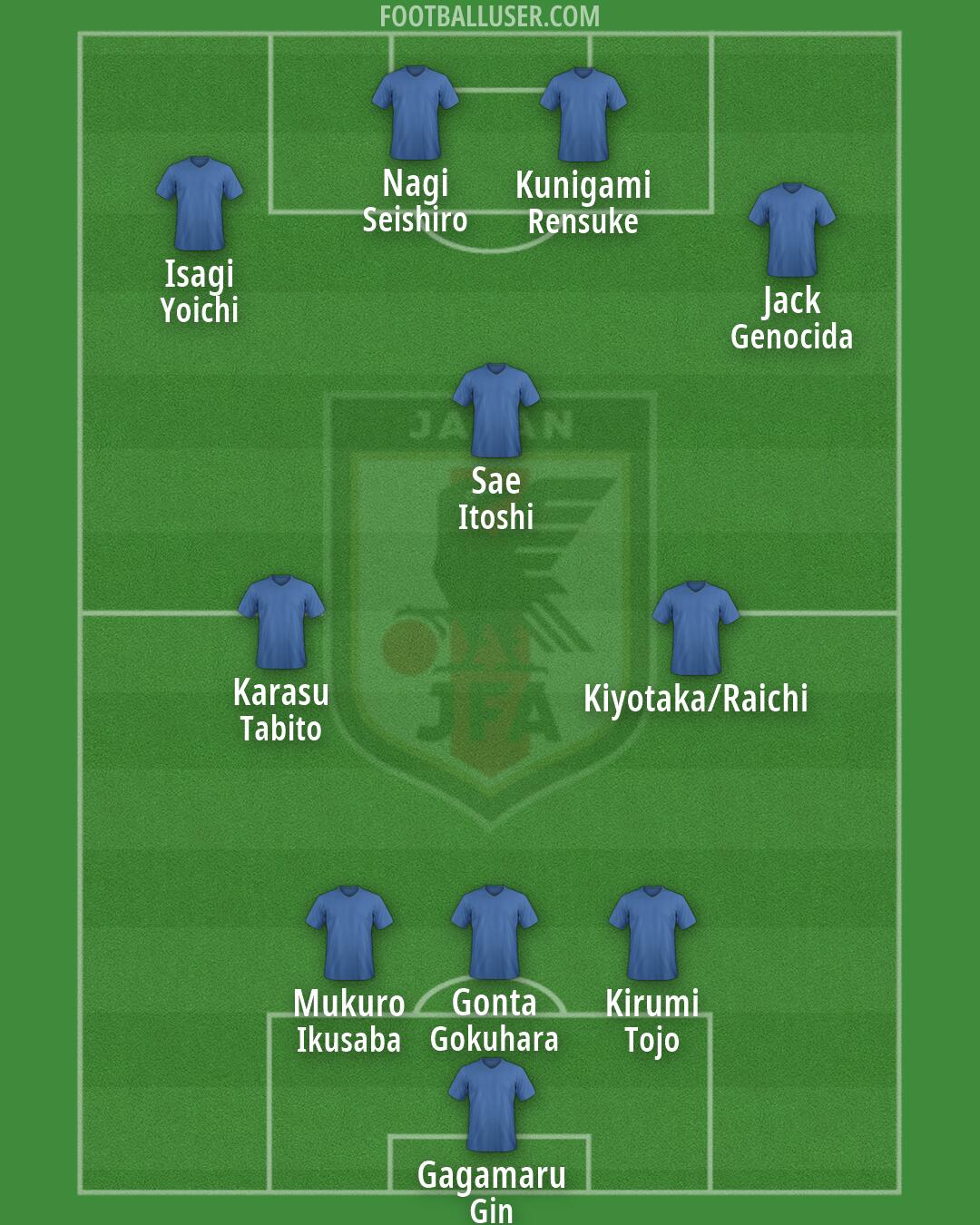
Kunigami (Rensuke) · Jack (Genocida) · Gonta (Gokuhara) · Isagi (Yoichi) · Mukuro (Ikusaba) · Karasu (Tabito) · Kiyotaka/Raichi · Sae (Itoshi) · Kirumi (Tojo) · Gagamaru (Gin) · Nagi (Seishiro)Japan focuses on an aggressive, high pressing style of play through a 3-3-4 formation. The lineup aims to overwhelm the opposition by committing massive numbers forward to win the ball back high up the pitch. This formation is built to play with extreme verticality, looking to squeeze the space in the opponent's half and force quick errors.
Gagamaru acts as the last line of defense, often needing to sweep behind a high line when the defenders push up. The back three consists of Gonta at the center, flanked by Kirumi on the right and Mukuro on the left. Gonta acts as the central anchor, while Kirumi and Mukuro must be ready to step up and cover wide areas if the opposition attempts to bypass the midfield. The unit works to hold the line and compress the pitch, ensuring the distance between the defenders and the midfield remains small.
The midfield operates with a three man midfield with a carrier to help progress the ball. Karasu and Kiyotaka/Raichi work in the central areas to win the second ball and disrupt the opponent's rhythm. Karasu focuses on controlling the tempo and recycling possession, while Kiyotaka/Raichi works to drive forward with the ball to bridge the gap to the attack. Sae plays as an attacking ten behind the strikers, looking to play through the lines and find the forwards in dangerous pockets. Sae acts as the primary creative hub, looking to split the defence with a through ball.
Japan employs four attackers to create constant chaos in the final third. Kunigami and Nagi act as a central partnership, with Kunigami often working as a pressing centre-forward to harass defenders while Nagi looks to find space for clinical finishes. Isagi and Jack provide width, with Isagi acting as an inverted winger who cuts inside to exploit central gaps and Jack working to stretch the defence on the flank. This front line is designed to attack in combinations and hit in behind on the transition, using the movement of the two strikers to pin the last defender.
The primary strength of this Japan lineup is the ability to press high in coordinated waves, making it very difficult for opponents to build from the back. By committing four players to the front line, the team creates constant pressure and can quickly win the ball back high up the pitch. Additionally, the presence of Sae behind the four attackers allows for quick combinations in tight spaces, creating many chances through rapid vertical movement.
This formation is designed for a high octane, offensive identity that seeks to dominate through sheer numbers in the attacking third. It is best suited for games where Japan needs to break down a low block or overwhelm an opponent through relentless pressure.