Custom Team Football Formation
 Today, October 2, 2026


Starting Lineup
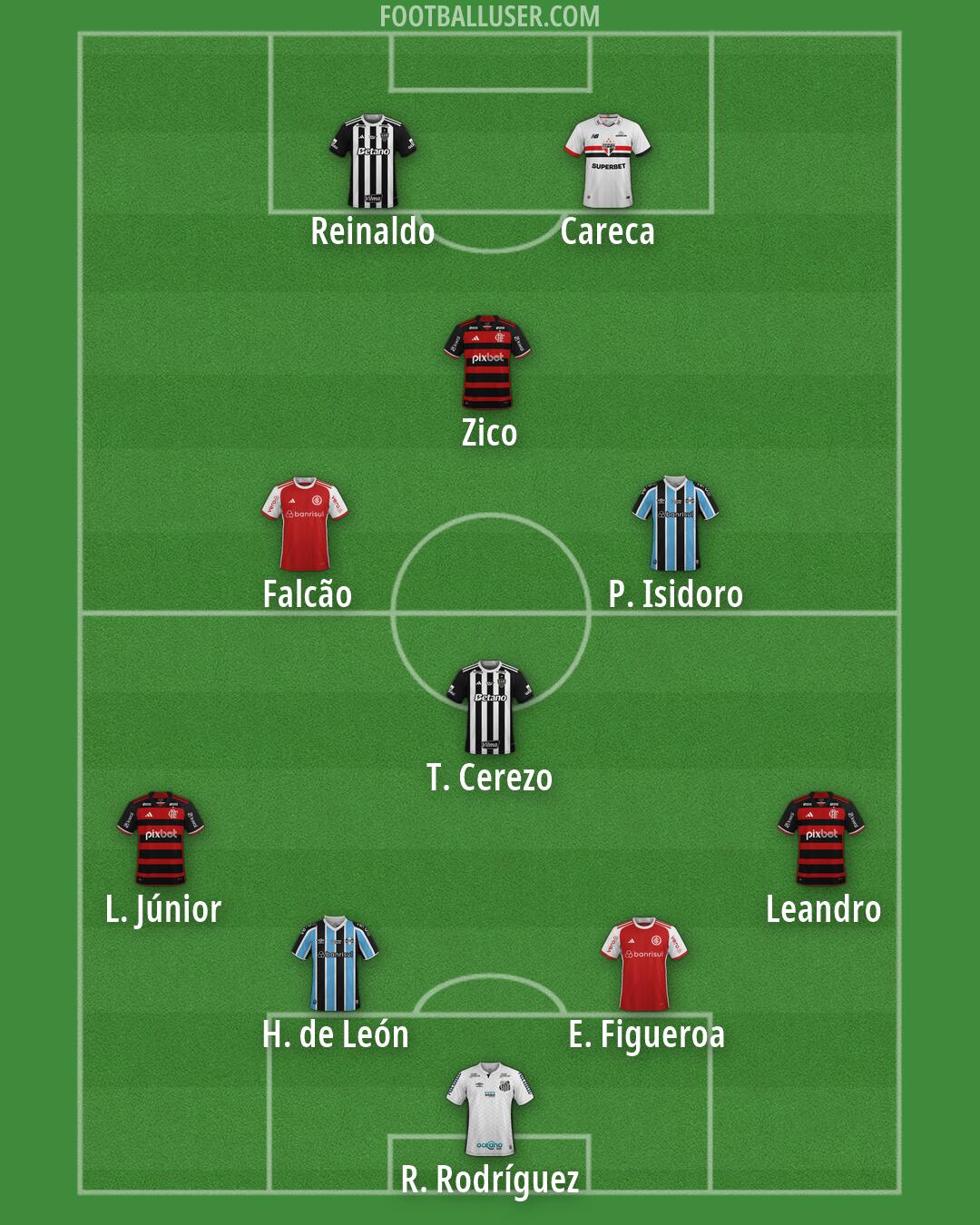
R. Rodríguez (Santos) · E. Figueroa (Internacional) · H. de León (Grêmio) · Leandro (Flamengo) · L. Júnior (Flamengo) · T. Cerezo (Atlético Mineiro) · P. Isidoro (Grêmio) · Falcão (Internacional) · Zico (Flamengo) · Reinaldo (Atlético Mineiro) · Careca (São Paulo)Prioritising a high press and quick transitions, this lineup uses a 4-5-1 formation to control the pitch. The team seeks to win the ball back high up the pitch to catch opponents out of position. By spreading the midfield across the width of the field, the team can control the tempo and create passing lanes for quick breaks.
Reinaldo operates between the posts to organize the defensive unit. The back four stays relatively compact to prevent breakthroughs through the middle. Falcão and P. Isidoro act as full backs, looking to provide width while ensuring they track back to cover the flanks. Zico and Careca form the central defensive pair, focusing on winning the second ball and clearing the lines when under pressure. They must hold the line to keep the defensive unit together.
A five man midfield provides the engine room for this team. T. Cerezo sits in the single pivot role to shield the defence and intercept passes. In front of him, L. Júnior and Leandro operate as two central midfielders to help recycle possession and link the defence to the attack. H. de León and E. Figueroa play as wide attacking midfielders, positioned in the half spaces to stretch the defence. These four work to compress the midfield when the ball is lost, forcing the opposition into long balls.
The attacking plan relies on a lone striker, R. Rodríguez, who acts as a pressing centre-forward to harass the opposition back line. He works to hold up the ball and lay it off to the oncoming midfielders. When the team moves into the final third, H. de León and E. Figueroa look to cut inside or deliver crosses to R. Rodríguez. The formation creates many runs in behind and relies on the movement of the wide players to isolate defenders in one on one situations.
The main tactical advantages include the ability to press high in coordinated waves and the ability to maintain compactness when defending. Because the midfield is so broad, the team can easily transition from a narrow defensive block to a wide attacking posture. This setup allows the team to dominate the middle of the pitch while keeping enough bodies back to prevent counter attacks.
This 4-5-1 formation is built to overwhelm opponents through intense pressing and rapid verticality. It is best suited for games where the team needs to squeeze the space in the middle and exploit gaps left by an advancing opponent.