Crystal Palace Football Formation
 October 2, 2026


Starting Lineup
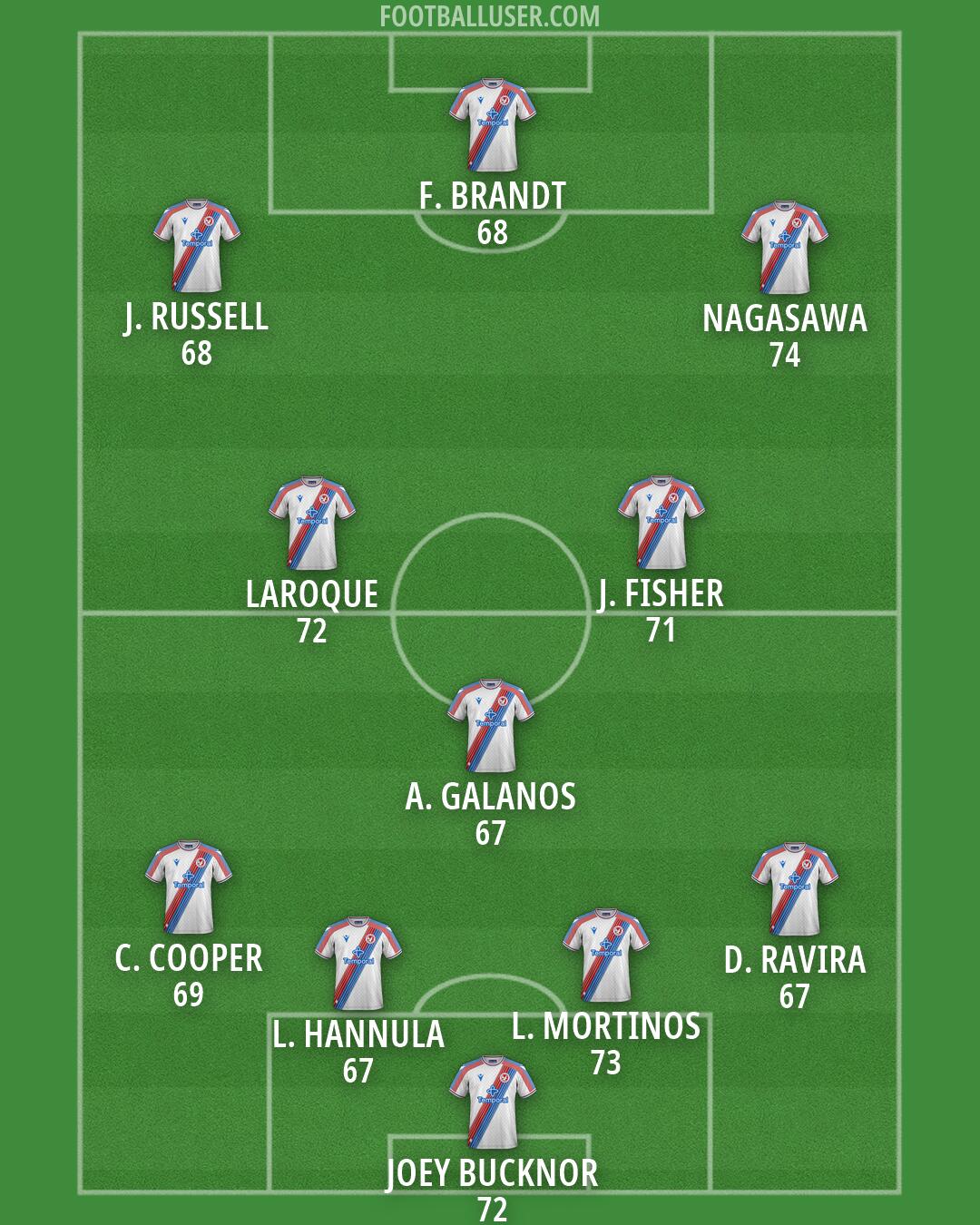
JOEY BUCKNOR (72) · D. RAVIRA (67) · L. MORTINOS (73) · L. HANNULA (67) · C. COOPER (69) · A. GALANOS (67) · LAROQUE (72) · J. FISHER (71) · NAGASAWA (74) · F. BRANDT (68) · J. RUSSELL (68)Crystal Palace relies on a vertical style of play through a 5-2-3 formation. The team looks to sit deep and absorb pressure before hitting the opposition on the transition with speed. This lineup is built to exploit gaps in the defense once the ball is won in the middle third.
Joey Bucknor stays between the posts to command the area. The defensive unit functions as a back five, using a central trio of A. Galanos, L. Hannula, and L. Mortinos to protect the middle. Galanos sits as the central man to organize the line, while Hannula and Mortinos cover the spaces to his left and right. The wide defenders, C. Cooper and D. Ravira, act as attacking wing backs who push high up the pitch to provide width. When the team loses possession, Cooper and Ravira drop back to form a compact defensive block that is hard to break down.
The midfield consists of a double pivot with Laroque and J. Fisher. These two work to control the central zone and protect the back five. Laroque works to recycle possession and find the attackers, while J. Fisher looks to intercept passes and win the second ball. They must work hard to cover the space between the defense and the front three to prevent the opposition from playing through the lines. The midfield acts as the engine that connects the defensive unit to the forward line.
Crystal Palace utilizes three attackers across the front, featuring Nagasawa on the right wing and J. Russell on the left. Nagasawa and Russell act as wide wingers who look to stretch the defense and provide crosses into the box. F. Brandt leads the line as a lone striker, tasked with holding up the ball and pinning the last defender. The forwards press the opposition back line to force a long ball, allowing the defensive unit to win it back. The team creates chances through quick combinations and runs in behind.
One major strength of this formation is the ability to transition quickly from a low block to a high attacking threat. The wide presence of C. Cooper and D. Ravira allows the team to create wide overloads once they move into the final third. Additionally, the back five provides great compactness when defending against teams that try to play through the center.
This formation offers Crystal Palace a reliable way to defend against high possession teams by staying narrow and disciplined. It is best suited for matches where the team needs to sit deep and strike on the counter at pace.