Custom Team Football Formation
 October 2, 2026


Starting Lineup
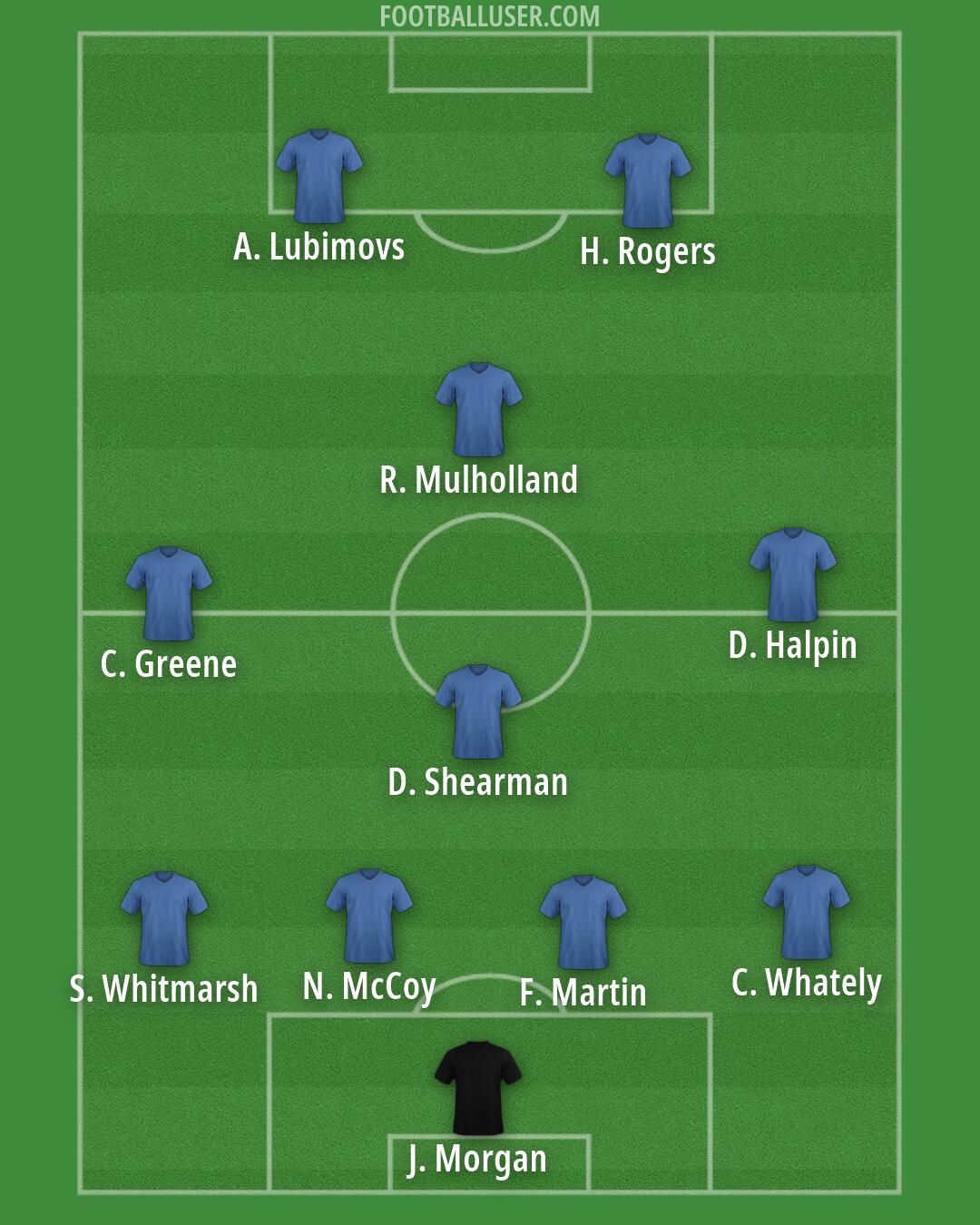
J. Morgan · F. Martin · C. Whately · N. McCoy · C. Greene · S. Whitmarsh · D. Shearman · R. Mulholland · A. Lubimovs · D. Halpin · H. RogersA focus on direct play and quick transitions defines this lineup using a 4-4-2. The team aims to move the ball forward rapidly to catch the opposition before they can settle. By utilizing two banks of four, the team seeks to maintain control through verticality and heavy pressure in the middle of the pitch.
J. Morgan sits between the posts to organize the defensive line. The back four operates as a flat defensive line to keep the distances between players short. N. McCoy and F. Martin act as the central defenders, with N. McCoy providing cover while F. Martin looks to win the second ball. On the flanks, C. Whately and S. Whitmarsh act as full backs, tasked to hold the line and prevent any runs in behind. This unit functions by staying compact to deny the turn to opposing attackers.
The midfield is built around a central core that connects the defense to the front line. D. Shearman plays as a single pivot to shield the defense and recycle possession. Beside him, C. Greene and D. Halpin operate as two central midfielders, with C. Greene looking to drive forward with the ball and D. Halpin tasked to intercept passes. R. Mulholland plays as an attacking ten behind the strikers, finding pockets of space to play through the lines and link the midfield to the attack.
Up front, the team employs two forwards in a partnership to stretch the opposition. A. Lubimovs plays as a lone striker who works to hold up the ball and pin the last defender, while H. Rogers plays as a second striker to make runs in behind. They work to press from the front to force a long ball from the opposition. The attacking movements rely on the ability of A. Lubimovs to lay it off for H. Rogers to burst into space or for R. Mulholland to arrive late into the box.
This formation offers a clear advantage through its ability to press in a mid-block and maintain compactness when defending. The presence of R. Mulholland behind the two strikers allows for quick transitions, creating numerical superiority in the final third during attacks. The wide players and full backs can also work to create wide overloads if the opposition pins the midfield too narrow.
The 4-4-2 relies on quick vertical movements and strong central presence to break down opponents. This lineup is best suited for matches against teams that play a high line and leave space behind their defenders.