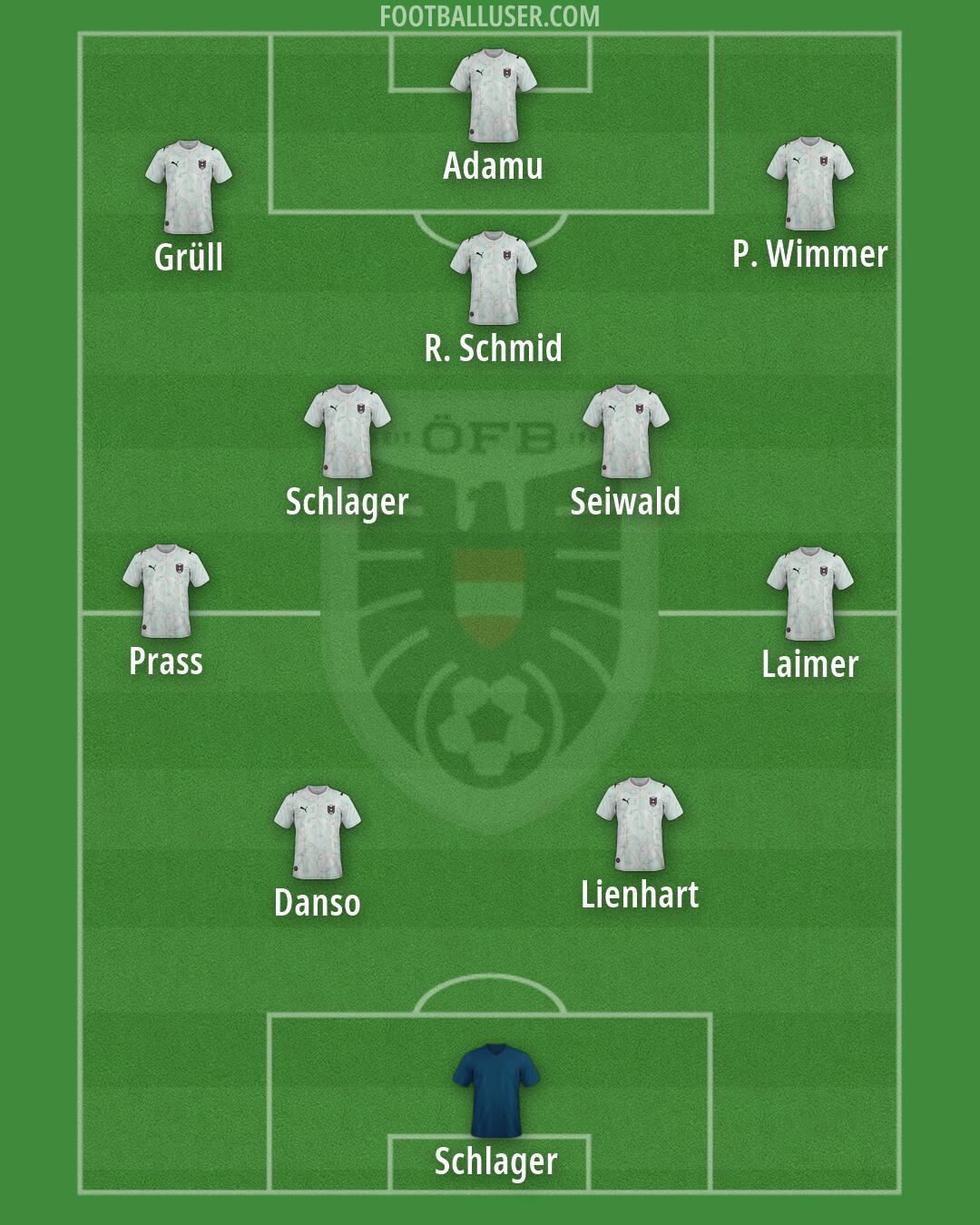

Austria National Football Team Formation
 October 3, 2026


Starting Lineup
Prass · Laimer · Danso · Lienhart · Adamu · Schlager · Seiwald · Grüll · P. Wimmer · R. Schmid · SchlagerAustria focuses on high intensity and aggressive pressure using a 2-5-3 formation. This lineup seeks to win the ball back high up the pitch and move the play forward through heavy pressing. The team intends to dominate the central areas and overwhelm opponents with numbers in the middle third to drive the game toward the opposition goal.
Schlager plays between the posts to command the area. The defensive unit relies on a narrow two man back line consisting of Danso and Lienhart. Danso and Lienhart must stay compact to defend the central channel and are expected to win the header when the team is forced to defend deep. Because there are only two central defenders, they must hold the line and be prepared to cover wide spaces if the midfield is bypassed.
The midfield is heavily congested to control the center of the pitch. Laimer and Prass act as a double pivot to shield the two central defenders and disrupt play. Schlager and Seiwald operate in the half spaces to link the defense to the attack, with Schlager looking to carry the ball forward and Seiwald providing stability. R. Schmid plays as an attacking ten behind the striker, looking to find pockets of space and play through the lines to feed the front three.
In the final third, Austria uses three attackers to stretch the opposition. Adamu acts as a pressing centre-forward to harass the defenders and hold up the ball. Grüll and P. Wimmer play as wide wingers, with Grüll pulling wide to spread the defence and P. Wimmer looking to cut inside and create chances. This front line works to isolate defenders in one on one situations and uses quick combinations to create runs in behind.
The main advantage for Austria is the numerical superiority in midfield which allows them to squeeze the space in the center. By packing the middle with five players, they can easily win the second ball and transition quickly. This formation also allows the team to press in coordinated waves, making it very difficult for opponents to play out from the back without making errors.
This formation relies on a heavy press to force turnovers in the attacking third. It is best suited for matches against teams that struggle to play under pressure and prefer a slower tempo.