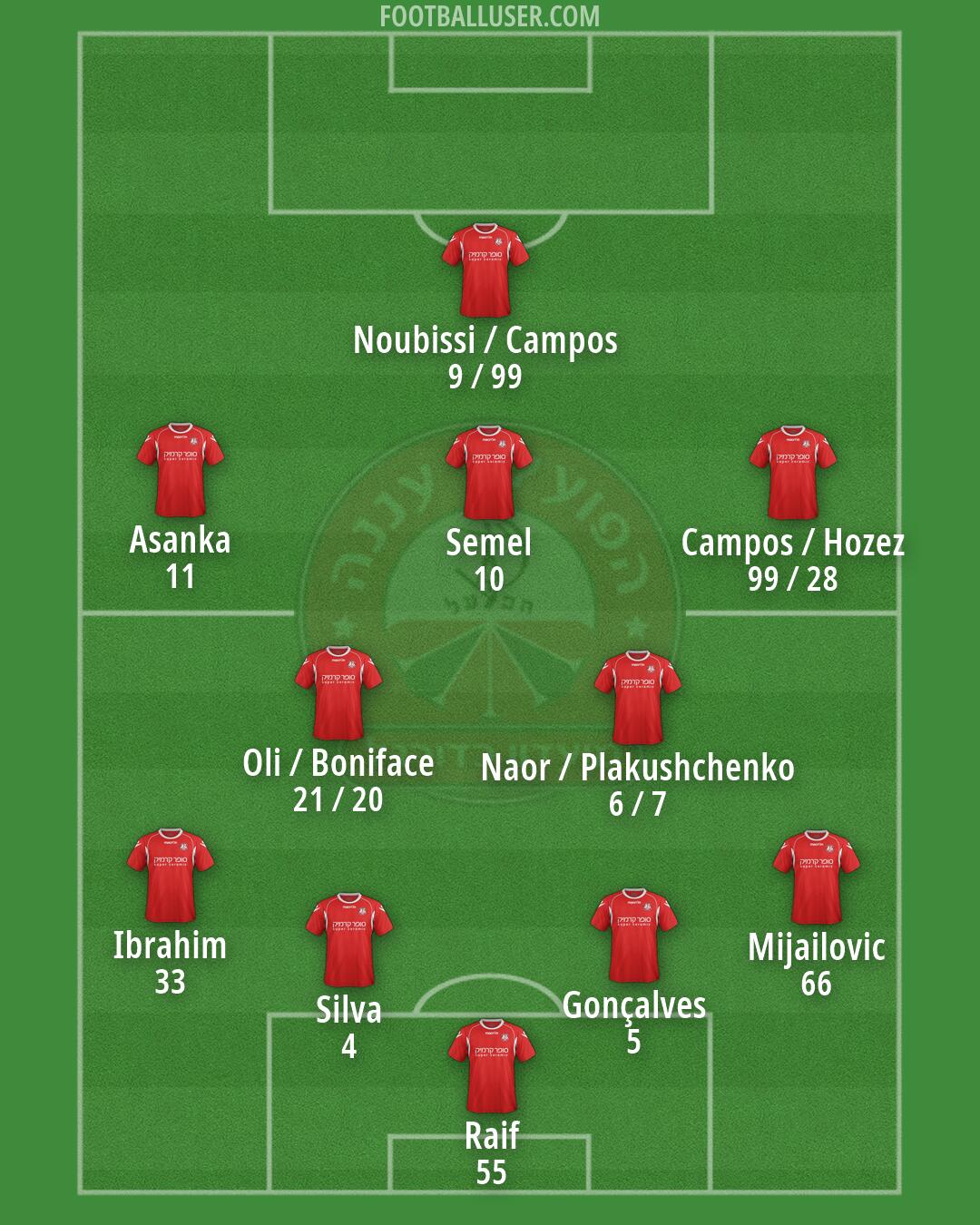

Hapoel Ramat-Gan Football Formation
 October 3, 2026


Starting Lineup
Asanka (11) · Semel (10) · Naor / Plakushchenko (6 / 7) · Oli / Boniface (21 / 20) · Noubissi / Campos (9 / 99) · Mijailovic (66) · Campos / Hozez (99 / 28) · Silva (4) · Ibrahim (33) · Raif (55) · Gonçalves (5)Hapoel Ramat-Gan aims to play a direct and high tempo game using a 4-2-4. This formation is built to stretch the opposition and find quick ways to reach the final third. By pushing players high up the pitch, the team looks to overwhelm the opponent through verticality and constant pressure.
Raif stays between the posts to act as the last line of defense. Ahead of him, the back four operates as a flat line to keep the defensive unit compact. Ibrahim acts as the left back, while Mijailovic provides width and support from the right. In the middle, Silva and Gonçalves serve as the central defenders, tasked with winning headers and clearing the lines when under pressure. The defensive unit must stay disciplined to prevent being caught out during transitions.
The midfield functions as a double pivot to provide a base for the attack. Naor or Plakushchenko works to shield the defense and win the second ball, while Oli or Boniface connects the defensive and attacking lines. This duo is responsible for recycling possession and finding the forwards quickly. They must stay central to prevent the opposition from playing through the middle, ensuring the team can shift from defense to attack without losing control of the center.
Hapoel Ramat-Gan uses a heavy attacking lineup with three players across the front line. Asanka occupies the left wing to provide width, while Campos or Hozez operates on the right. The team uses a two-man forward partnership with Semel and Noubissi acting as the central strikers. These forwards are tasked to press from the front and pin the last defender to create space. The goal is to create runs in behind and use the width to deliver crosses into the box for the strikers to attack.
A major advantage of this 4-2-4 lineup is the ability to create wide overloads and isolate defenders in one on one situations. By spreading the pitch, the team can force the opposition to stretch their defensive block. Furthermore, the high number of attackers allows for intense pressing in coordinated waves to win the ball back high up the pitch. This setup makes the team very dangerous when they transition quickly and catch the opposition out of position.
This formation relies on high intensity and quick movement to break down the opposition. It is best suited for matches where the team needs to chase a result or play against an opponent that sits deep in a low block.