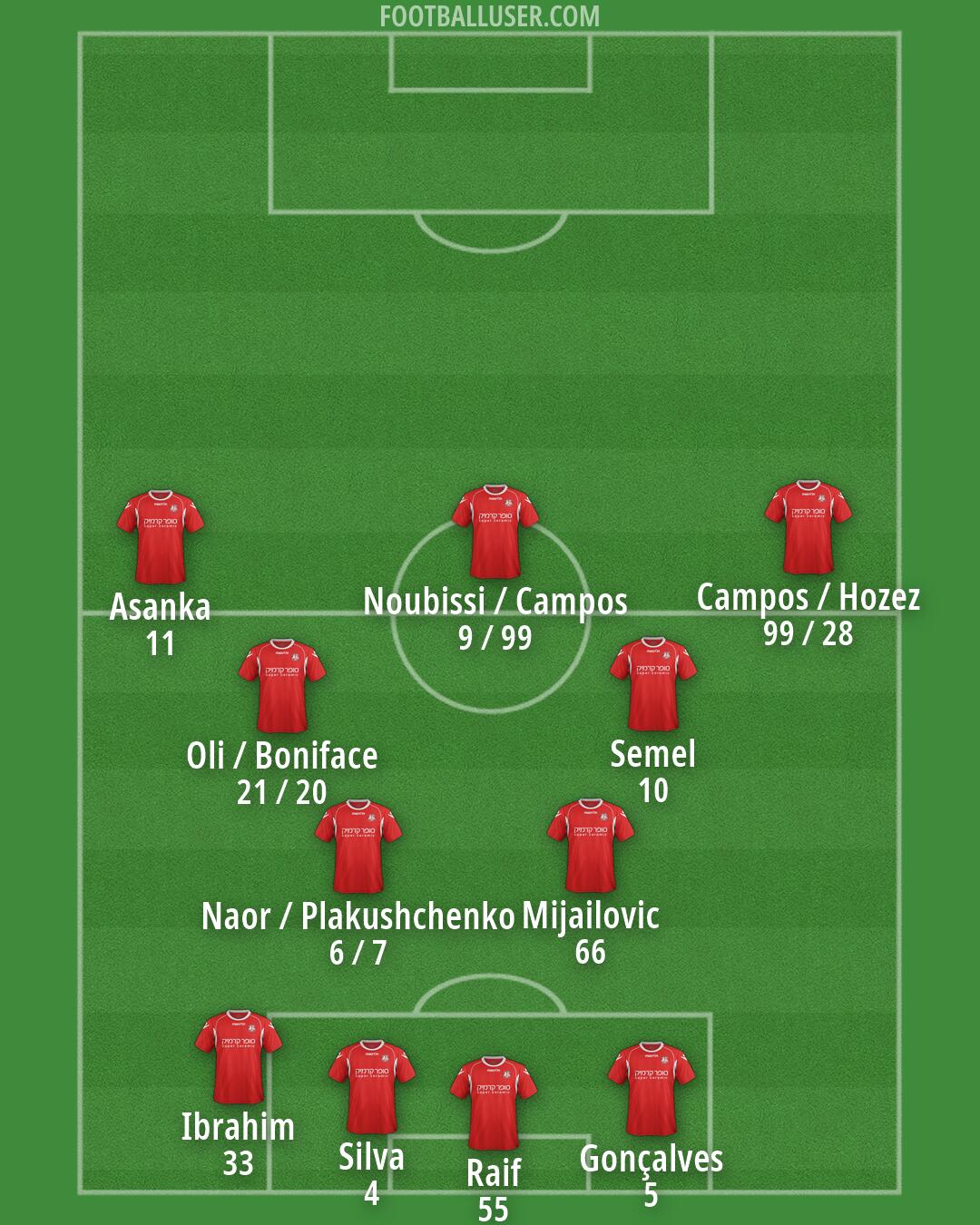

Hapoel Ramat-Gan Football Formation
 Today, October 3, 2026


Starting Lineup
Asanka (11) · Semel (10) · Naor / Plakushchenko (6 / 7) · Oli / Boniface (21 / 20) · Noubissi / Campos (9 / 99) · Mijailovic (66) · Campos / Hozez (99 / 28) · Silva (4) · Ibrahim (33) · Raif (55) · Gonçalves (5)Hapoel Ramat-Gan focuses on aggressive pressing and rapid transitions using a 3-4-3 formation. The team seeks to win the ball high up the pitch and strike quickly before the opposition can settle. This lineup relies on intense energy to stretch the defence and exploit spaces left behind during the transition.
Raif stays between the posts to organize the back line. The defensive unit operates as a back three where Silva sits centrally to command the area. To his sides, Gonçalves acts as the right wide centre-back and Ibrahim plays as the left wide centre-back. This trio works to maintain a compact defensive block, with Silva looking to win the second ball and cover the spaces behind the wingers.
The midfield operates with a double pivot to control the center of the pitch. Mijailovic works alongside Naor or Plakushchenko to shield the defence and intercept passes. These two players are tasked with breaking the line and finding the attackers quickly. Further up, Semel operates in the right half space while Oli or Boniface occupies the left, connecting the midfield to the front three and providing driving runs to carry the ball forward.
Hapoel Ramat-Gan utilizes three attackers to pin the last defender. Asanka stays wide on the left to pull defenders out of position, while Campos or Hozez occupies the right wing to provide width. In the center, Noubissi or Campos acts as a focal point to hold up the ball and link play with the advancing midfielders. This attacking group is designed to create one on one situations and deliver crosses into the box.
One major advantage for Hapoel Ramat-Gan is the ability to press high in coordinated waves, forcing the opposition into mistakes. The formation also allows for wide overloads when the midfielders push up to support the wingers. This creates constant pressure in the final third and makes it difficult for opponents to play out from the back.
This 3-4-3 formation is built for high intensity and quick counter attacks. It is best suited for matches against teams that play a high line and leave gaps behind their defensive unit.