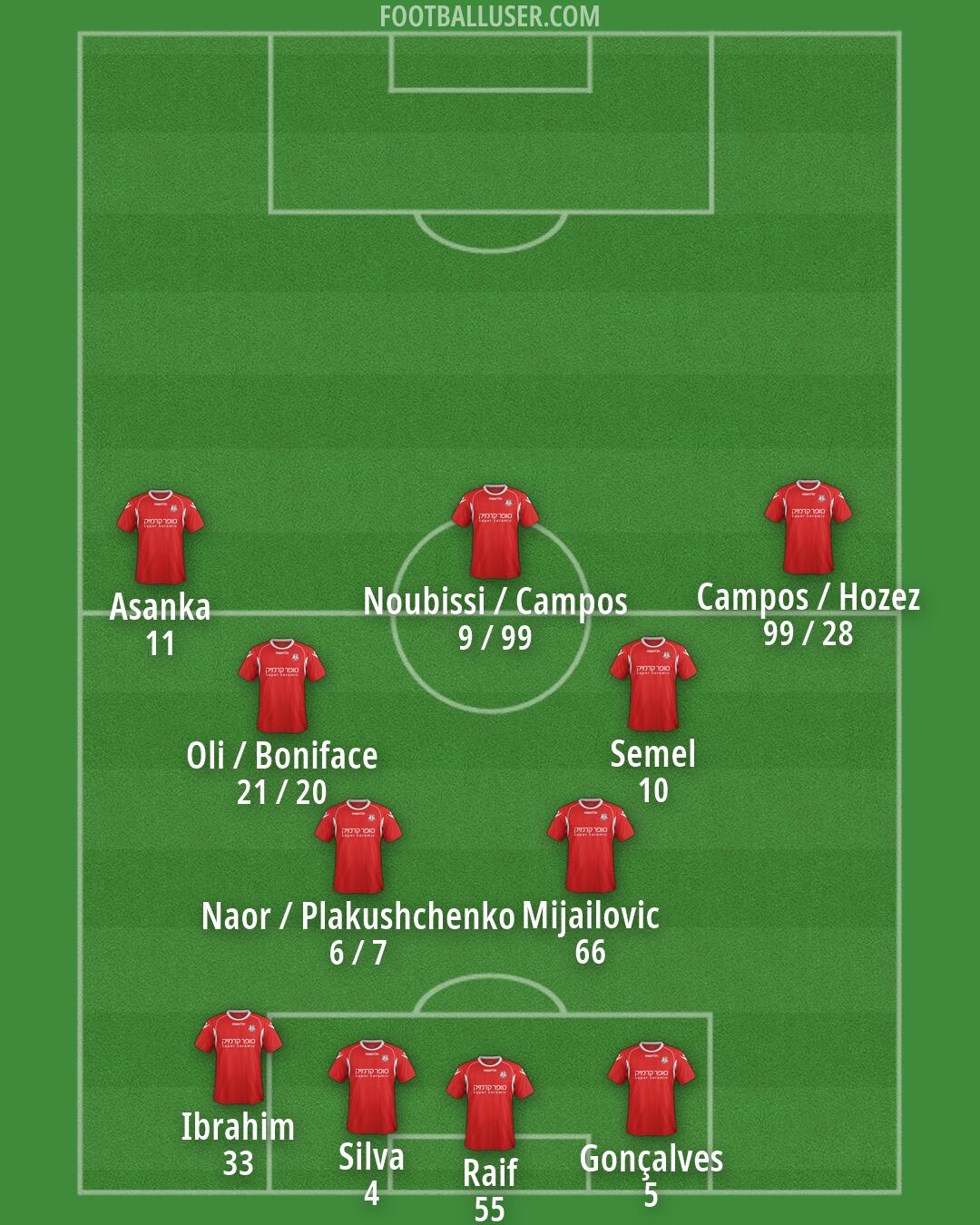

Hapoel Ramat-Gan Football Formation
 Today, October 3, 2026


Starting Lineup
Asanka (11) · Semel (10) · Naor / Plakushchenko (6 / 7) · Oli / Boniface (21 / 20) · Noubissi / Campos (9 / 99) · Mijailovic (66) · Campos / Hozez (99 / 28) · Silva (4) · Ibrahim (33) · Raif (55) · Gonçalves (5)Hapoel Ramat-Gan focuses on aggressive pressing and quick transitions using a 3-4-3 formation. This lineup is built to squeeze the opposition in their own half and win the ball high up the pitch to catch defenders out of position. The team looks to use width and central intensity to overwhelm opponents through rapid vertical movement.
Raif sits between the posts to organize the defensive line. A back three consisting of Gonçalves, Silva, and Ibrahim forms the core of the defense. Silva acts as the central defender to hold the line while Gonçalves and Ibrahim provide cover on the sides. The unit functions as a compact block that stays narrow to force the opposition wide before they can penetrate the middle.
The midfield utilizes a double pivot to control the central zones. Naor or Plakushchenko works to shield the defense and recycle possession, while Mijailovic provides the link to move the ball forward. In the half spaces, Oli or Boniface acts as an attacking midfielder to drive the ball forward, supported by Semel who operates on the right side of the midfield. This group works to compress the midfield and win the second ball to sustain pressure.
Hapoel Ramat-Gan employs three attackers to stretch the opposition. Asanka operates on the left wing to provide width, while Campos or Hozez plays on the right to cut inside and find space. Noubissi or Campos acts as the central striker to lead the press and find the feet of the midfielders. The forwards move in combinations to create runs in behind, using the wingers to pull defenders out of position and create gaps for the striker to exploit.
This formation offers significant advantages through its ability to press in coordinated waves. The presence of wide players alongside attacking midfielders creates wide overloads that can isolate defenders in one on one situations. By utilizing a heavy midfield presence, the team can often achieve numerical superiority in the middle of the pitch to dominate play.
The 3-4-3 setup relies on high intensity and quick recovery to disrupt the opponent. This formation is best suited for matches against teams that struggle to play out from the back under pressure.