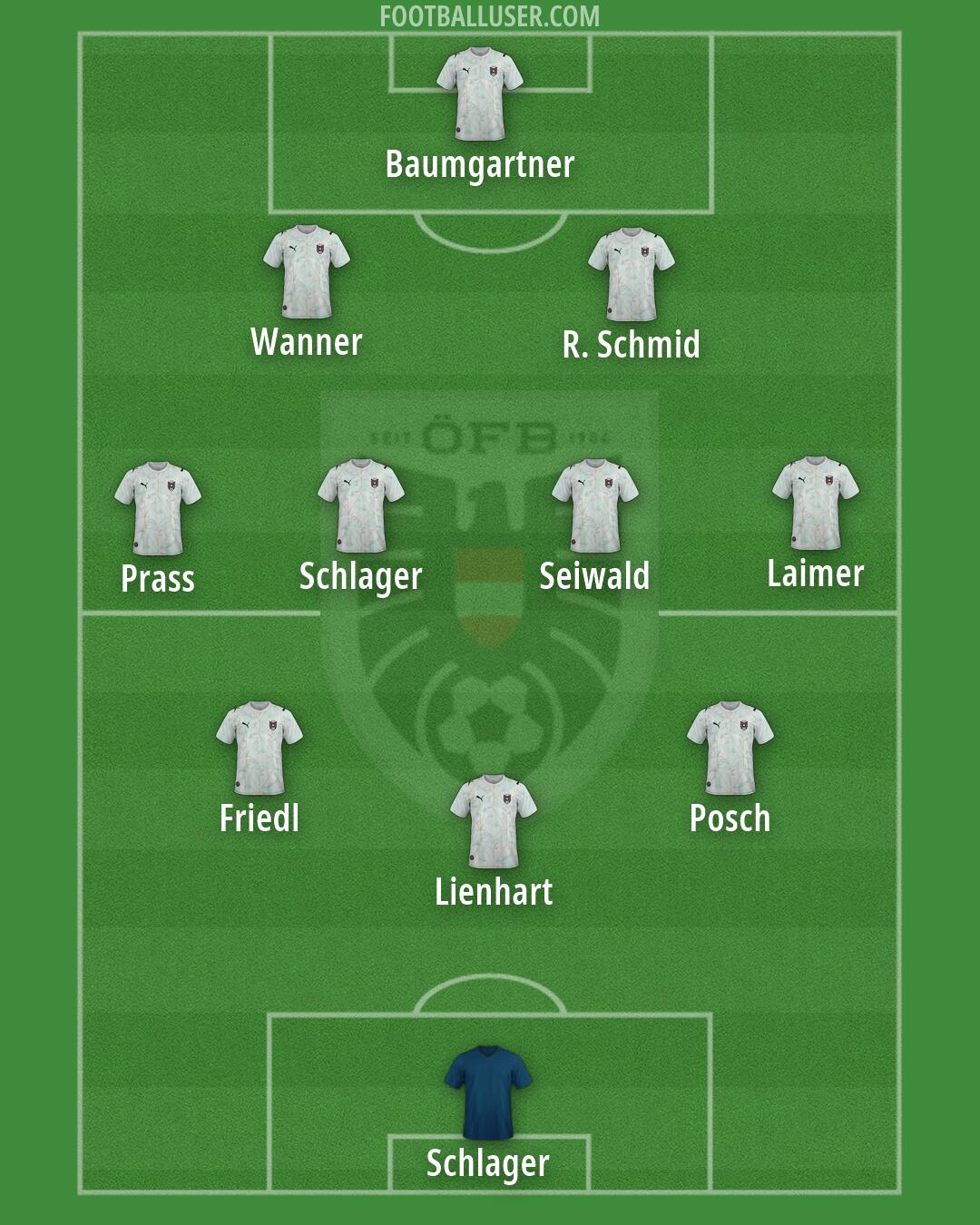

Austria National Football Team Formation
 Today, October 5, 2026


Starting Lineup
Baumgartner · Wanner · R. Schmid · Schlager · Seiwald · Prass · Laimer · Lienhart · Friedl · Posch · SchlagerAustria prioritizes a high press and verticality to catch opponents out of position. This style of play is built around a 3-4-3 formation that looks to win the ball high up the pitch and move forward quickly. The lineup is designed to stretch the opposition through wide channels while maintaining a strong central presence to dominate the middle of the park.
In the defensive third, Schlager acts as the last line of defense to organize the unit. The back three consists of Lienhart, Friedl, and Posch, who operate as a compact defensive block. Lienhart focuses on reading the game and stepping into midfield to intercept passes, while Friedl and Posch provide cover and strength to defend zonally. The unit works to maintain a high line to squeeze the space and support the midfield when the team wins the ball back.
The midfield functions as a central engine with a four man unit. Seiwald and Schlager sit in the center to shield the defense and win the second ball. Seiwald is known for his high work rate and ability to disrupt play, while Schlager helps to recycle possession. On the flanks, Prass and Laimer act as wide midfielders who provide the width. They are tasked to track back when defending but will push forward to overlap the wingers and deliver crosses into the box.
Austria utilizes three attackers to pressure the opposition back line. Baumgartner operates as a pressing centre forward to harass defenders and create space for others. On the wings, Wanner and R. Schmid play as wide attackers who look to cut inside and create goal scoring chances. They combine in tight spaces to play through the lines or use the width provided by Prass and Laimer to hit in behind on the transition. The forwards work to pin the last defender and create runs in behind.
This formation offers several tactical advantages. The wide midfielders and wingers can create wide overloads to isolate defenders in one on one situations. Additionally, the three central defenders and two central midfielders allow Austria to win the second ball and maintain compactness when defending. This setup enables the team to press in coordinated waves to force a long ball from the opponent.
This 3-4-3 formation relies on high intensity and rapid transitions to break down opponents. It is best suited for games where Austria can exploit space behind a high defensive line through quick vertical play.