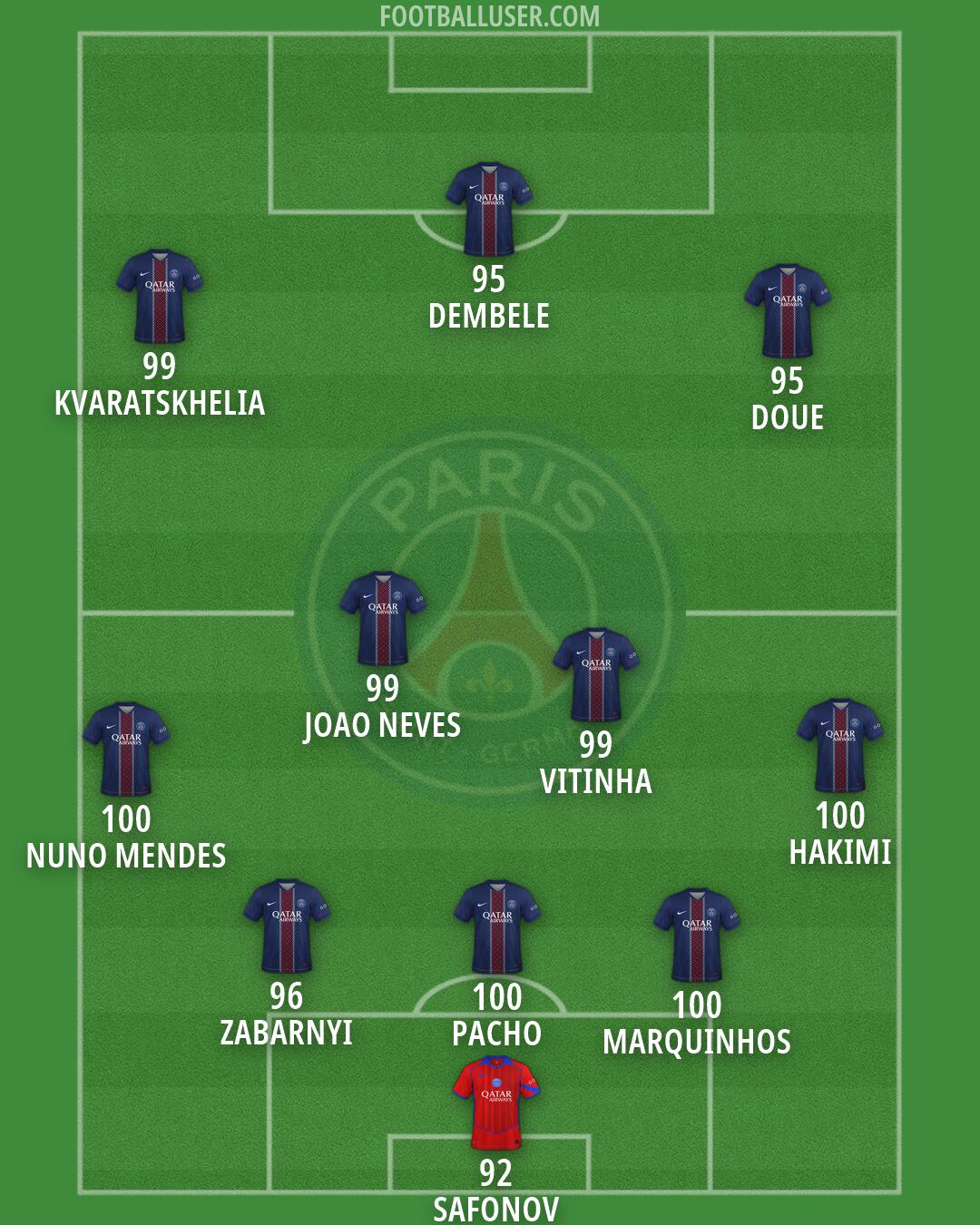

PSG Football Formation
 Today, October 8, 2026


Starting Lineup
92 (SAFONOV)100 (PACHO)
96 (ZABARNYI)
100 (MARQUINHOS)
100 (NUNO MENDES)
100 (HAKIMI)
99 (VITINHA)
99 (JOAO NEVES)
99 (KVARATSKHELIA)
95 (DOUE)
95 (DEMBELE)
PSG focuses on high pressing and rapid transitions through a 3-4-3 formation. This lineup is built to dominate the ball in the attacking third and suffocate opponents by winning it back high up the pitch. The goal is to control the tempo through a heavy central presence while using wide attackers to stretch the defense.
92 acts as the last line of defense, sweeping behind a high line when the team pushes up. The back three consists of 100, 100, and 96, who operate as a narrow defensive block. The central defender, 100, holds the line and directs the unit, while 100 and 96 act as ball playing defenders to play short from the back. These defenders must be ready to step up to squeeze the space or cover the gaps left by the advancing midfield.
The midfield is a dense engine room featuring a three-man midfield with a carrier alongside an attacking ten. 99 operates as a deep lying playmaker to recycle possession, while 100 and 100 act as driving midfielders who carry the ball forward into the half spaces. The 99 in the attacking ten role sits just behind the frontline to pick up runners and play through the lines. This group connects the defense to the attack by moving the ball quickly between the lines to find pockets of space.
PSG utilizes three attackers across the front to maintain constant pressure. 95 and 99 act as inverted wingers who cut inside to create overloads in the middle, while 95 operates as a pressing centre forward to pin the last defender. These forwards work in combinations to pull the opposition defense apart, often looking to hit in behind on the transition. The movement of 95 is designed to create space for the wide players to enter the box and attack the far post.
A primary advantage for PSG is the ability to press high in coordinated waves, using the front three and the attacking ten to trigger a press. The midfield density allows for numerical superiority in the center, making it difficult for opponents to bypass the midfield. Additionally, the combination of inverted wingers and a central attacking ten creates constant threats through quick one-two passes in tight spaces.
This 3-4-3 formation relies on aggressive ball recovery and central dominance to dictate play. It is best suited for matches against teams that sit deep and struggle to handle high intensity pressure.