Man Utd Football Formation
 Today, October 13, 2026


Starting Lineup
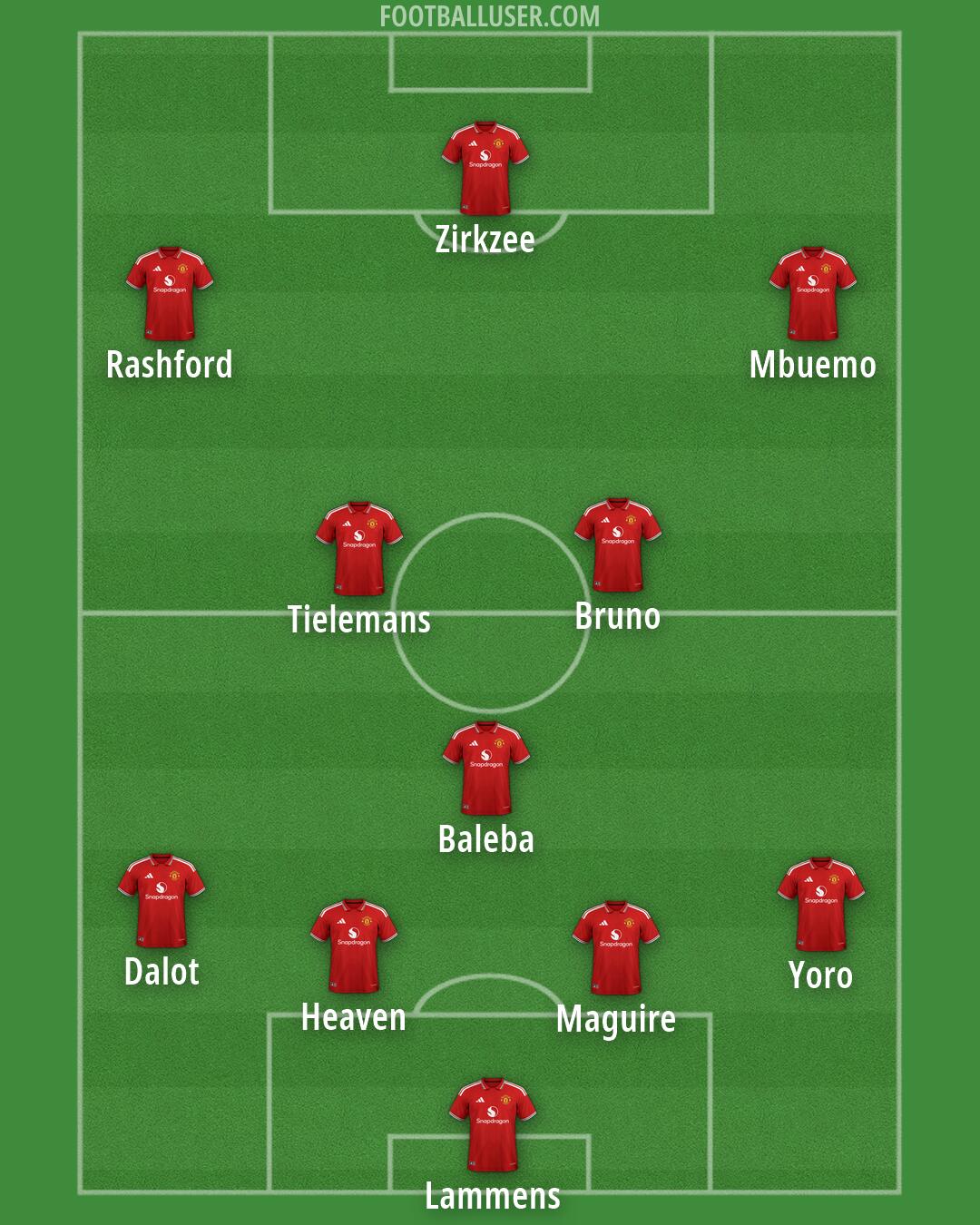
Lammens · Dalot · Heaven · Maguire · Yoro · Baleba · Bruno · Tielemans · Rashford · Mbuemo · ZirkzeeManchester United rely on a heavy verticality to transition from defense to attack using a 5-2-3. The formation aims to win the ball and hit the opposition quickly in transition. This lineup focuses on strength in the central areas while using wide players to stretch the opposition.
Lammens stays between the posts to manage the defense. The back line operates as a back three with Baleba acting as the central presence. Maguire plays as the right centre-back to win the header and use his physical presence, while Heaven covers on the left. Dalot and Yoro act as attacking wing backs to provide width. Dalot pushes up to support the left flank and Yoro works to overlap the winger on the right. The defensive unit remains compact to deny the turn to strikers.
A double pivot controls the middle of the pitch for Man Utd. Tielemans works to connect the defensive and attacking lines and recycle possession. Bruno plays as the more advanced side of the pair to find the feet of the striker and play through the lines. Bruno is known for his passing range and ability to create chances. This pair must work to compress the midfield and cover the space when the wing backs push high.
The attack utilizes three forwards to pin the last defender. Zirkzee plays as a lone striker who drops into midfield to link up play. Mbuemo and Rashford act as wide attackers to stretch the defense. Rashford is noted for his pace and ability to run in behind. Mbuemo cuts inside from the right to create more central presence. The front three press from the front to force a long ball and win the second ball in the final third.
Manchester United gain tactical advantages through wide overloads and speed of transition. The presence of Dalot and Yoro creates extra numbers in the wide areas to isolate the opposition full backs. The midfield pairing of Tielemans and Bruno allows the team to control the tempo while remaining ready to counter at pace. This setup also allows the team to hold a compact shape when defending in a mid-block.
This formation is built for teams that want to absorb pressure and strike with speed. It is best suited for matches against opponents that leave space behind their defensive line.