Man City Football Formation
 Today, October 15, 2026


Starting Lineup
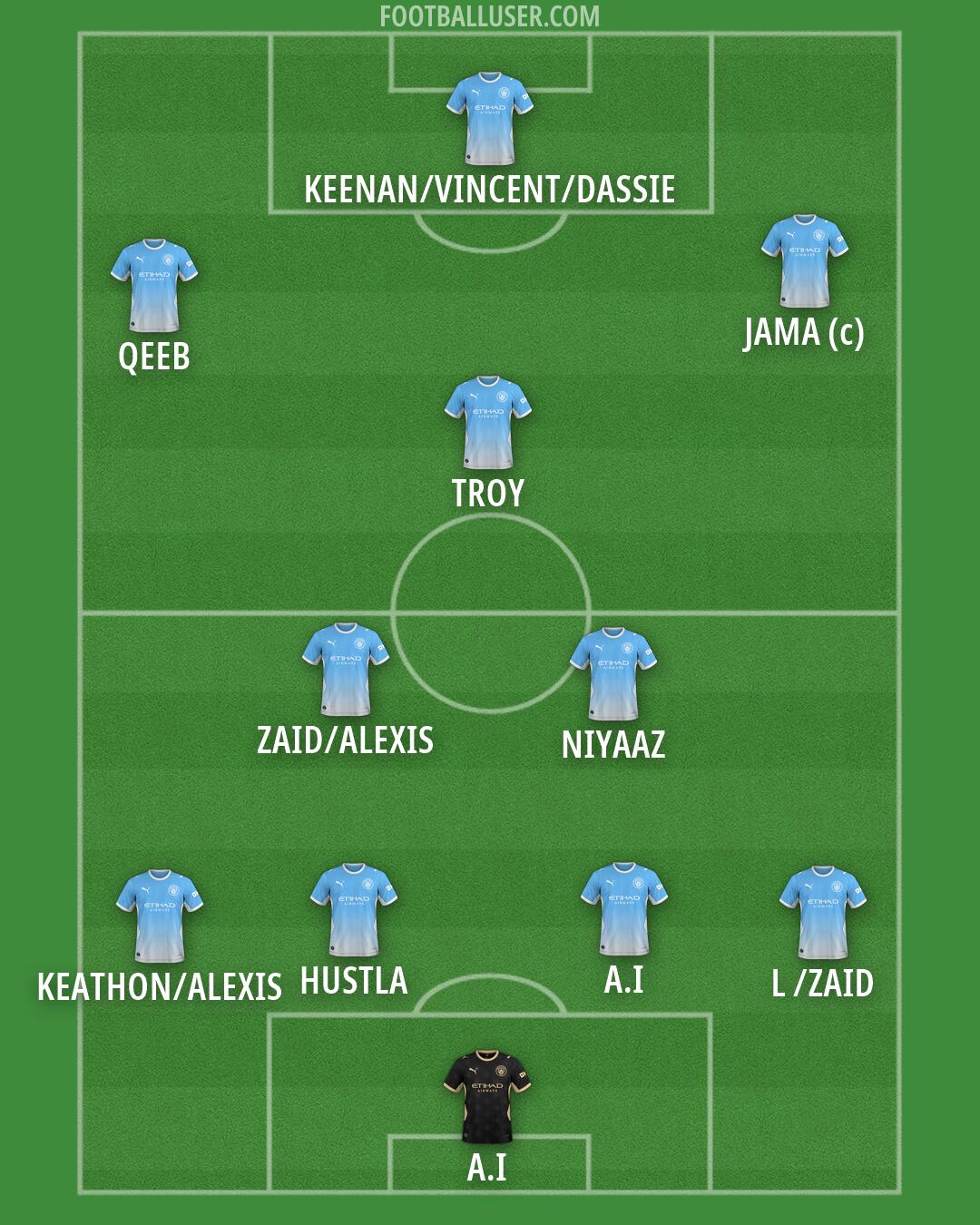
JAMA (c) · ZAID/ALEXIS · KEATHON/ALEXIS · TROY · QEEB · NIYAAZ · A.I · KEENAN/VINCENT/DASSIE · L /ZAID · HUSTLA · A.IMan City relies on heavy possession and high pressure to control matches through a 4-3-3 formation. This lineup is built to dominate the ball and pin the opposition back into their own half. The goal is to use ball retention to tire out the opponent before using quick combinations to break the lines.
A.I operates between the posts to organize the defense. The back four works as a flat line that can step up to set the offside trap. L /ZAID plays as an attacking full back to provide width, while KEATHON/ALEXIS performs similar duties on the left. In the center, HUSTLA and A.I act as the central defenders, with HUSTLA acting as a ball playing defender to start attacks and A.I providing cover to sweep behind the high line.
The midfield functions with a three man midfield with a carrier. ZAID/ALEXIS occupies the left central role to connect the defensive and attacking lines, while NIYAAZ plays on the right to drive forward with the ball. TROY operates as an attacking ten behind the striker to find space in the pockets. This unit works to recycle possession and ensure the team can always find a way to progress through the thirds.
Man City employs three attackers across the front to stretch the defence. QEEB stays wide on the left to pull defenders away, while JAMA (c) plays as an inverted winger on the right who looks to cut inside and create chances. The central role is filled by KEENAN/VINCENT/DASSIE, who acts as a pressing centre-forward to force long balls from the opposition. These players combine to create runs in behind and use overlaps from the full backs to overload the flanks.
One major advantage for Man City is the ability to create wide overloads by using the full backs to support the wingers. The formation also allows for numerical superiority in midfield when TROY moves between the lines. This setup makes it very difficult for opponents to keep the ball because the players can press in pairs to win it back high up the pitch.
This 4-3-3 formation is designed for teams that want to dictate the tempo of the game through control. It is best suited for matches against low block opponents where constant ball circulation is needed to create gaps.