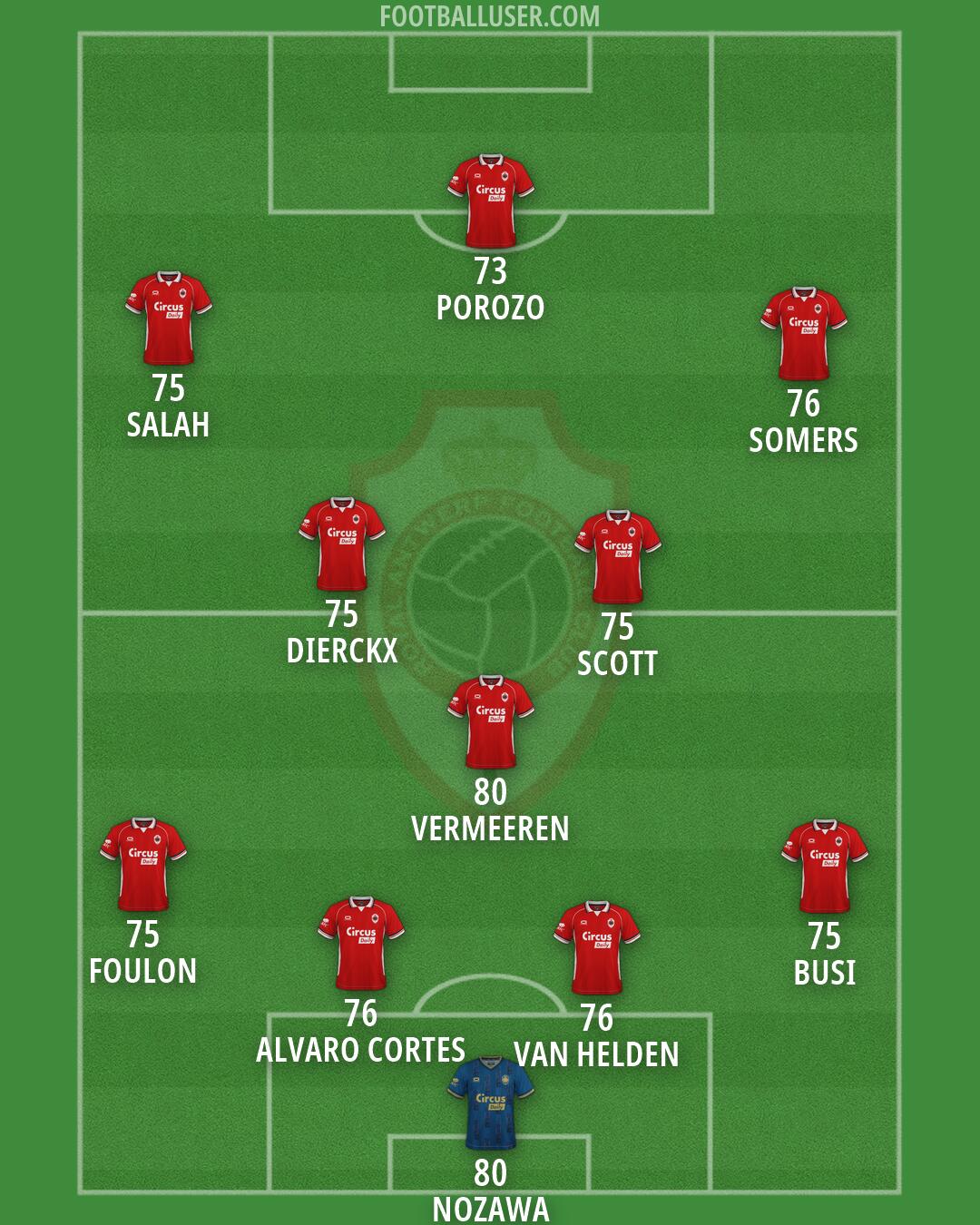

Antwerp Football Formation
 Today, October 16, 2026


Starting Lineup
80 (NOZAWA)76 (ALVARO CORTES)
76 (VAN HELDEN)
75 (FOULON)
75 (BUSI)
80 (VERMEEREN)
75 (DIERCKX)
75 (SCOTT)
75 (SALAH)
76 (SOMERS)
73 (POROZO)
Antwerp prioritizes a solid defensive base and quick transitions using a 5-2-3 formation. This lineup is built to sit in a mid-block and wait for the right moment to hit the opposition on the break. The goal is to remain compact and difficult to break down while using width to stretch the play when moving forward.
In goal, 80 provides the last line of defense. The back five consists of a central anchor in 80 who commands the area and acts as a leader for the defensive unit. Beside him, 76 on the left and 76 on the right act as wide centre-backs to cover the channels. The wing backs, 75 on the right and 75 on the left, are responsible for providing the width. They must track back to form a five man line when defending deep, but they also need to push up to support the attack. The whole defensive unit works together to squeeze the space and deny runners.
The midfield is a double pivot consisting of 75 on the right and 75 on the left. These two players act as the engine room, tasked with shielding the back five and winning the second ball. One of them often drops deeper to help the defenders play out from the back, while the other looks to carry the ball forward into the middle third. Their main job is to connect the defensive block to the front three and ensure the team does not get overrun in the center of the pitch.
Antwerp uses three attackers across the front line to stretch the opposition. On the flanks, 76 on the right and 75 on the left act as wide wingers who hug the touchline to create space in the middle. In the center, 73 operates as a lone striker who needs to hold up the ball and link up play with the wingers. This front line is designed to press from the front and trigger a press when the ball enters certain zones. They look to exploit the space behind the opposition full backs through runs in behind or quick combinations.
One major advantage for Antwerp is the ability to create wide overloads when the wing backs join the wingers. This forces the opposition to defend deep and can lead to dangerous crosses. Another strength is the compactness when defending in a five man line, which makes it very hard for opponents to find gaps between the lines. The speed of transition from a mid-block to an attacking shape allows them to catch teams out of position.
This formation offers a reliable way to stay defensively solid while maintaining a threat on the break. It is best suited for matches against dominant teams where Antwerp can soak up pressure and counter at pace.