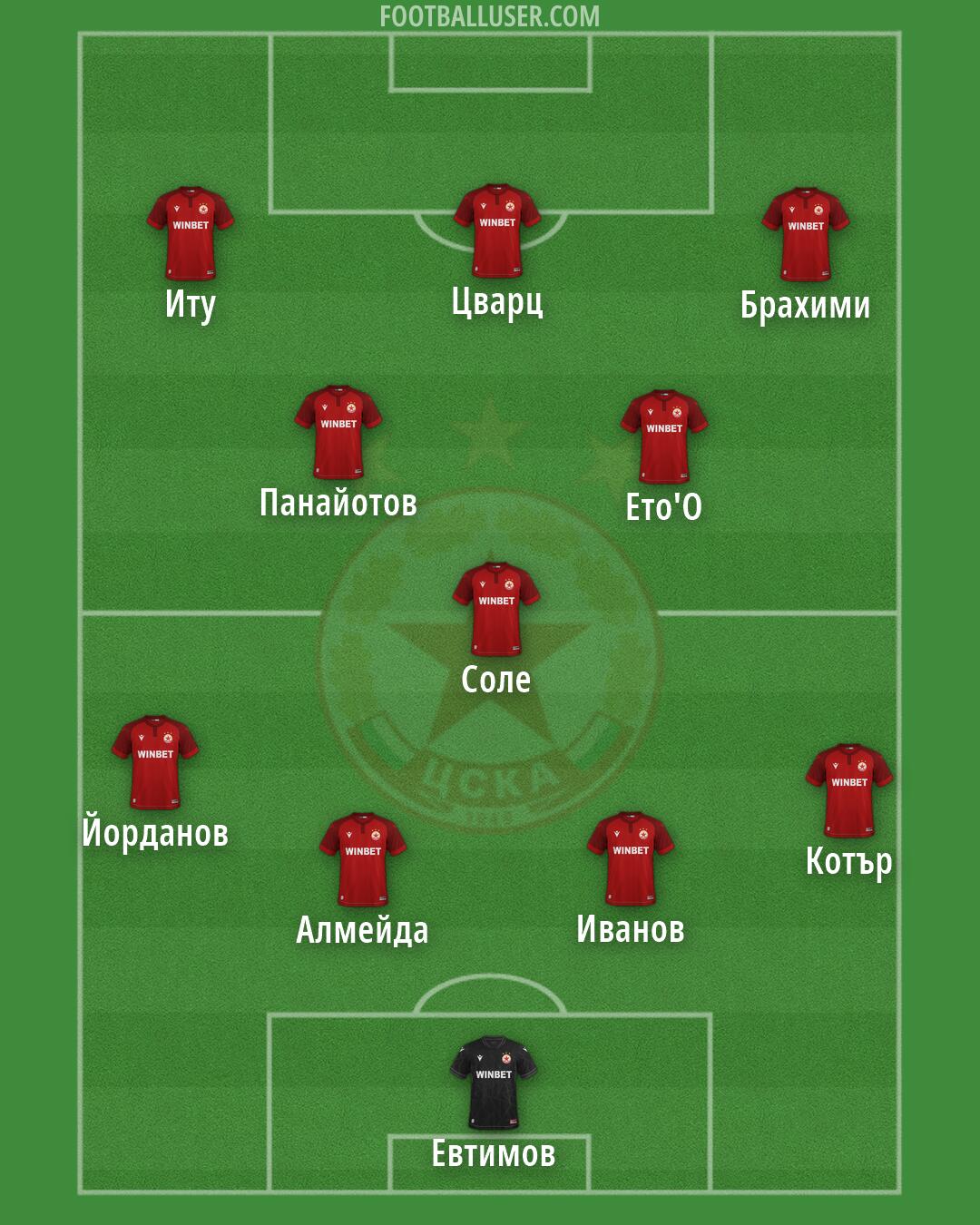

CSKA-Sofia Football Formation
 Today, October 17, 2026


Starting Lineup
Евтимов · Котър · Йорданов · Иванов · Алмейда · Соле · Ето'О · Панайотов · Брахими · Иту · ЦварцCSKA-Sofia focuses on a heavy defensive presence and quick vertical transitions through a 5-2-3 formation. This lineup is built to sit in a mid-block, absorb pressure, and use the pace of the attackers to hit in behind on the transition. The team aims to keep the center compact and use the width provided by the wing backs to stretch the play once the ball is won back.
Евтимов acts as the last line of defense in goal. The defensive unit operates as a back five with Соле acting as the central anchor to command the area. To his sides, Алмейда and Иванов operate as wide centre-backs to provide cover and win the second ball. Йорданов and Котър play as attacking wing backs, tasked with providing all the width on the flanks. This group works together to hold the line and deny the turn to opposition strikers.
The midfield functions as a double pivot to control the center of the pitch. Панайотов and Ето'О work to shield the defense and win back possession. Панайотов helps to recycle possession, while Ето'О looks to carry the ball forward to connect the defensive and attacking lines. This pair must stay disciplined to avoid leaving the center backs exposed, ensuring they can quickly find the forwards after a turnover.
The attack utilizes three attackers across the front to punish teams that commit too many men forward. Цварц leads the line as a central striker, looking to hold up the ball and link up play with the others. Иту and Брахими operate as wide wingers, looking to cut inside or get to the byline to whip it in. The movements of these three are designed to create runs in behind and isolate wide players in one on one situations against the opposition full backs.
CSKA-Sofia gains a significant advantage through the defensive compactness of the back five, making it difficult for opponents to play through the middle. The team also creates wide overloads when Йорданов and Котър push up to overlap the wingers. These wide threats allow the side to switch play effectively and find space in the final third.
This formation is built to frustrate dominant teams by denying space in the central areas. It is best suited for matches where the team needs to defend a lead or play against an opponent that controls high levels of possession.