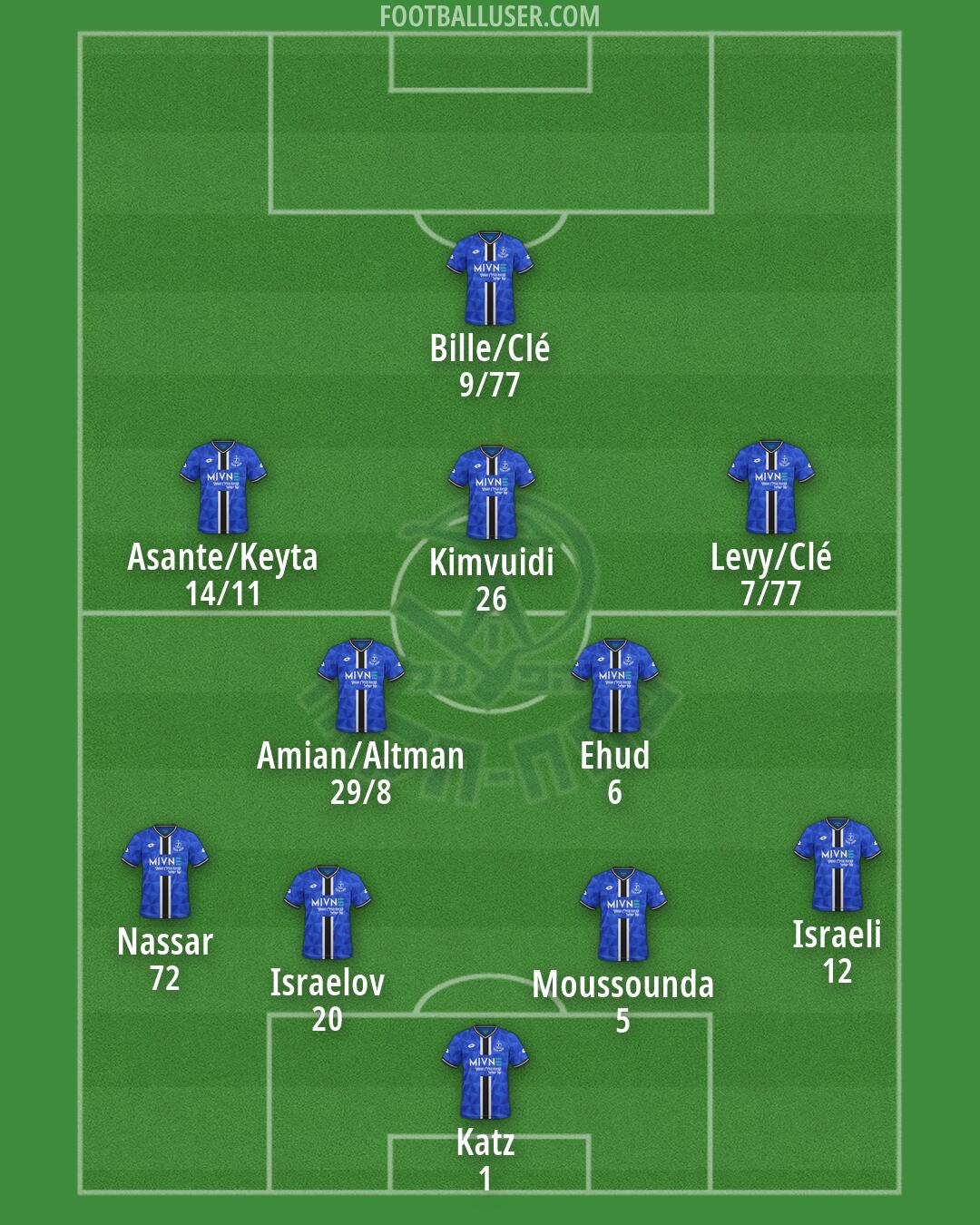

Hapoel Petach-Tikva Football Formation
 Today, October 21, 2026


Starting Lineup
Katz (1) · Moussounda (5) · Israelov (20) · Ehud (6) · Amian/Altman (29/8) · Kimvuidi (26) · Bille/Clé (9/77) · Levy/Clé (7/77) · Israeli (12) · Nassar (72) · Asante/Keyta (14/11)Hapoel Petach-Tikva relies on a high press and quick transitions within a 4-5-1 formation. This lineup is built to congest the central areas and force the opposition into mistakes before hitting them on the break. The team aims to win the ball back high up the pitch to catch the opponent out of position.
Katz guards the goal as the last line of defense. The back line operates as a flat back four with Israelov and Moussounda acting as the central defenders. Moussounda and Israelov must hold the line and win the header whenever the ball is played long. Nassar and Israeli act as full backs, looking to support the midfield while ensuring they do not leave space behind. The defensive unit functions to squeeze the space between the lines and maintain a compact shape.
The midfield is a five man unit that focuses on controlling the middle of the park. Ehud plays as a single pivot to shield the defense and recycle possession. Amian/Altman works alongside Ehud to disrupt play and press the opponent. Kimvuidi, Levy/Clé, and Asante/Keyta operate in the central and wide areas to connect the defensive and attacking lines. These players are tasked to press aggressively to win the ball high and drive forward with the ball to link the play.
In the attacking phase, the team utilizes a lone striker, Bille/Clé, to lead the line. The striker is expected to be a pressing centre-forward, working to pin the last defender and disrupt the build up from the back. The wide midfielders must stretch the defence by spreading wide, allowing the central players to combine in tight spaces. The goal is to create runs in behind or find the feet of the striker to trigger a quick attack.
Hapoel Petach-Tikva possesses the ability to press in a mid-block or high up the pitch to create turnovers. The formation offers compactness when defending, making it hard for opponents to play through the lines. This allows the team to spring the offside trap and hit the opponent on the transition.
This 4-5-1 formation is designed for a team that wants to control the tempo through numbers in the middle. It is best suited for facing opponents that dominate possession but struggle with speed of transition.