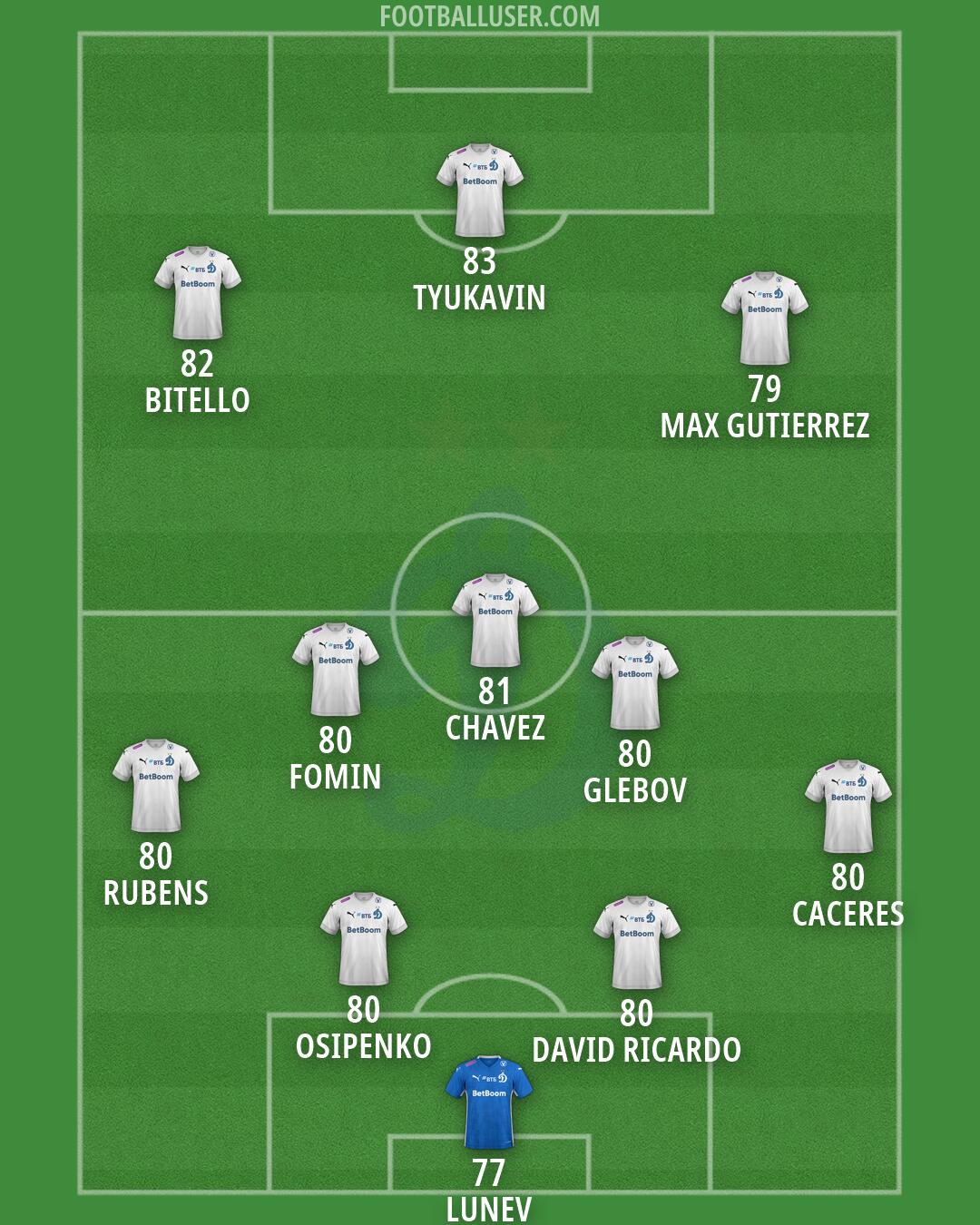

Dinamo Moscow Football Formation
 Today, October 21, 2026


Starting Lineup
77 (LUNEV)80 (OSIPENKO)
80 (DAVID RICARDO)
80 (RUBENS)
80 (CACERES)
80 (GLEBOV)
80 (FOMIN)
81 (CHAVEZ)
82 (BITELLO)
79 (MAX GUTIERREZ)
83 (TYUKAVIN)
Dinamo Moscow prioritizes a heavy verticality and high press using a 2-5-3 formation. This lineup is built to dominate the center of the pitch and force turnovers high up the field to strike quickly. The goal is to overwhelm the opposition through sheer numbers in the middle and a direct attacking intent that moves the ball forward as fast as possible.
The defensive unit relies on 77 in goal to manage the space behind the line. Because the formation uses only two central defenders, 80 and 80, they must play a high line to squeeze the space and catch opponents offside. These two central defenders act as the last line of defense, needing to be quick to cover any runners who try to exploit the space behind them. The defensive unit functions by compressing the pitch, which forces the opposition to play long balls.
A massive five man midfield controls the center of the ground. The two holding players, 80 and 80, act as a double pivot to shield the defense and recycle possession. In front of them, the central midfielders 80, 80, and 81 form a congested block that makes it difficult for opponents to play through the middle. These players are tasked to win the second ball and carry the ball forward into the attacking third. This midfield engine room links the two central defenders to the front three by providing constant passing options and pressing aggressively in a mid block.
The attack features three forwards designed to pin the opposition back line. The lone striker, 83, acts as a focal point to hold up the ball and link play with the wide players. On the flanks, 82 and 79 operate as wide wingers who stretch the defense. The winger 82 often looks to cut inside to create space, while 79 aims to stay wide to provide width. This front three works to press from the front, forcing the opposition into mistakes in their own half so the team can attack in transition.
Dinamo Moscow gains a massive advantage through numerical superiority in midfield. By packing the center with five players, they can easily win the battle for possession and control the tempo. Another strength is the ability to press high in coordinated waves, using the front three and the midfield to trap the opponent in their own territory. This creates many chances to hit in behind on the transition.
This formation is a high risk high reward system centered on aggressive central dominance. It is best suited for matches where the team needs to dominate possession and overwhelm an opponent that sits in a deep low block.