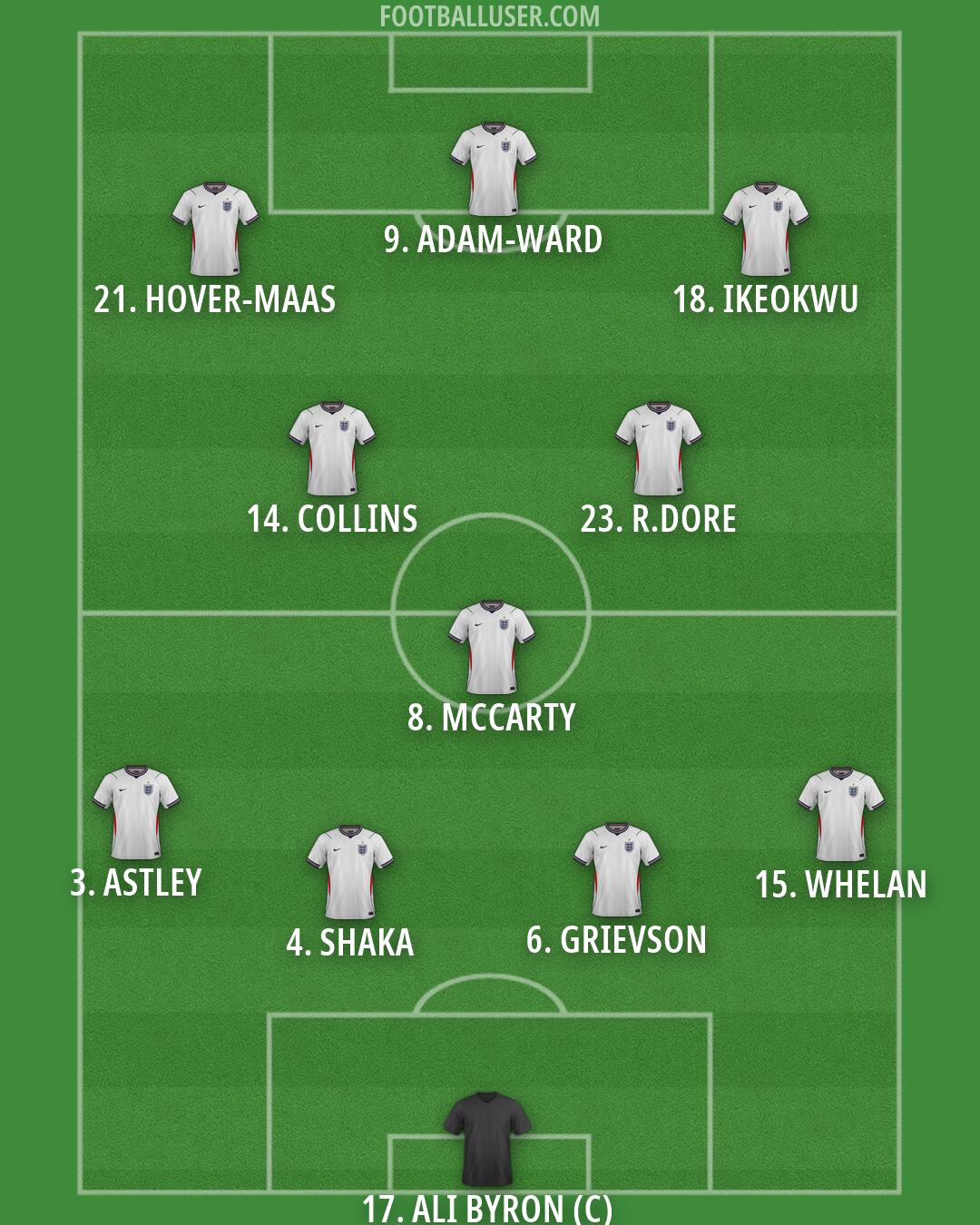
England National Football Team Formation
 Today, October 22, 2026


Starting Lineup
9. ADAM-WARD18. IKEOKWU
21. HOVER-MAAS
14. COLLINS
23. R.DORE
8. MCCARTY
4. SHAKA
6. GRIEVSON
15. WHELAN
3. ASTLEY
17. ALI BYRON (C)
England focuses on a direct and vertical style of play with a 5-2-3 formation. This lineup is built to hit teams on the break and use significant width to stretch the opponent. By utilizing heavy numbers in the back, the team aims to sit deep and win the second ball before launching quick attacks.
Ali Byron (C) guards the goal and manages the defensive line from his position. The back five features McCarty as the central defender, flanked by Shaka and Grievson who act as the wide centre-backs. Astley plays as an attacking left wing back to provide width, while Whelan operates as a right wing back to overlap on the opposite side. This defensive unit is designed to hold a compact shape and deny the turn to any incoming attackers.
A double pivot controls the central area to protect the back line. Collins and R.Dore occupy the two central midfield roles, working to shield the defence and recycle possession. Collins works to win the ball and connects the defensive and attacking lines, while R.Dore helps to press in a mid-block. These two must communicate well to prevent opponents from playing through the lines.
The attack uses three players across the front to pressure the opposition back line. Hover-Maas and Ikeokwu act as wide wingers who hug the touchline to pull defenders apart, while Adam-Ward works as a lone striker. Adam-Ward stays central to find the feet of the striker or to run in behind the defence. This frontline setup relies on quick combinations and direct balls to break quickly when the midfield wins possession.
England gains a tactical advantage through the width provided by Astley and Whelan. These wing backs can create wide overloads by pushing forward to support the wingers. Additionally, the formation offers great compactness when defending, making it difficult for opponents to find space between the lines. The speed of transition allows the team to move from a low block to an attacking phase in seconds.
The 5-2-3 formation provides a solid foundation for teams that want to counter at pace. This lineup is best suited for facing opponents that dominate possession and leave space behind their high line.