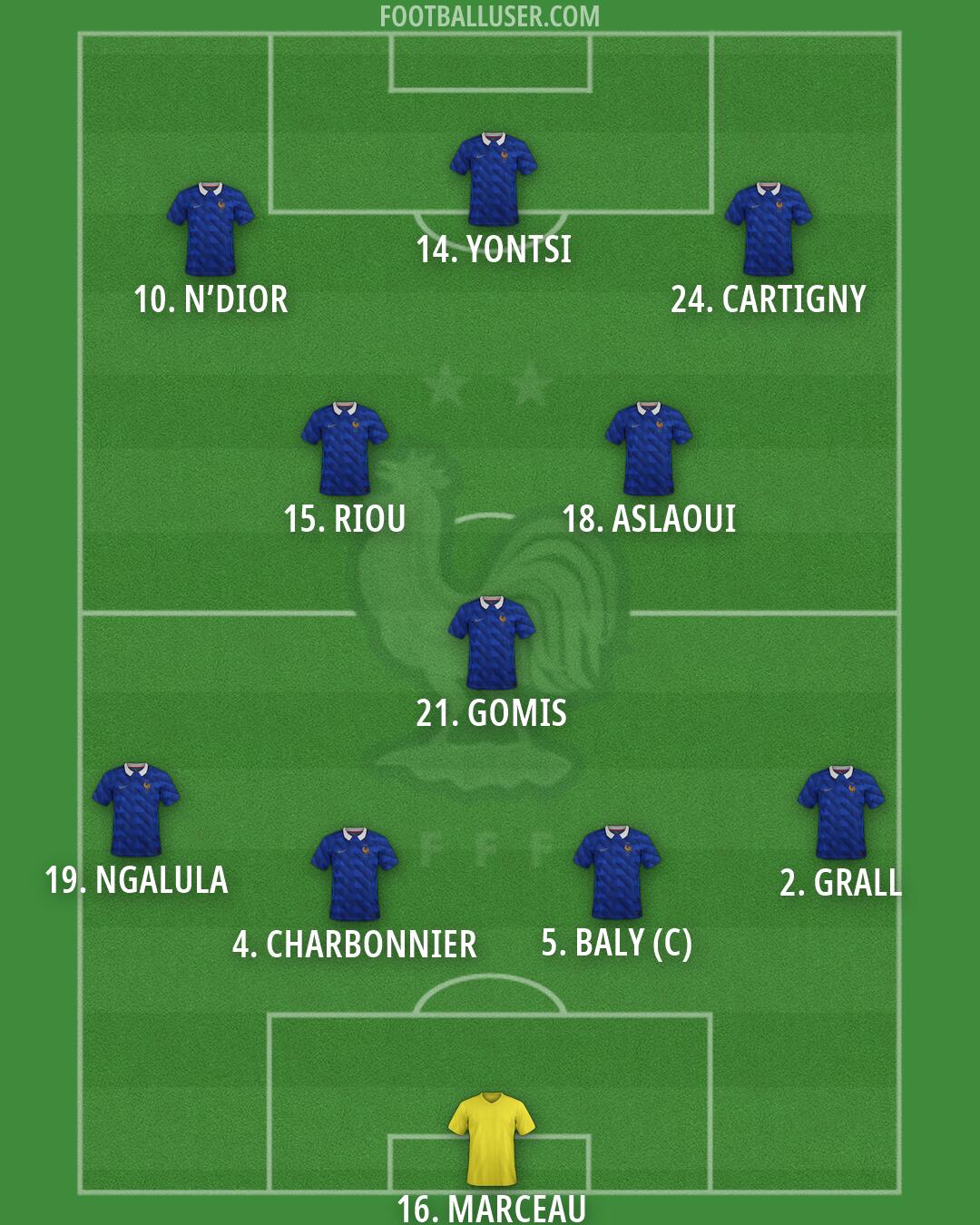

France National Football Team Formation
 Today, October 22, 2026


Starting Lineup
14. YONTSI24. CARTIGNY
10. N’DIOR
15. RIOU
18. ASLAOUI
21. GOMIS
5. BALY (C)
4. CHARBONNIER
2. GRALL
19. NGALULA
16. MARCEAU
France looks to win the ball back high up the pitch using a 5-2-3 formation. This lineup relies on intense pressure and quick transitions to catch opponents out of position. The team seeks to control the game through aggressive movement in the final third while maintaining a solid foundation behind the ball.
MARCEAU acts as the last line of defense, starting the build up play from the back. The defensive unit operates with a back five that can shift to defend more narrowly when needed. BALY (C) leads the defense as the central figure, providing leadership and dominance in the air. GOMIS and CHARBONNIER sit on either side of him to cover space and win the second ball. NGALULA and GRALL operate as attacking wing backs, pushing high to provide width while tracking back to support the central defenders.
The midfield is composed of a double pivot where RIOU and ASLAOUI work to control the central zone. These two players must work hard to press in a mid-block and win the ball to trigger quick attacks. RIOU often looks to connect the defensive and attacking lines, while ASLAOUI works to drive forward with the ball to break the line. Their primary job is to shield the defense and prevent opponents from playing through the middle.
France uses three attackers to stretch the opposition defense. YONTSI leads the line as a lone striker, looking to hold up the ball and link up play with the wide players. N’DIOR and CARTIGNY play as wide wingers who cut inside to create central presence and threaten the goal. This front three presses the opposition back line to force a long ball. The movements are designed to create runs in behind and allow the wing backs to overlap the winger.
One major advantage for France is the ability to press high in coordinated waves, making it difficult for the opposition to build from the back. The formation also offers wide overloads when GRALL and NGALULA push forward to join the attackers. This creates numerical superiority in the final third and forces the opposition to defend in much larger spaces.
This 5-2-3 formation provides a balance of defensive solidity and attacking intent. It is best suited for games where the team needs to exploit spaces on the transition against a high defensive line.