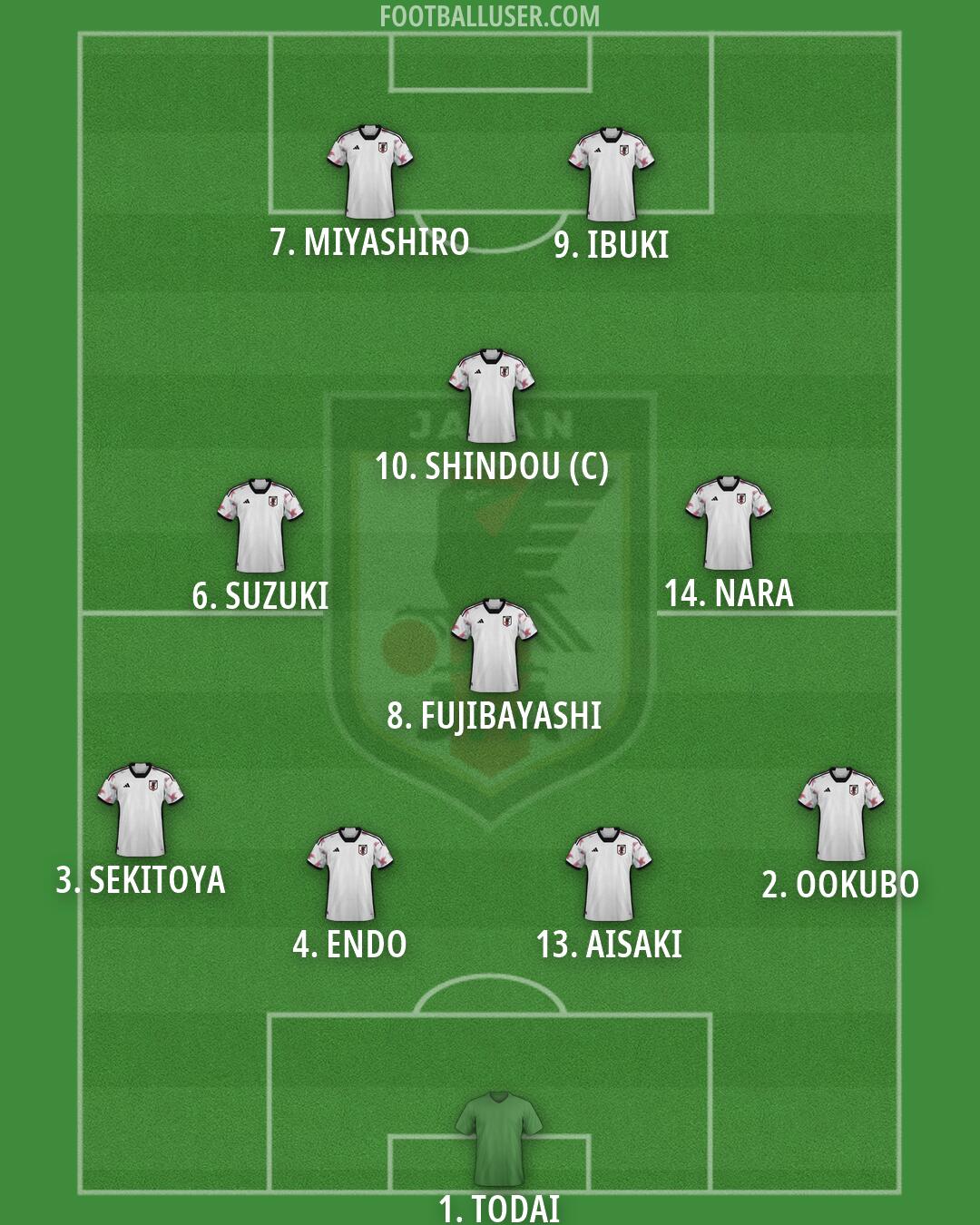

Japan National Football Team Formation
 Today, October 22, 2026


Starting Lineup
9. IBUKI7. MIYASHIRO
10. SHINDOU (C)
14. NARA
6. SUZUKI
8. FUJIBAYASHI
13. AISAKI
4. ENDO
2. OOKUBO
3. SEKITOYA
1. TODAI
Japan plays a vertical style of football designed to hit teams in transition, utilizing a 4-4-2 formation. The team looks to win the ball in the middle third and quickly push it forward to exploit gaps in the opposition defense. This lineup relies on directness and quick movement to stretch the playing area.
In the defensive unit, TODAI operates between the posts to manage the back line. The team maintains a flat back four consisting of OOKUBO at right back and SEKITOYA at left back. AISAKI and ENDO act as the central defenders, working together to defend zonally and cover for one another. OOKUBO and SEKITOYA are expected to hold their positions to prevent wide entries, while AISAKI and ENDO focus on winning the second ball and clearing the lines when the opposition enters the final third.
The midfield setup features a central block designed to squeeze the space in the center of the pitch. FUJIBAYASHI plays as a single pivot to shield the defense and recycle possession. Beside him, SUZUKI and NARA operate as the two central midfielders, tasked with pressing in a mid-block and breaking the line with forward passes. SHINDOU (C), the captain, operates as the attacking ten behind the strikers, looking to find pockets of space to receive on the half-turn and play through the lines.
Up front, Japan uses two forwards in a partnership to pressure the opposition back line. MIYASHIRO and IBUKI act as a mobile duo, with MIYASHIRO leading the line and IBUKI looking to make runs in behind. The two attackers work to pin the last defender and create space for SHINDOU (C) to arrive late into the box. When attacking, the team looks to use the width provided by the full backs to create crossing opportunities or isolate wide players in one on one situations.
One major tactical strength for Japan is the ability to press in coordinated waves once the ball enters the midfield. The closeness of the four midfielders allows them to double up on opponents and force a long ball. Additionally, the direct link between the midfield and the two strikers creates high speed of transition, making it very difficult for opponents to settle once they lose possession.
This 4-4-2 formation provides a balance of defensive compactness and direct attacking intent. It is best suited for matches against teams that play a high line and can be caught out on the break.