
Rostov Football Formation
 October 23, 2026


Starting Lineup
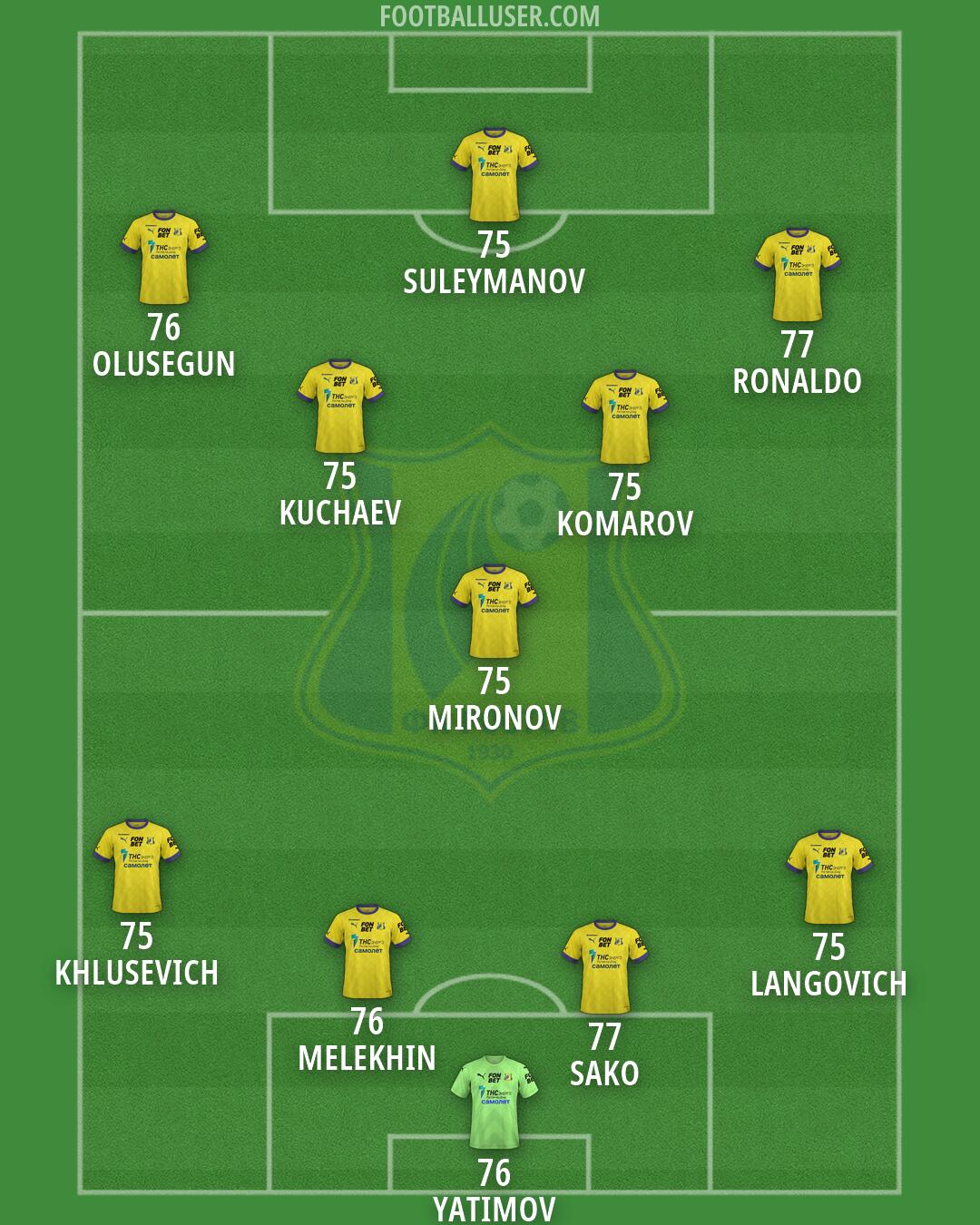
76 (YATIMOV)76 (MELEKHIN)
77 (SAKO)
75 (KHLUSEVICH)
75 (LANGOVICH)
75 (MIRONOV)
75 (KUCHAEV)
75 (KOMAROV)
76 (OLUSEGUN)
77 (RONALDO)
75 (SULEYMANOV)
Rostov aims to play a high press to win the ball high up the pitch using a 4-3-3 formation. This lineup is built to control the game by squeezing the space in the opposition half and staying aggressive when they lose the ball. The team wants to win it back quickly to launch immediate attacks before the opponent can organize.
The defensive unit relies on 76 to command the area from goal. A flat back four provides the foundation for the Rostov defense, with 75 at right back and 75 at left back working to provide width. The central pairing of 77 at right centre back and 76 at left centre back must hold the line and be ready to step up to trigger a press. These defenders work together to maintain a high line and ensure the space behind them is covered through smart positioning and communication.
In the middle of the park, Rostov uses a three-man midfield to control the tempo. The 75 playing as a single pivot works to shield the defence and recycle possession. Alongside this player, the 75 at right central midfield and the 75 at left central midfield operate as inverted eights. They are responsible to connect the defensive and attacking lines, with one often looking to drive forward with the ball while the other stays to occupy the half spaces. This group aims to compress the midfield and deny the turn for opposing players.
The attacking front line is designed to stretch the defence across the pitch. The 77 on the right wing and the 76 on the left wing act as wide wingers who want to cut inside to create goal scoring chances. In the middle, the 75 acts as a lone striker to lead the press from the front. This combination allows the team to attack in combinations, with the wingers looking to receive on the half-turn and play through the lines to find the striker or arrive late into the box.
One major strength of this Rostov lineup is the ability to press high in coordinated waves to force a long ball from the opponent. The team also finds success in creating wide overloads when the full backs push up to overlap the winger. These movements force the opposition to shift constantly, creating gaps in the central areas for the midfielders to exploit.
This 4-3-3 formation relies on intense pressing and quick transitions to dominate games. It is best suited for matches against teams that struggle to play out from the back under heavy pressure.