
Fluminense Football Formation
 Today, October 23, 2026


Starting Lineup
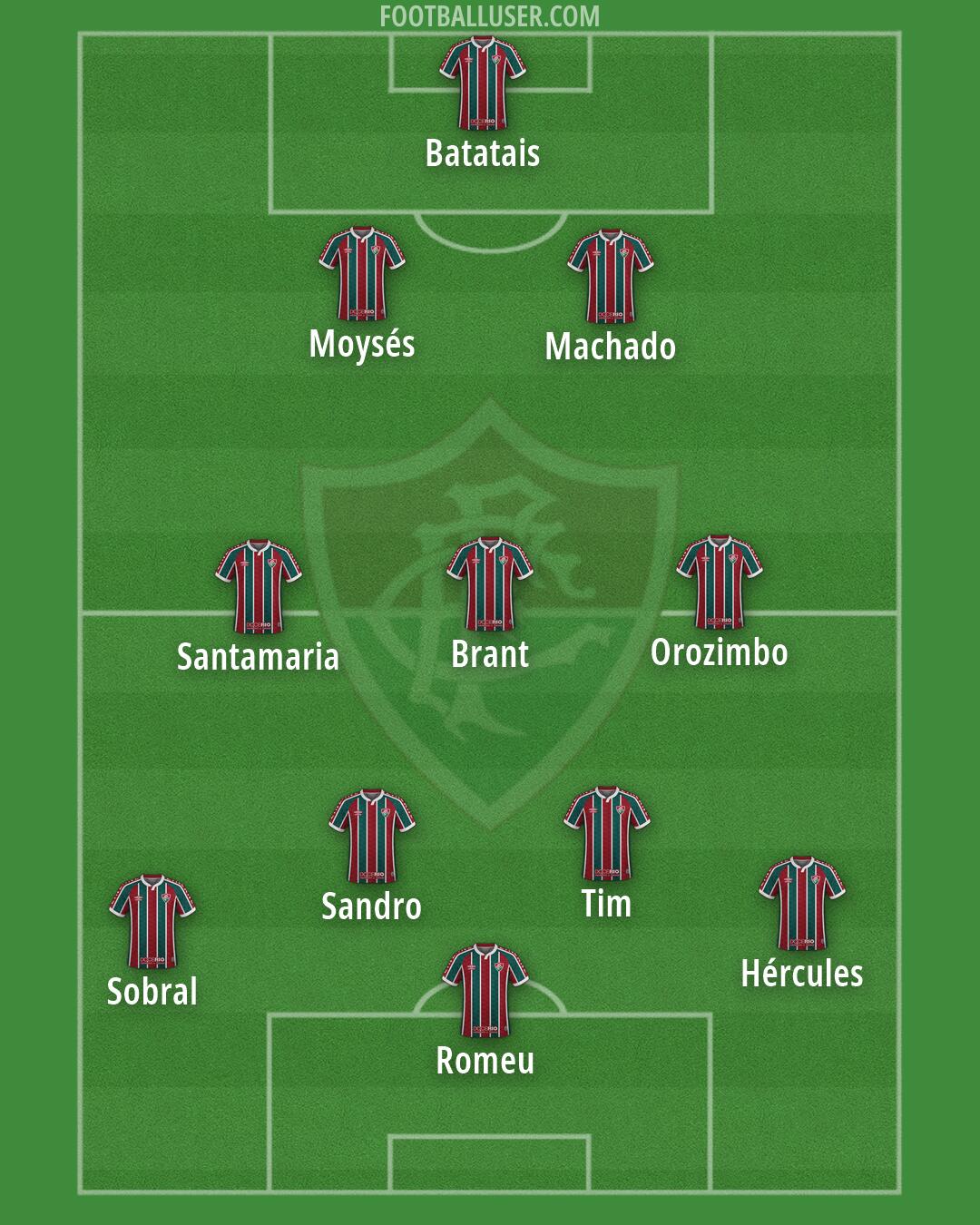
Batatais · Machado · Moysés · Orozimbo · Brant · Santamaria · Hércules · Tim · Sandro · Sobral · RomeuFluminense focuses on heavy central presence and overloading the middle to dominate the ball, utilizing a 2-5-3 formation. This lineup is built to control the tempo through a crowded midfield, making it difficult for opponents to find space between the lines. By packing the center, Fluminense aims to win the ball back high up the pitch and use short passing to move through the thirds.
Batatais guards the goal while the defensive unit remains very thin with only two central defenders. Moysés and Machado operate as a pair of ball playing defenders who must stay alert to cover the vast spaces left behind them. Because there are no full backs, these two must be able to step up and intercept passes before the opposition can exploit the wide areas. The two central defenders are tasked with holding a high line to keep the team compact, but they run the risk of being caught if the opposition hits in behind on the transition.
The midfield is a massive five man block designed to squeeze the space in the center of the pitch. Brant acts as the anchor to shield the defense, while Orozimbo and Santamaria operate as central midfielders to drive forward with the ball and win the second ball. The width in the middle comes from Tim and Sandro, who play as attacking midfielders in the half spaces. Tim and Sandro are tasked to press aggressively to win the ball high up the pitch, allowing the team to recycle possession quickly once the ball is regained.
Fluminense employs three attackers to stretch the opposition defense and provide constant pressure. Romeu operates as a lone striker, working to hold up the ball and find the feet of the oncoming midfielders. Hércules and Sobral play as wide wingers, with Hércules on the left and Sobral on the right. They often pull wide to create space for the midfielders or cut inside to combine in tight spaces near the box. The front three are expected to press from the front, forcing a long ball from the opposition to help the central unit regain control.
The main advantage of this formation is the numerical superiority in midfield, which allows the team to dictate play and bypass the midfield of the opposition easily. Another strength is the ability to press high in coordinated waves, using the five midfielders and three attackers to trap opponents. This density makes it very hard for teams to play through the center, forcing them to play wide where they might struggle to cross effectively.
This 2-5-3 formation relies on extreme control of the ball and high intensity pressing. It is best suited for games against teams that defend in a low block and struggle to handle constant pressure in central areas.