Man City Football Formation
 Today, October 24, 2026


Starting Lineup
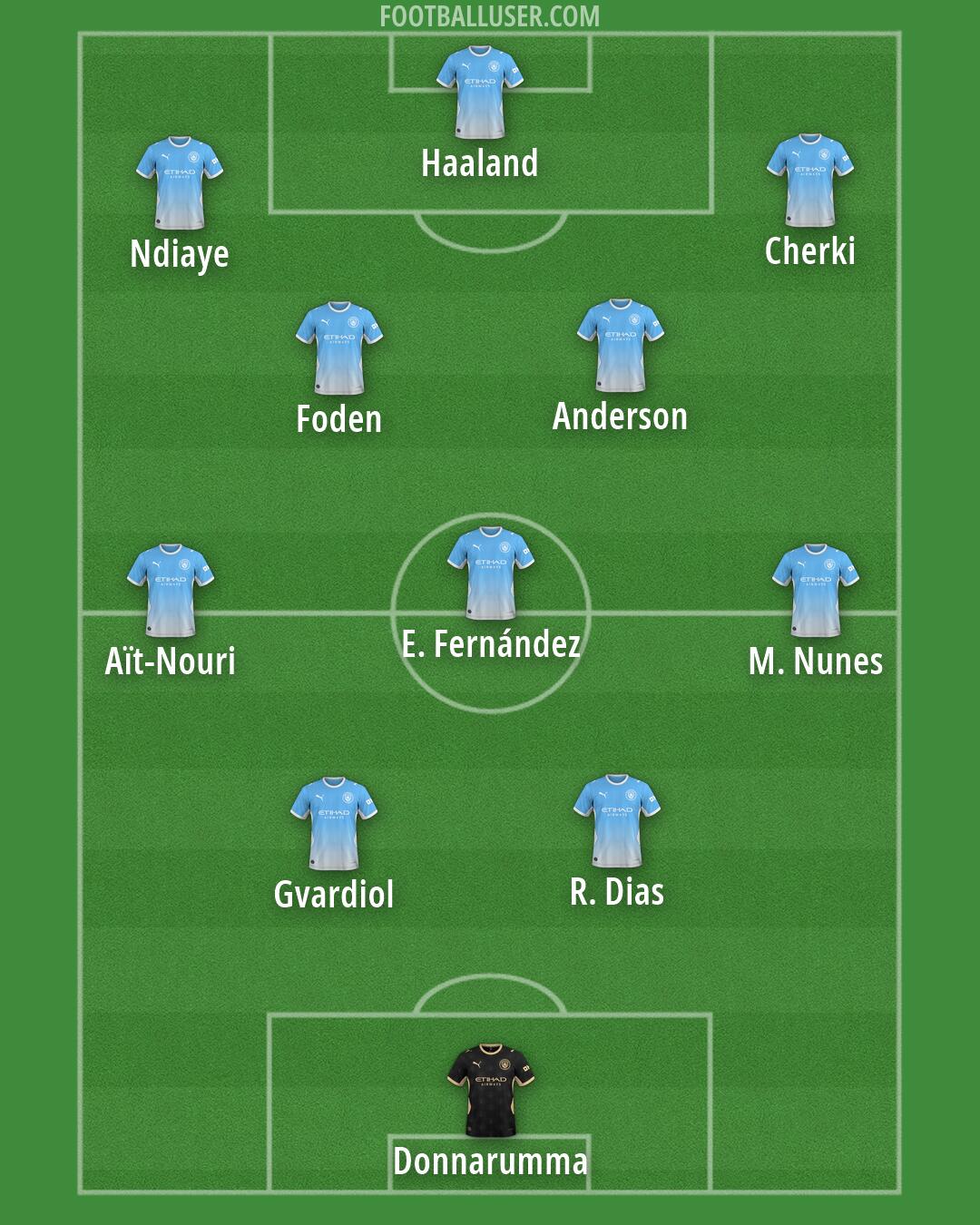
Aït-Nouri · M. Nunes · Gvardiol · R. Dias · Anderson · E. Fernández · Haaland · Cherki · Ndiaye · Foden · DonnarummaMan City focuses on high pressing and immediate ball recovery through a 2-5-3 formation. This lineup aims to squeeze the pitch and dominate central areas to force turnovers in the opposition half. The goal is to use overwhelming numbers in the middle of the pitch to sustain attacks and keep the ball in advanced areas.
Donnarumma acts as the lone goalkeeper behind a very high line. The defensive unit consists of only two central defenders, Gvardiol and R. Dias, who must be prepared to cover massive amounts of space. Gvardiol uses his recovery pace to sweep behind the line while R. Dias remains dominant in the air and commands the defensive block. This two man back line requires constant communication to manage the space left behind when the team pushes up.
The midfield is the engine of the Man City formation, operating as a five man block to control the tempo. E. Fernández sits in a deep role to shield the two defenders and recycle possession. M. Nunes and Aït-Nouri act as the central engines, with M. Nunes driving forward with the ball to link the lines. In the half spaces, Foden and Anderson operate as attacking midfielders who look to find gaps in the defensive block. Foden uses his dribbling and vision to break the line, while Anderson provides width and support to the attacking trio.
The attack utilizes three players across the front to stretch the defence. Haaland operates as a central target man, using his physical presence to hold up the ball and pin the last defender. On the flanks, Ndiaye and Cherki play as wide attackers, with Ndiaye looking to cut inside and Cherki to create chances from the right. The team attacks in combinations, using the attacking midfielders to provide support for Haaland or to arrive late into the box. These forwards press from the front to prevent the opposition from playing out from the back.
One main advantage of this formation is the numerical superiority in the midfield which allows the team to dominate possession and win the second ball. The heavy presence of five players in the middle makes it very difficult for opponents to find space between the lines. Additionally, the team can use the wide players to isolate defenders in one on one situations once the ball is switched quickly to the flanks.
This high pressing 2-5-3 formation is built to overwhelm opponents through central dominance and intense pressure. It is best suited for games where the team needs to pin the opponent into their own half and control the rhythm.