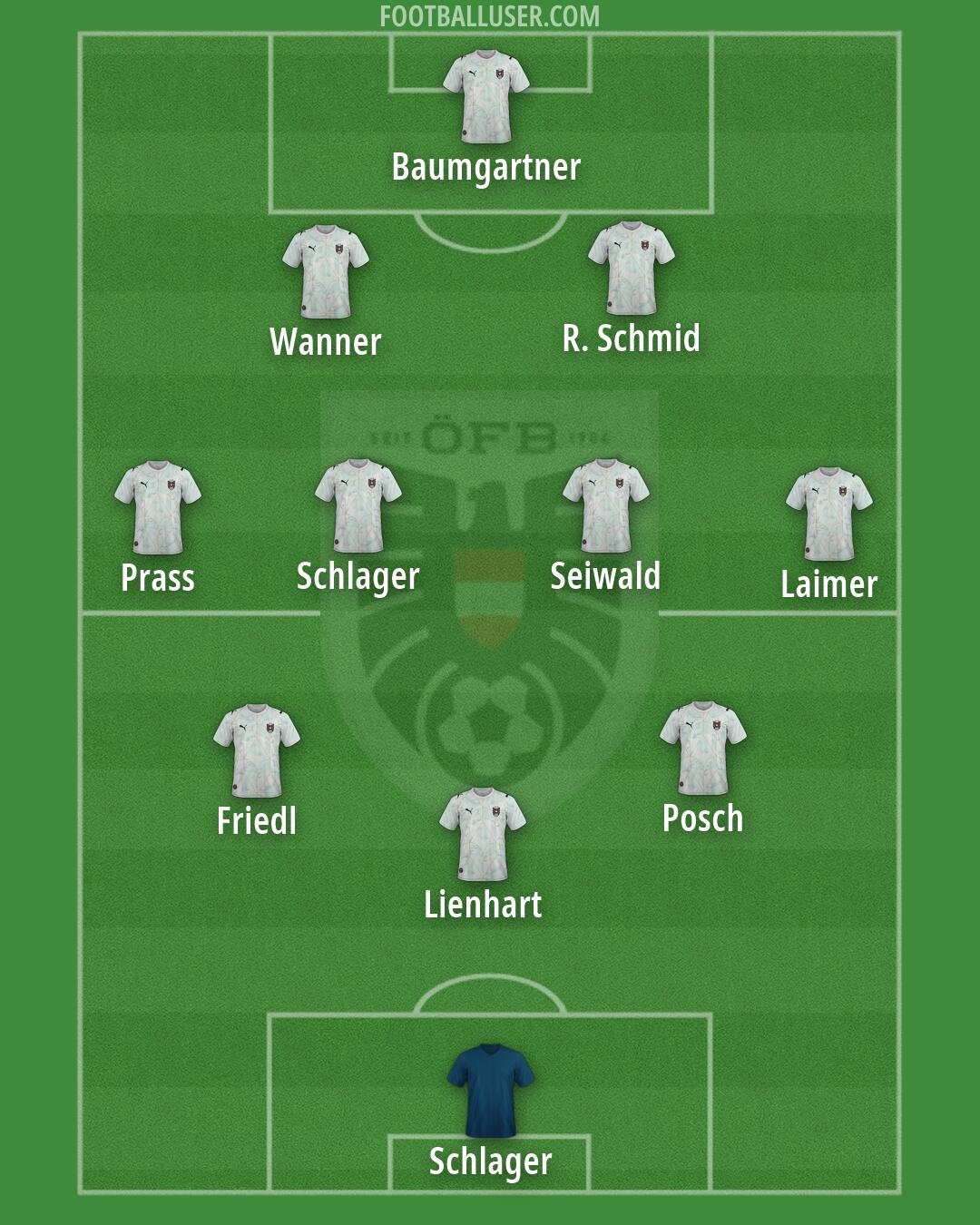

Austria National Football Team Formation
 October 25, 2026


Starting Lineup
Baumgartner · Friedl · R. Schmid · Wanner · Schlager · Seiwald · Prass · Posch · Lienhart · Laimer · SchlagerAustria aims to win the ball back high up the pitch and play with a heavy verticality, using a 3-4-3 formation. This lineup focuses on aggressive pressing and rapid transitions to catch opponents out of position. The team relies on high energy to squeeze the space and keep the opposition pinned in their own half.
Schlager sits between the defenders to act as a sweeper behind a high line. The back three consists of Lienhart, Friedl, and Posch, who act as a solid wall when defending zonally. Lienhart provides composure when playing out from the back, while Friedl and Posch focus on winning the second ball and clearing the lines. This defensive unit works as a compact block to deny the turn to any oncoming attackers.
A central duo forms the engine room, with Seiwald and Schlager operating as a double pivot. Seiwald works to shield the defence and intercept passes, while Schlager helps to connect the defensive and attacking lines by carrying the ball forward. On the flanks, Laimer and Prass act as attacking wing backs to provide width. Laimer and Prass push up to overlap the wingers, which helps Austria stretch the defence and create overloads on the touchlines.
The front three consists of Wanner and R. Schmid as wide attackers with Baumgartner leading the line as a lone striker. Wanner and R. Schmid often cut inside to occupy the half spaces, leaving the wide areas open for the wing backs. Baumgartner acts as a pressing centre-forward to trigger a press from the front, forcing long balls from the opposition. The goal is to use quick combinations to split the defence with a through ball or a cutback from the byline.
Austria gains a massive advantage through wide overloads when Laimer and Prass join the attack. The formation also allows for high pressing in coordinated waves, making it difficult for opponents to play out from the back. Because the midfield is so compact, the team can quickly shift to defend against counter attacks.
This 3-4-3 formation is built to dominate games through intense pressure and rapid attacking transitions. It is best suited for matches against opponents who struggle to play under high pressure or fail to defend wide areas.