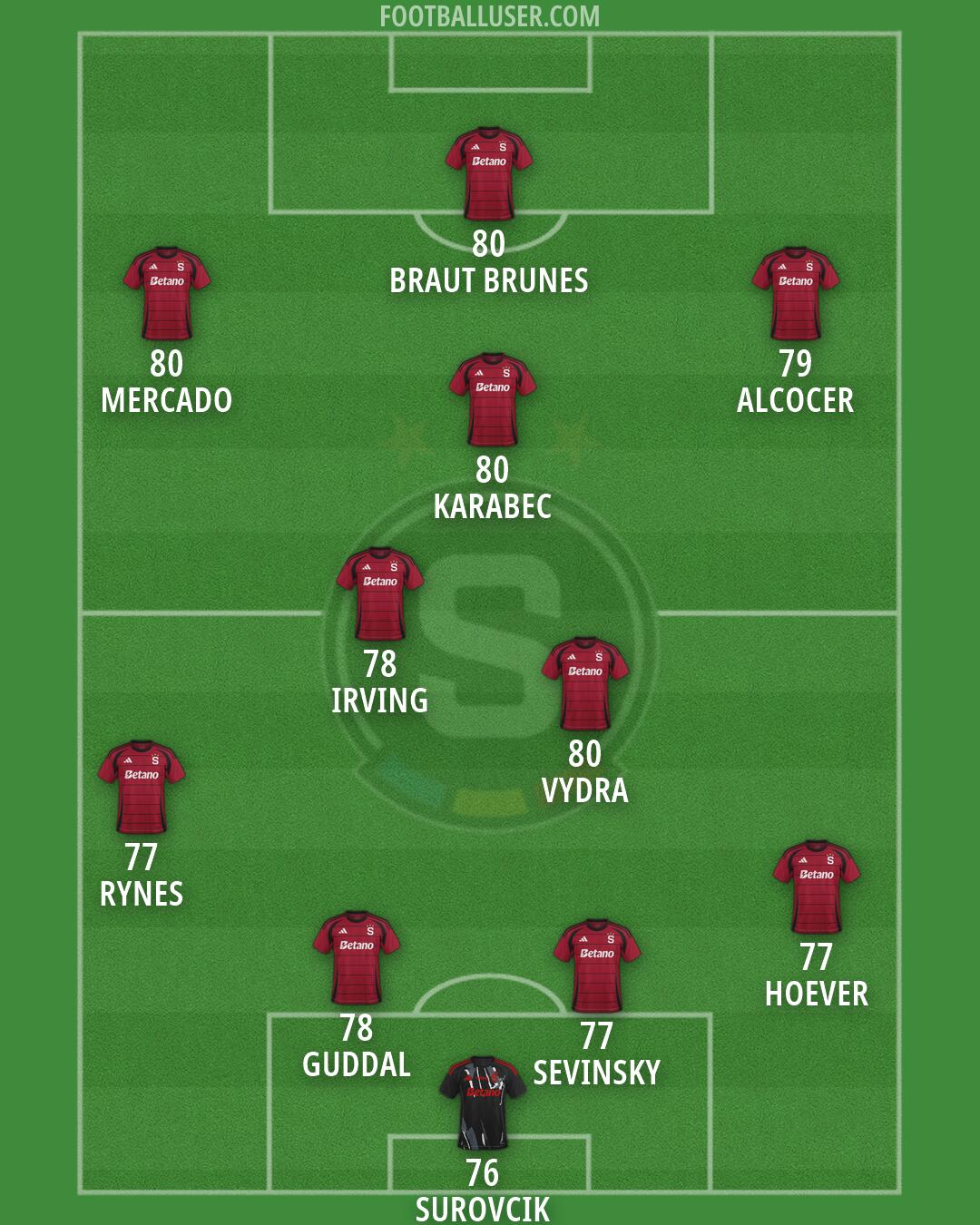

Sparta Praha Football Formation
 Today, October 26, 2026


Starting Lineup
76 (SUROVCIK)78 (GUDDAL)
77 (SEVINSKY)
77 (HOEVER)
77 (RYNES)
80 (VYDRA)
80 (KARABEC)
78 (IRVING)
80 (MERCADO)
79 (ALCOCER)
80 (BRAUT BRUNES)
Sparta Praha plays a high press game using a 4-3-3 formation. This lineup seeks to win the ball back high up the pitch and move forward with pace. The team looks to control the tempo through quick passes and aggressive movement to unsettle the opposition.
The defensive unit begins with 76 between the posts. A flat back four protects the area, with 77 acting as the right back and 77 operating as the left back. These wide defenders push up to provide width when the team has the ball. In the center, 77 and 78 form the core of the defense, tasked with defending zonally and clearing the lines when under pressure. They work together to hold the line and prevent runs in behind.
The midfield is a three-man midfield with a carrier and a deep pivot. The player at 80 in the defensive midfield role shields the defense and protects the back four. Alongside him, 78 works to connect the defensive and attacking lines by recycling possession. The player at 80 operates as an attacking ten behind the striker, looking to find the feet of the striker or arrive late into the box. This trio works to compress the midfield and ensure the team remains compact when defending.
In the final third, Sparta Praha utilizes three attackers across the front. The lone striker at 80 acts as a pressing centre-forward to force a long ball from the opposition. On the flanks, 80 and 79 act as wide wingers who look to stretch the defence by hugging the touchline or cutting inside to find space. This setup is designed to create runs in behind and allow the wingers to receive on the half-turn. They aim to combine in tight spaces to split the defence with a through ball.
One major advantage for Sparta Praha is the ability to press high in coordinated waves. The front three and the attacking midfielder at 80 trigger a press to win it back high up the pitch. Another strength is the speed of transition, as the team can quickly switch play to the wingers once the ball is recovered. This allows the players to isolate wide players in one on one situations during a break.
This 4-3-3 formation relies on high energy to maintain a constant squeeze on the opposition. It is best suited for matches against teams that struggle to play out from the back under heavy pressure.