Arsenal Football Formation
 Today, October 28, 2026


Starting Lineup
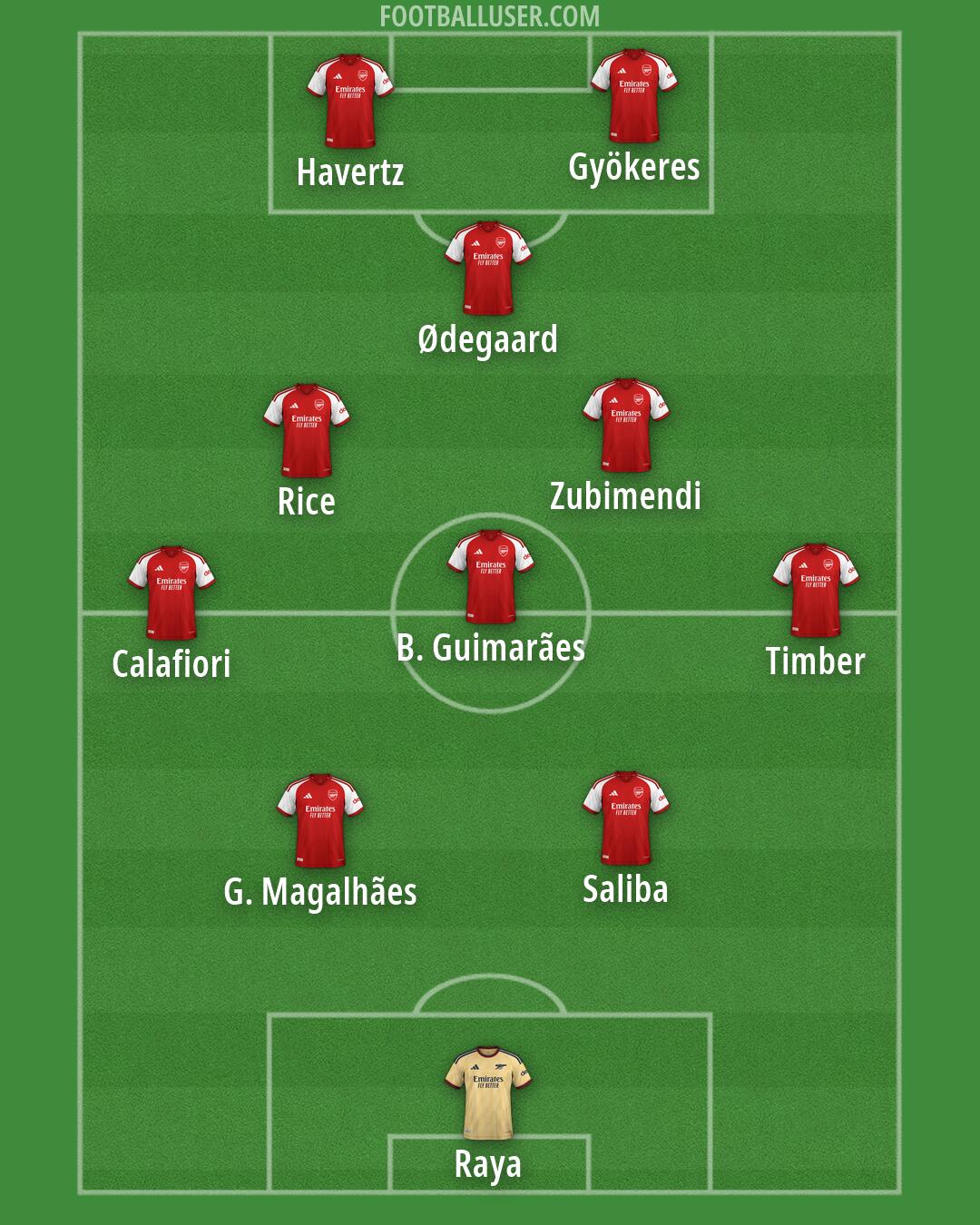
Havertz · Gyökeres · Ødegaard · B. Guimarães · Rice · Zubimendi · Calafiori · G. Magalhães · Saliba · Timber · RayaArsenal relies on heavy central congestion and control to dictate the tempo, utilizing a 2-6-2 formation. This lineup aims to dominate the middle of the pitch by crowding the center and forcing the opposition into wide areas where they are less dangerous. The team looks to win the ball back high up the pitch and use a massive midfield unit to keep possession and recycle the ball constantly.
Raya sits between the posts to act as the first point of distribution. In front of him, Gabriel Magalhães and Saliba operate as a back two, maintaining a very high line to squeeze the space in the middle. These two central defenders must be ready to cover large amounts of ground, with Saliba using his recovery speed to sweep behind when the opposition tries to hit in behind. The defensive unit works closely with the midfield to ensure that the gaps between the back line and the central players are minimal.
The midfield is the engine of this Arsenal lineup, functioning as a massive block of six players. Calafiori and Timber act as two holding players who shield the defense, with Timber often tasked to break the line with his carries. Beside them, Rice and B. Guimarães provide energy and strength, with Rice looking to win the second ball and B. Guimarães providing ability to drive forward. Zubimendi and Ødegaard operate in the half spaces to create chances, with Ødegaard using his vision to find the attackers. This dense midfield helps the team progress through the thirds by providing constant passing options and making it hard for opponents to find passing lanes.
The attacking unit consists of two forwards, Havertz and Gyökeres, who work as a partnership. Havertz often plays as a pressing centre-forward to harass the opposition back line, while Gyökeres looks to use his strength to hold up the ball and lay it off to oncoming runners. They combine in tight spaces to pull defenders out of position, creating room for the midfielders to arrive late into the box. The attack is built through quick combinations and short passes to find the feet of the striker before the defense can settle.
One major advantage of this formation is the massive numerical superiority in midfield, which makes it nearly impossible for opponents to maintain control. Arsenal can also use the density of the central players to trigger a press in waves, quickly winning the ball in dangerous areas. The ability to control the center of the pitch allows the team to dictate where the game is played and force the opponent to play long.
This 2-6-2 formation is built to dominate possession and suffocate the opponent in the central zones. It is best suited for games against teams that play narrow and rely on slow buildup play.