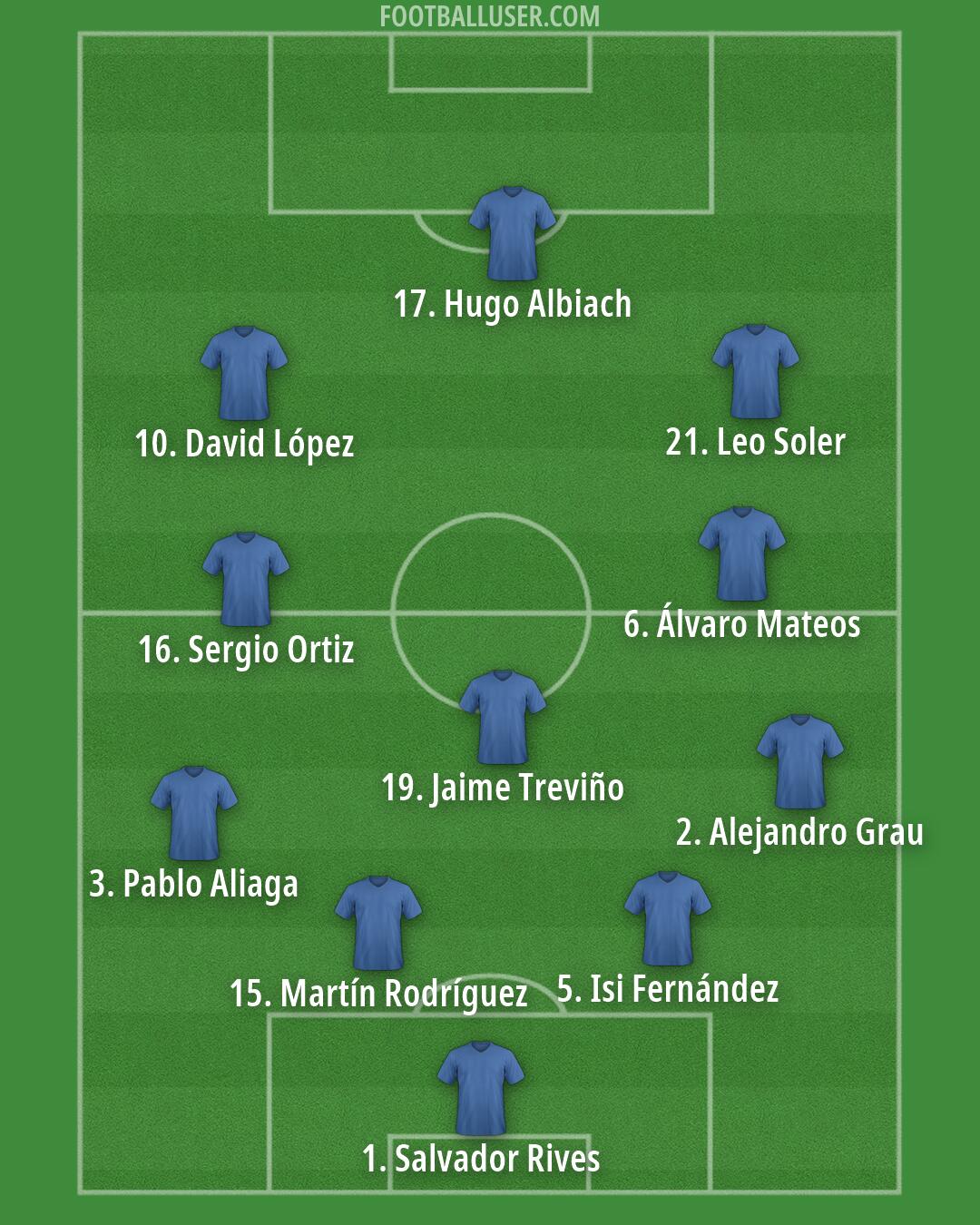
Custom Team Football Formation
 Today, October 29, 2026


Starting Lineup
1. Salvador Rives3. Pablo Aliaga
5. Isi Fernández
15. Martín Rodríguez
19. Jaime Treviño
16. Sergio Ortiz
21. Leo Soler
10. David López
2. Alejandro Grau
17. Hugo Albiach
6. Álvaro Mateos
A heavy emphasis on defensive stability and quick transitions defines this lineup using a 5-2-3. The team aims to sit deep when out of possession and hit in behind on the transition to catch the opposition disorganized. This formation is built to soak up pressure and use the width of the pitch to stretch the game during counter attacks.
Salvador Rives acts as the last line of defense in goal. The back five features Jaime Treviño as the central anchor while Martín Rodríguez and Isi Fernández operate as the side center backs in a narrow defensive block. Pablo Aliaga and Alejandro Grau function as attacking wing backs who provide the necessary width for the team. The three center backs work to clear the lines and cover any runners that attempt to break the defensive line.
The midfield works as a double pivot to protect the back five. Sergio Ortiz and Álvaro Mateos occupy the central spaces to shield the defense and recycle possession when needed. They are tasked with winning the second ball and then quickly looking to progress through the thirds. This pair must connect the defensive unit to the front three by playing short from the back or driving the ball forward into the middle third.
In the final third, the team utilizes three attackers across the front to create constant threats. Hugo Albiach acts as a lone striker who needs to hold up the ball and find the feet of his teammates. David López and Leo Soler operate as wide wingers who look to get to the byline and whip it in toward the box. The attackers press from the front to force a long ball and prevent the opposition from playing out from the back.
One major advantage of this formation is the ability to create wide overloads when Pablo Aliaga and Alejandro Grau push high up the pitch. The team also gains significant compactness when defending in a low block. By keeping the lines close together, the players can squeeze the space in the middle and force the opposition wide where they are less dangerous.
This formation provides a solid base for teams that want to defend deep and exploit space on the break. It is best suited for facing opponents who commit many players forward and leave gaps behind their defensive line.