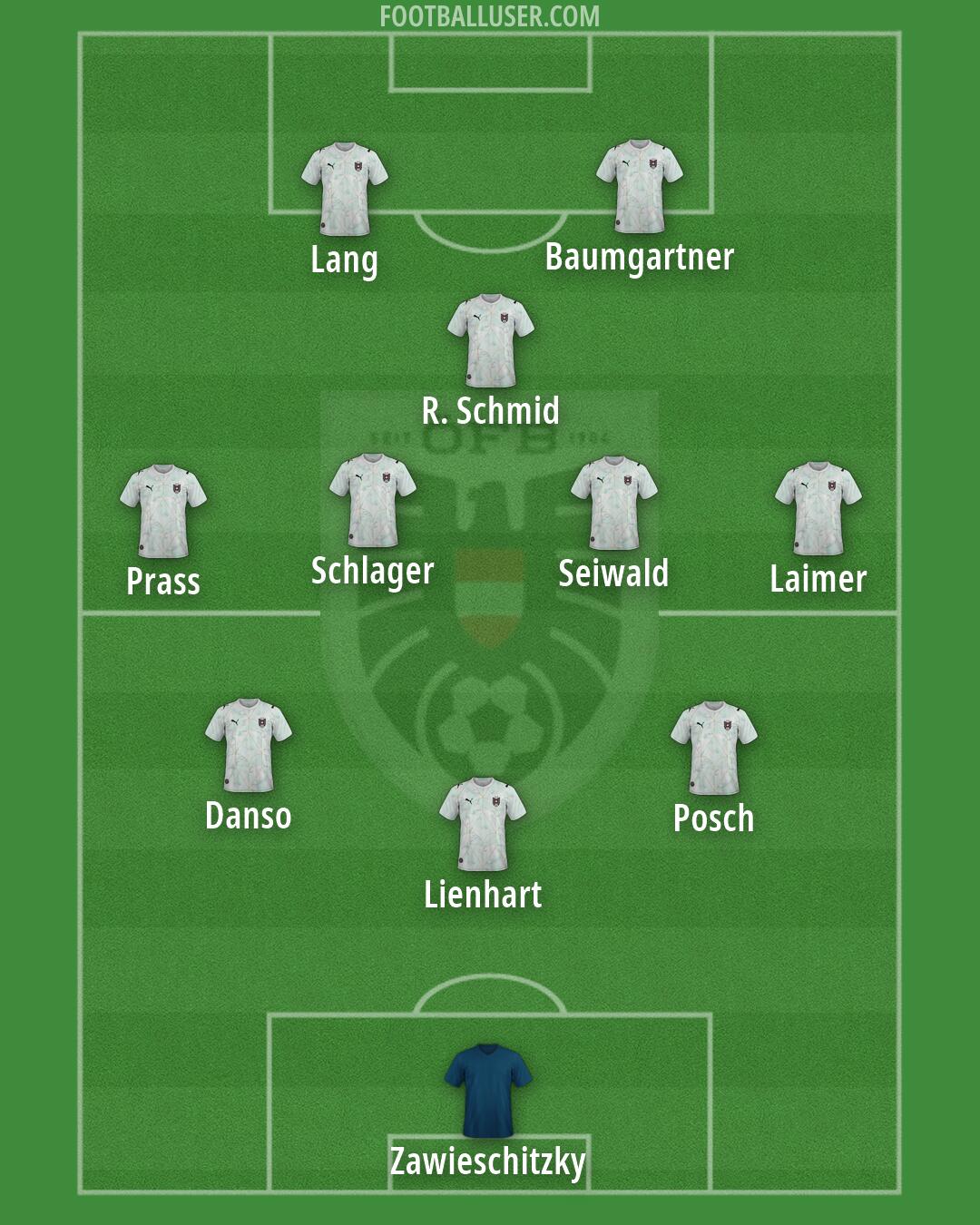

Austria National Football Team Formation
 Today, November 4, 2026


Starting Lineup
Prass · Laimer · Baumgartner · Lang · R. Schmid · Schlager · Seiwald · Lienhart · Danso · Posch · ZawieschitzkyAustria focuses on a high press and quick transitions through a 3-5-2. This lineup is built to squeeze the space in the opponent's half and win the ball back high up the pitch to strike before the defense can set. The team looks to dominate the central areas and use the width of the pitch to stretch the opposition.
Zawieschitzky operates between the posts to manage the defense. The back three consists of Lienhart, Posch, and Danso. Lienhart acts as a ball playing defender who helps play out from the back. Danso provides aerial strength and covers ground when the line steps up, while Posch maintains a solid position to protect the right side. This defensive unit functions by holding a high line to keep the team compact and reducing the distance between the lines.
The midfield relies on a three-man midfield with a carrier to control the tempo. Seiwald shields the defense and works to intercept passes, while Schlager connects the defensive and attacking lines by moving the ball forward. R. Schmid plays as an attacking ten behind the strikers, looking to find pockets of space between the lines. On the flanks, Prass and Laimer act as wide midfielders who provide width and track back to support the defense. This central core aims to win the second ball and recycle possession quickly.
Austria utilizes two forwards in a partnership to lead the attack. Lang acts as a pressing centre-forward to disrupt the opposition build up, while Baumgartner works to find runs in behind the defense. The team builds play by using the wide midfielders to stretch the defense, creating space for R. Schmid to play through the lines. When attacking, the team looks to combine in tight spaces or hit in behind on the transition to catch the opposition out of position.
One major tactical advantage for Austria is the ability to press high in coordinated waves, making it difficult for opponents to play out from the back. The presence of Laimer and Prass allows for wide overloads when they push forward to support the attack. Additionally, the central density provided by Seiwald, Schlager, and R. Schmid ensures the team maintains control in the middle of the park.
This 3-5-2 formation is designed for high intensity and aggressive ball winning. It is best suited for games against teams that struggle to play under pressure or attempt to build slowly from the back.