Custom Team Football Formation
 Today, November 4, 2026


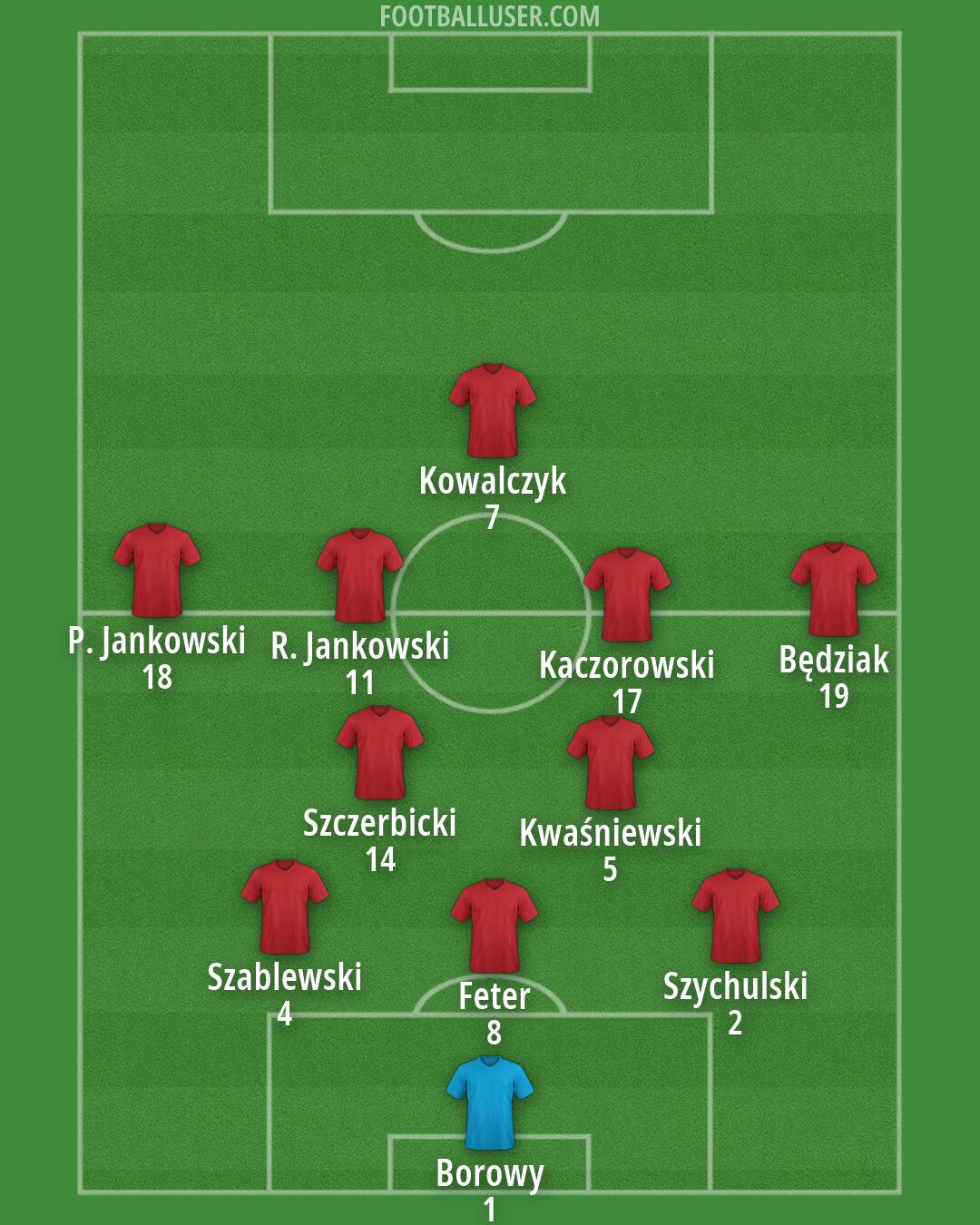
Starting Lineup
Borowy (1) · Feter (8) · Szychulski (2) · Szablewski (4) · Będziak (19) · Szczerbicki (14) · R. Jankowski (11) · Kaczorowski (17) · Kowalczyk (7) · Kwaśniewski (5) · P. Jankowski (18)A focus on defensive stability and quick breaks defines this team in a 5-4-1. This lineup is built to sit deep, absorb pressure, and strike with speed when the opposition leaves gaps. The formation prioritizes a low block to deny space between the lines, making it difficult for opponents to play through the center.
Borowy stays between the posts to organize the defensive unit. The back five acts as a narrow defensive block to protect the central areas. Feter and Kwaśniewski provide central presence, while Szczerbicki covers the left side of the defense. Szychulski and Szablewski function as attacking wing backs, tasked with providing width and tracking back to support the three center backs. The defensive unit aims to stay compact, forcing the opposition to the flanks and preventing through balls.
In the middle of the pitch, a four man midfield works to protect the back five. Kaczorowski and R. Jankowski sit in the central spaces to shield the defense and win the second ball. Będziak and P. Jankowski play on the flanks to press the opposition and track back when defending. This group connects the defensive line to the attack by recycling possession and finding ways to play through the lines during transitions.
The attack relies on a lone striker, Kowalczyk, who acts as a focal point to hold up the ball. Kowalczyk must press the opposition back line and fight for long balls to allow the midfield to move up the pitch. When the team wins the ball, the wing backs Szychulski and Szablewski push high to provide width, creating chances for cutbacks from the byline. The team looks to break quickly, using combinations between the wide players and the striker to exploit space.
One major advantage of this lineup is the compactness when defending, which makes it hard for opponents to find passing lanes. The team also benefits from the ability to hit in behind on the transition, using the width of the wing backs to stretch the defence. This setup allows the team to remain solid under heavy pressure while staying ready to counter at pace.
This 5-4-1 formation provides a reliable way to deny space to dominant attacking sides. It is best suited for games where the team needs to protect a lead or play against opponents who control high levels of possession.