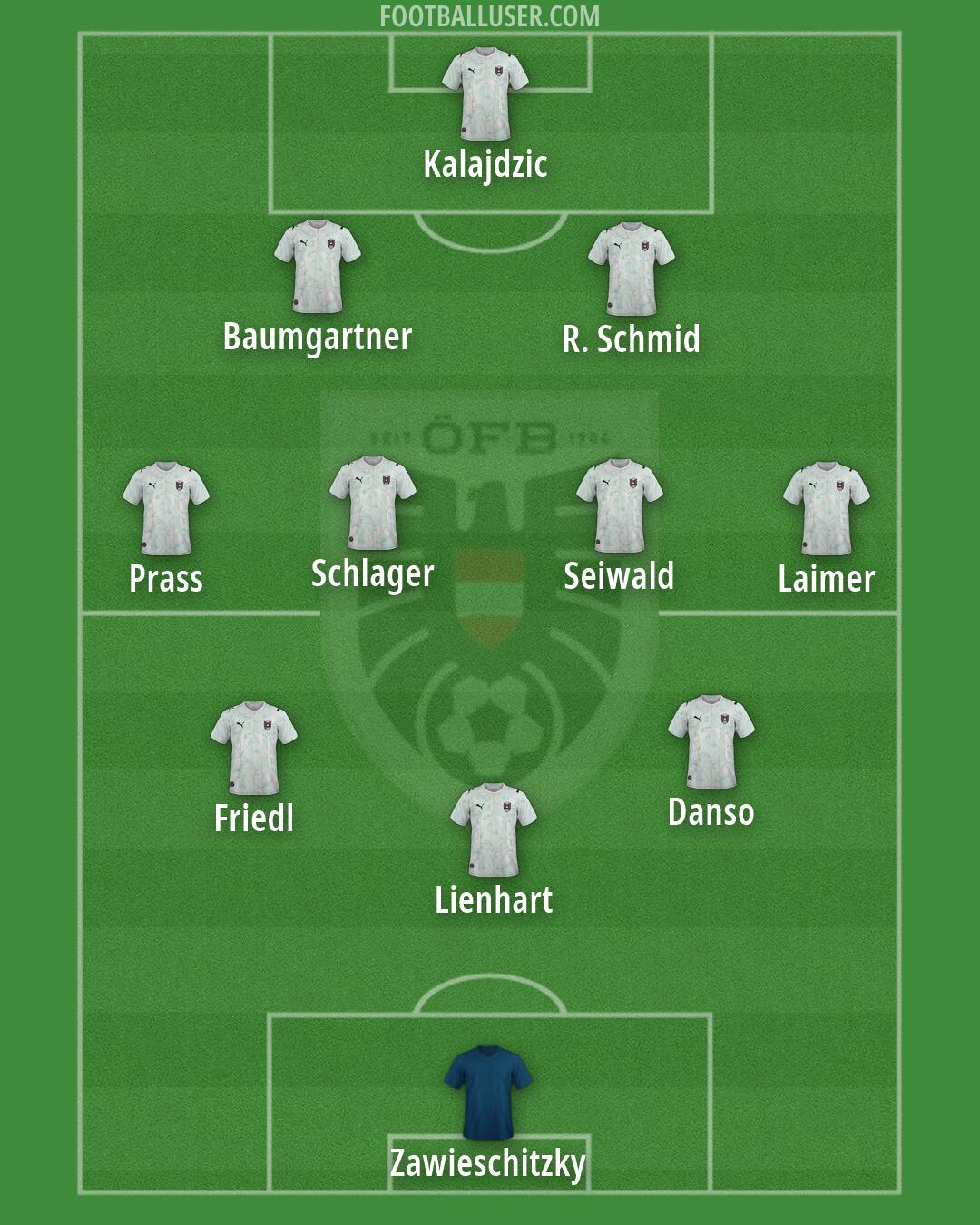

Austria National Football Team Formation
 Today, November 4, 2026


Starting Lineup
Prass · Laimer · Friedl · Lienhart · Danso · Schlager · Seiwald · Kalajdzic · Baumgartner · R. Schmid · ZawieschitzkyAustria aims to play with a high press and direct verticality using a 3-4-3 formation. This lineup focuses on winning the ball high up the pitch to catch opponents before they can settle. The goal for Austria is to use heavy pressing to force long balls and then strike quickly in transition.
Zawieschitzky operates between the posts to organize the defensive line. The back three consists of Lienhart, Friedl, and Danso working as a compact unit. Lienhart acts as a ball playing defender to start attacks, while Friedl and Danso provide aerial strength and physical presence to defend the zone. This trio works to squeeze the space between the defense and the midfield, setting the offside trap when the team steps up high.
The midfield functions as a central block with Schlager and Seiwald operating as a double pivot. Schlager presses aggressively to win the ball back, while Seiwald focuses on shielding the defense and intercepting passes. Prass and Laimer act as wide midfielders who provide the necessary width. They are tasked with tracking back to help the defenders and carrying the ball forward to support the front three when the team moves into the attacking third.
The attacking front line uses three attackers to stretch the opposition. Kalajdzic plays as a pressing centre-forward, using his height to hold up the ball and win headers. Baumgartner and R. Schmid act as wide wingers who cut inside to create goal scoring chances. They look to play through the lines and find the feet of Kalajdzic or make runs in behind the defense. The front three work together to press the opposition back line, forcing mistakes in the build up.
Austria gains a major advantage through the ability to press high in coordinated waves. The presence of a double pivot allows Seiwald and Schlager to control the center while Prass and Laimer provide wide overloads. This setup creates significant pressure on the opponent's defenders, often leading to quick turnovers in dangerous areas. The formation also allows for quick transitions from a compact defensive block to a direct attack.
This 3-4-3 formation is built for high intensity and rapid vertical play. It is best suited for matches against teams that struggle to play out from the back under heavy pressure.