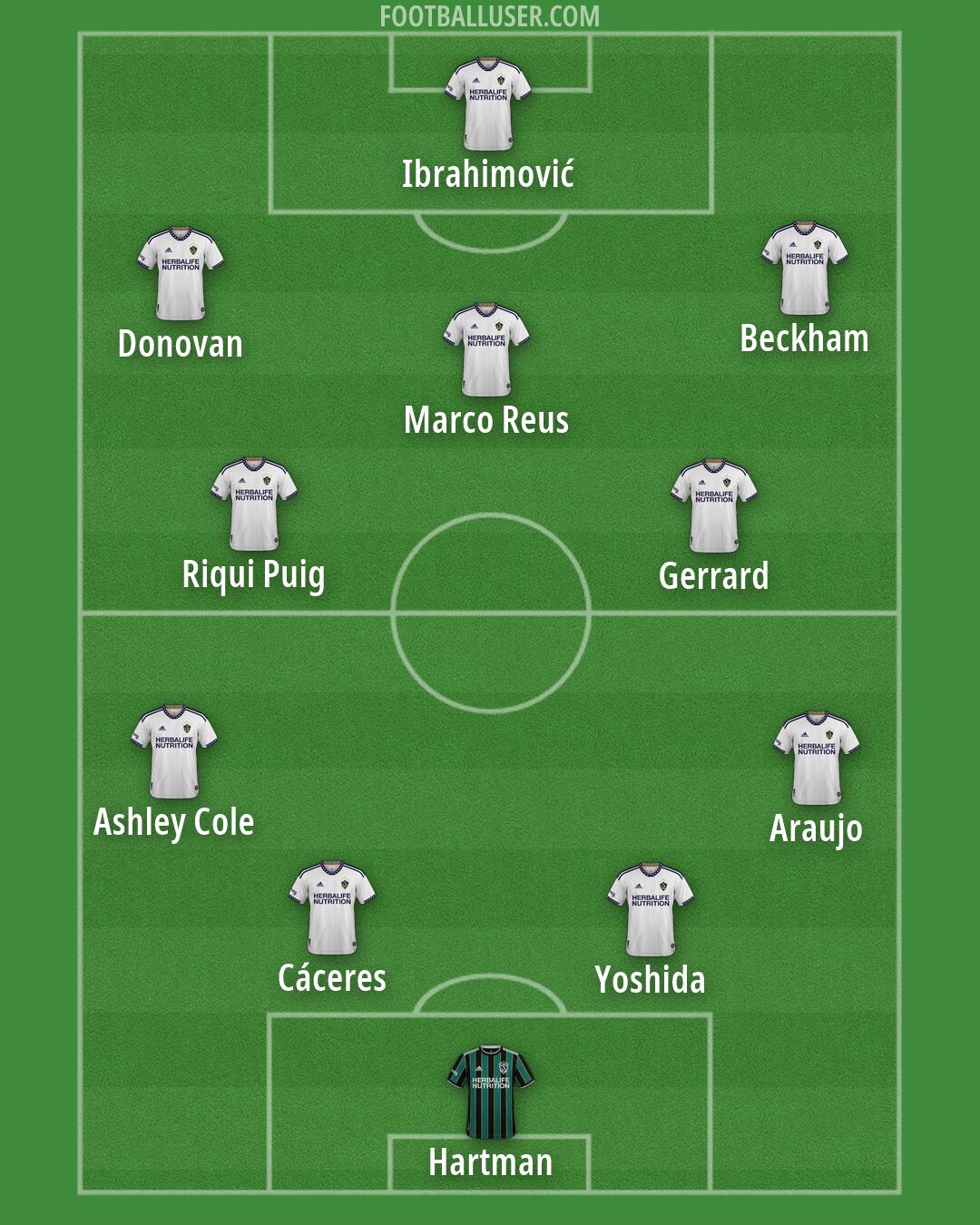
LA Galaxy Soccer Formation
 Today, November 5, 2026


Starting Lineup
Ibrahimović · Marco Reus · Beckham · Ashley Cole · Gerrard · Riqui Puig · Donovan · Hartman · Araujo · Yoshida · CáceresLA Galaxy relies on a high press and direct verticality within a 4-5-1. This formation is built to win the ball high up the pitch and quickly transition into attacking situations. The team aims to control the middle of the park before launching direct service toward the front line.
Hartman plays between the posts to organize the back line. The defensive unit operates as a flat back four with Araujo acting as a right back to provide width and Ashley Cole pushing up as an attacking left back. In the center, Yoshida and Cáceres form a central pairing where Yoshida uses his aerial strength to defend long balls while Cáceres provides cover. This unit works to squeeze the space and force the opposition into wide areas.
The midfield relies on a double pivot to control the central zones. Gerrard and Riqui Puig act as the holding pair, with Puig looking to receive on the half-turn and Gerrard working to break the line with his passing range. Ahead of them, Marco Reus operates as a central midfielder who connects the defense to the attack. On the flanks, Beckham and Donovan provide the creative spark, with Beckham looking to whip it in from wide areas and Donovan operating in the half spaces to find pockets of room.
The attacking play centers on Ibrahimović acting as a lone target man. He is tasked to hold up the ball and allow the wide players to join the attack. Beckham and Donovan look to deliver early crosses or cutbacks to find him in the box. The team uses the width provided by the full backs and the wingers to stretch the defense, creating room for Marco Reus to arrive late into the box. Ibrahimović also leads the press from the front to force a long ball from the opposition.
LA Galaxy gains a significant advantage through numerical superiority in the midfield when the full backs push high. This allows the team to win the second ball frequently and exploit the space left behind the opponent's midfield. The combination of technical passing in the middle and direct service from the flanks creates multiple ways to break the line.
This formation provides a balance of defensive solidity and rapid transition play. It is best suited for matches against teams that play a high defensive line or struggle to deal with physical target men.