
Germany National Football Team Formation
 Today, November 6, 2026


Starting Lineup
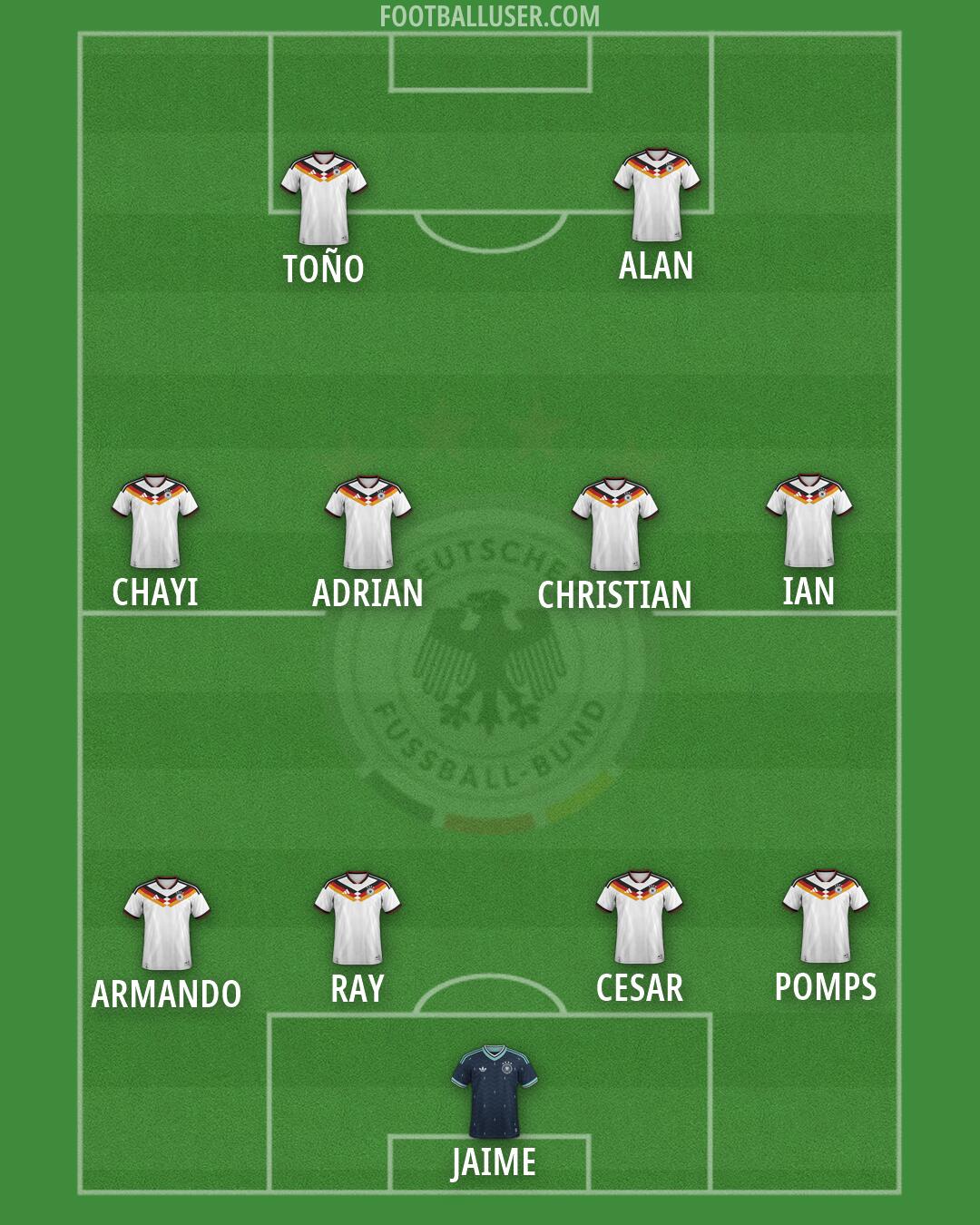
JAIME · RAY · CESAR · ARMANDO · POMPS · ADRIAN · IAN · ALAN · TOÑO · CHAYI · CHRISTIANGermany operates with a direct and vertical identity using a 4-4-2 formation. This lineup aims to win the second ball and strike quickly once possession is regained. The goal is to stretch the defence through wide play and quick transitions to catch the opposition off guard.
JAIME starts between the posts to command the area. The back four functions as a flat line with POMPS acting as the right back to provide width. ARMANDO plays as the left back to support the flank while RAY and CESAR operate as the central defenders. RAY and CESAR focus on defending zonally and clearing the lines when under pressure. The defensive unit aims to hold a compact shape to deny space between the lines.
The midfield is built around two central players, CHRISTIAN and ADRIAN, forming a double pivot to control the middle. ADRIAN works to shield the defence and intercept passes, while CHRISTIAN looks to carry the ball forward and connect the lines. On the flanks, IAN plays as the right midfielder and CHAYI operates on the left. These wide players provide the necessary width to stretch the pitch and can support the central duo to compress the midfield when defending.
In the attacking third, Germany uses two forwards in a partnership consisting of TOÑO and ALAN. TOÑO acts as a pressing centre-forward to trigger a press from the front, while ALAN works to find the feet of the striker and play one-two combinations. They use the width provided by IAN and CHAYI to create space centrally. The duo often looks to hit in behind on the transition or receive the ball in tight spaces to turn the defenders.
Germany gains a tactical advantage through the ability to press in pairs across the pitch. The 4-4-2 allows the team to maintain compactness when defending in a mid-block, making it difficult for opponents to play through the lines. By using the wide players to pin the opposition full backs, the team can create overloads in the half-spaces.
This formation relies on a high level of coordination between the two banks of four. It is best suited for matches against teams that struggle with quick transitions and direct attacking play.