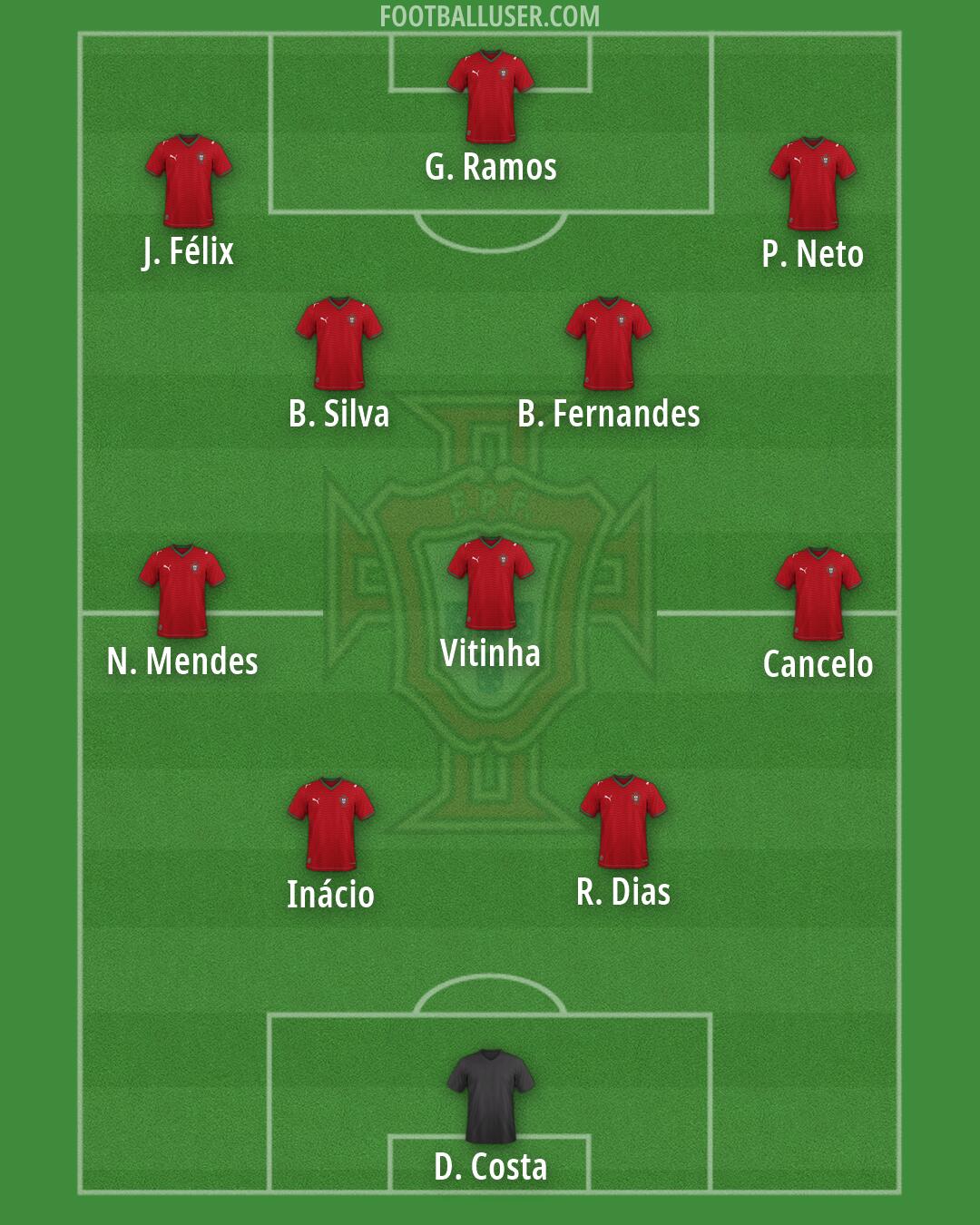

Portugal National Football Team Formation
 Today, November 6, 2026


Starting Lineup
G. Ramos · J. Félix · P. Neto · B. Silva · B. Fernandes · Vitinha · N. Mendes · Cancelo · Inácio · R. Dias · D. CostaPortugal aims to win the ball high up the pitch and hit opponents in behind on the transition, using a 5-2-3 formation to control the game. This lineup relies on verticality and quick movement to punish teams that leave space behind their defense. The team looks to use the width of the pitch to stretch the opposition before looking to play through the lines.
D. Costa operates between the posts to sweep behind the high line. A back five provides a solid base with Vitinha, R. Dias, and Inácio forming the central unit. R. Dias uses his aerial strength to defend crosses, while Inácio covers the spaces to the side. Cancelo acts as an attacking wing back on the right to provide width, and N. Mendes pushes up on the left to overlap the winger. This defensive unit stays compact to deny the turn to attackers.
The midfield functions as a double pivot where B. Silva and B. Fernandes work to control the center. B. Silva acts as a carrier to drive forward with the ball, while B. Fernandes looks to create from deep and find the feet of the striker. They work to press in a mid-block to win the ball back quickly. These two connect the defensive line to the front three, ensuring the team can recycle possession or break quickly when the ball is recovered.
Portugal uses three attackers across the front to pin the last defender. G. Ramos acts as the lone striker to hold up the ball and lead the press from the front. J. Félix operates as an inverted winger on the left to cut inside and find space in the half spaces, while P. Neto stays wide on the right to stretch the defense. The forwards aim to create runs in behind and work in combinations to exploit gaps in the opposition back line.
One major advantage for Portugal is the ability to create wide overloads through the runs of Cancelo and N. Mendes. The formation also provides a high level of compactness when defending, making it hard for opponents to find passing lanes through the middle. The speed of transition allows the team to move from a defensive block to an attacking threat in seconds.
This 5-2-3 formation provides a strong balance between defensive solidity and rapid attacking movement. It is best suited for games against teams that play a high line or rely heavily on possession.