
Austria National Football Team Formation
 Today, November 6, 2026


Starting Lineup
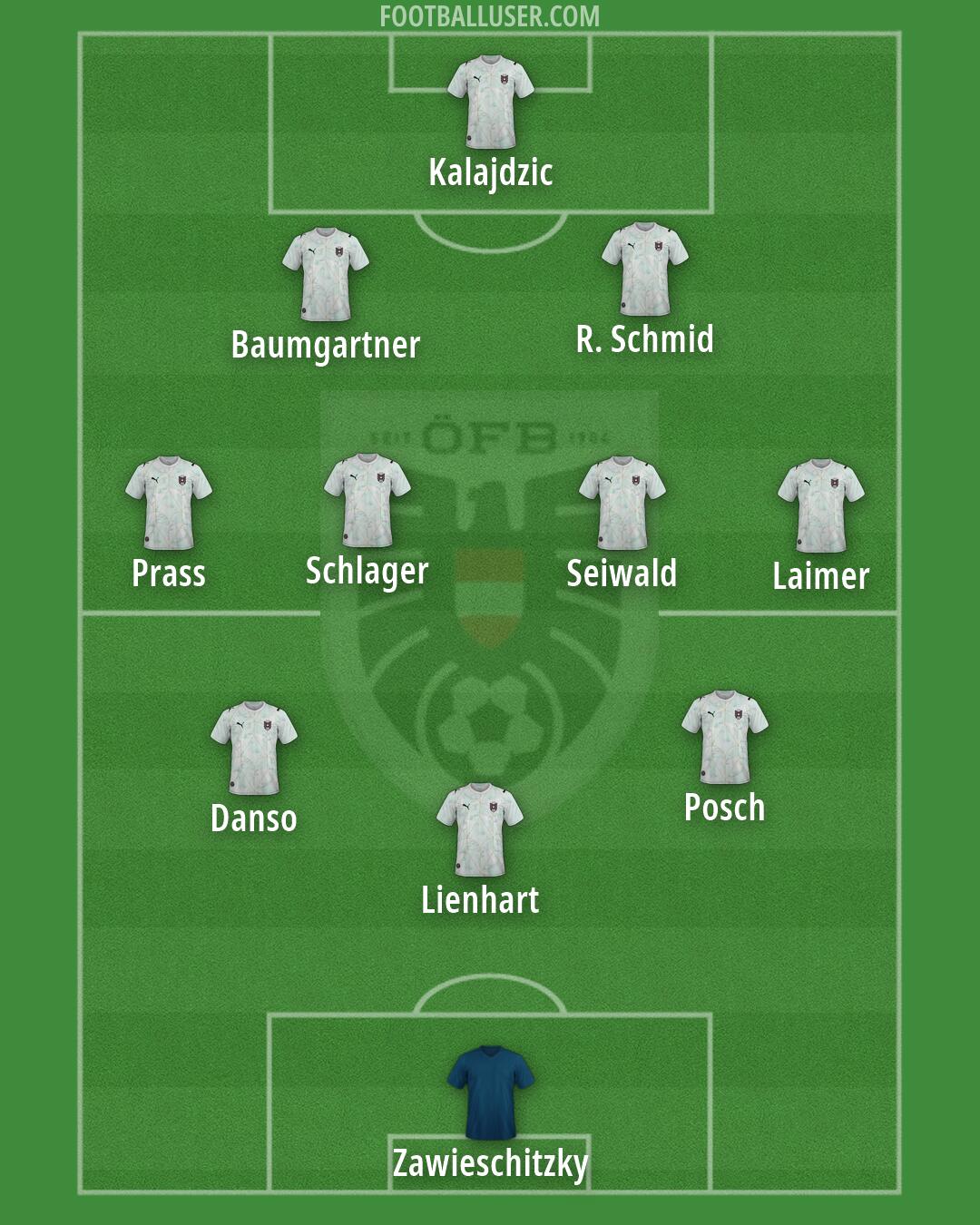
Prass · Laimer · Lienhart · Danso · Posch · Schlager · Seiwald · Kalajdzic · Baumgartner · R. Schmid · ZawieschitzkyAustria relies on a high press and quick transitions to unsettle opponents, utilizing a 3-4-3 formation. This lineup is built to win the ball back high up the pitch and hit in behind on the transition. The team looks to stretch the defence through wide players while maintaining a compact unit in the middle to squeeze the space.
Zawieschitzky acts as the last line of defence, often needing to sweep behind a high line when the team pushes up. The back three consists of Lienhart, Danso, and Posch, who form a narrow defensive block. Lienhart plays as a ball playing defender to help play out from the back, while Danso provides aerial strength and physical presence in the center. Posch acts as the right centre back, focusing on covering space and stopping direct runs. This defensive unit works to keep the lines tight to prevent through balls.
The midfield functions as a four man unit with a central pairing that controls the tempo. Seiwald acts as a single pivot to shield the defence and intercept passes, while Schlager works as an inverted eight to connect the defensive and attacking lines. Seiwald is known for his high pressing intensity and ability to win the second ball. Laimer and Prass operate as wide midfielders who provide the necessary width. Laimer can carry the ball forward to drive into the half spaces, while Prass tracks back to help the defensive line when the team loses possession.
In the attacking third, Austria uses three attackers to pin the last defender. Kalajdzic acts as a pressing centre forward and a target man to hold up the ball and win headers. He finds the feet of the midfielders to allow for combinations. Baumgartner operates as an inverted winger on the left, cutting inside to create chances, while R. Schmid stays wide on the right to provide service. These forwards press from the front to force a long ball from the opposition, creating opportunities to win it back high up the pitch.
Austria gains a major advantage through their ability to press high in coordinated waves, making it difficult for opponents to build from the back. The presence of Laimer and Prass allows for wide overloads when they push up to support the front three. This formation also offers great speed of transition, allowing the team to move from a mid-block to an attacking state in seconds.
The Austria lineup is a high energy system designed to dominate through physical pressing and quick vertical movements. It is best suited for games against teams that struggle to play short from the back or lack composure under pressure.