Arsenal Football Formation
 Today, November 7, 2026


Starting Lineup
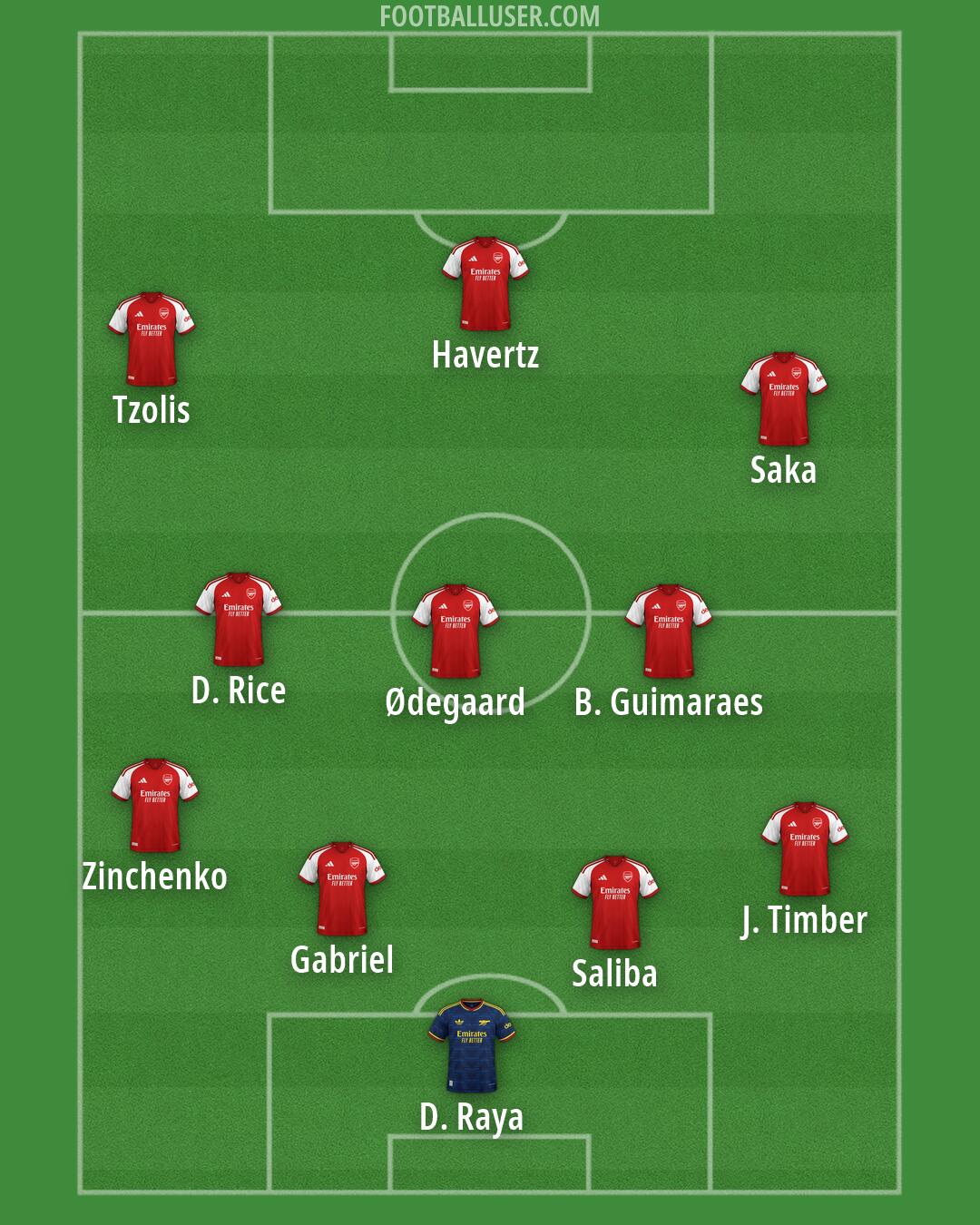
D. Raya · Gabriel · Zinchenko · Saliba · J. Timber · D. Rice · Ødegaard · B. Guimaraes · Tzolis · Havertz · SakaArsenal aims to control matches through heavy possession and a high press in a 4-3-3 formation. This lineup is built to dominate the ball and squeeze the space in the opponent's half. The team seeks to control the rhythm of the game by keeping the ball in tight spaces and using short passing to move up the pitch.
In goal, D. Raya plays a key role in playing out from the back to start attacks. Arsenal uses a flat back four where the defenders often step up to maintain a high line. Saliba and Gabriel act as the central duo, with Saliba using his recovery speed and Gabriel providing aerial strength. Zinchenko operates as an inverted full back to help control the middle, while J. Timber provides width and covers the flank. The defensive unit works to compress the midfield and keep the opposition pinned back.
The midfield consists of a three-man midfield with a carrier and creative profiles. D. Rice acts as the main anchor to shield the defence and win the second ball. B. Guimaraes works alongside him to drive forward with the ball and link the lines. Captain Ødegaard operates in the half-space to create chances and find the feet of the striker. This group is tasked to press aggressively to win the ball high up the pitch and recycle possession quickly.
The attacking front line uses three attackers across the front. Havertz acts as a pressing centre-forward who can drop deep to link up play. Saka stays wide on the right to isolate defenders one on one, while Tzolis plays as an inverted winger on the left to cut inside. The forwards press the opposition back line to force a long ball and create opportunities in transition. This movement is designed to create runs in behind and allow Saka to get to the byline for cutbacks.
Arsenal offers several tactical advantages with this formation. The team can create numerical superiority in midfield when Zinchenko moves inside. They also use wide overloads from J. Timber and Saka to stretch the defence. The ability to press high in coordinated waves allows the team to win it back high up the pitch and attack the near post or far post in quick combinations.
This formation is designed for a side that wants to dominate territory and control the ball. It is best suited for matches against teams that sit deep and defend in a low block.