Aston Villa Football Formation
 Today, November 9, 2026


Starting Lineup
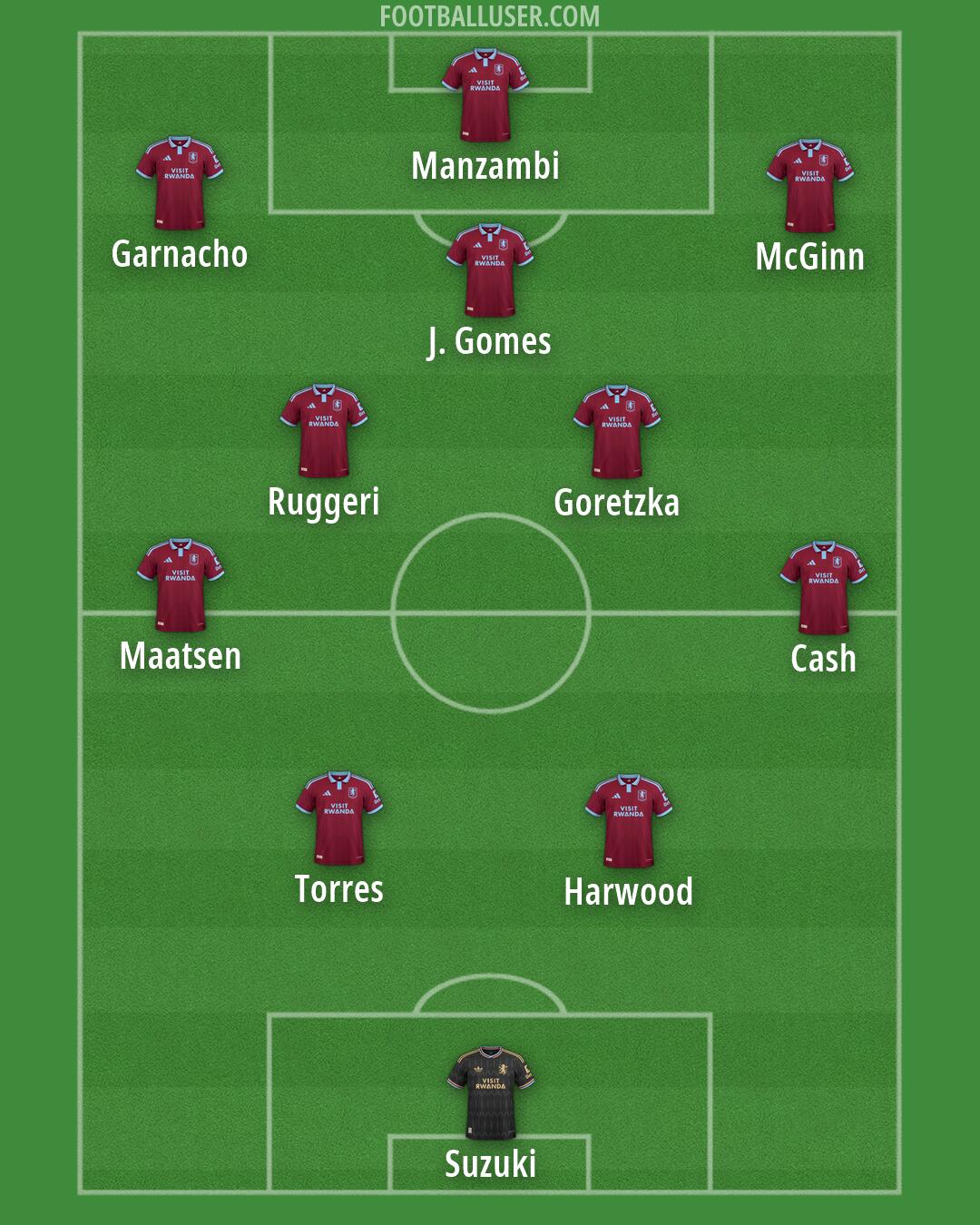
Maatsen · Cash · Ruggeri · Goretzka · Manzambi · McGinn · J. Gomes · Garnacho · Torres · Harwood · SuzukiAston Villa relies on a vertical style of play to catch opponents out of position using a 2-5-3 formation. This lineup is built to press high and move the ball forward with speed to exploit spaces left behind the opposing midfield. The goal is to dominate the central areas while using the wide players to stretch the defence during the attacking phase.
Suzuki operates between the posts to manage the space behind the high defensive line. The back line consists of a pair of central defenders, Harwood and Torres, who must act as ball playing defenders to initiate attacks. Harwood and Torres often play in a high line to squeeze the space, meaning they need to be ready to cover ground when the opposition tries to hit in behind. This defensive unit functions as a tight block that relies on quick recovery runs to maintain stability.
The midfield is a dense five man unit designed to control the game through central dominance. Cash plays as a right sided defensive midfielder to shield the two centre backs, while Maatsen acts as a left sided defensive midfielder to provide balance. Goretzka operates in the right central midfield role, using his driving runs to carry the ball forward into the final third. Ruggeri works alongside him to connect the defensive and attacking lines, and J. Gomes plays as an attacking ten behind the striker to create chances in the half spaces. This midfield group works to win it back high up the pitch and recycle possession quickly.
In the final third, Aston Villa uses three attackers across the front to pin the last defender. Manzambi acts as the lone striker, tasked to hold up the ball and find the feet of the oncoming midfielders. Garnacho plays as an inverted winger on the left to cut inside and create goal scoring opportunities, while McGinn operates on the right to provide width and assist the attack. The forwards press from the front to force a long ball from the opposition, allowing the midfield to intercept and spring the transition. This setup creates many runs in behind and allows the wide players to combine in tight spaces near the penalty area.
The tactical advantages of this 2-5-3 formation include extreme numerical superiority in midfield and the ability to press high in coordinated waves. By crowding the center with five players, Aston Villa can easily win the second ball and dominate possession in the middle third. Furthermore, the presence of Garnacho and McGinn allows the team to isolate wide players in one on one situations when the opposition defense is stretched.
This formation is a high risk, high reward system built on aggressive pressing and central control. It is best suited for matches against teams that struggle to play through a dense midfield or those that leave massive gaps between their lines.