Aston Villa Football Formation
 Today, November 9, 2026


Starting Lineup
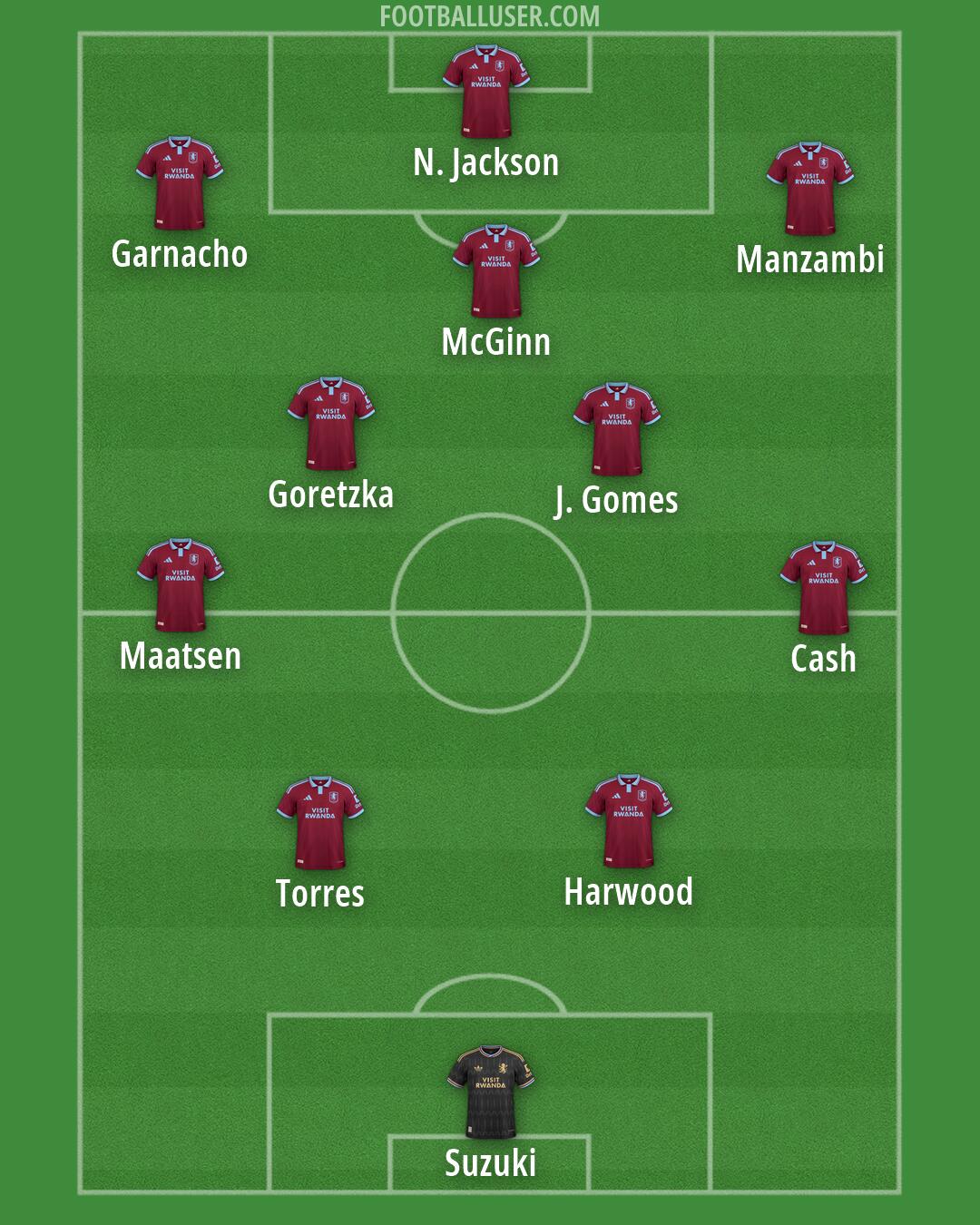
Maatsen · Cash · N. Jackson · Goretzka · Manzambi · McGinn · J. Gomes · Garnacho · Torres · Harwood · SuzukiAston Villa aims to dominate through a high press and aggressive verticality using a 2-5-3. This formation focuses on overwhelming the opponent in the final third and winning the ball back high up the pitch to catch teams in transition. It is built to play with heavy intensity, looking to squeeze the space in the middle and force errors from the opposition.
Suzuki sits between the posts to act as the foundation for the back line. The defensive unit consists of a narrow pair of central defenders with Torres and Harwood. Torres is expected to use his strength to win the header and block the runner, while Harwood provides cover to manage any balls played in behind. Because there are no traditional full backs, these two must hold a high line to keep the team compact and prevent the opposition from playing through the lines.
The midfield is a five man block that controls the tempo and central areas. Cash and Maatsen act as a double pivot to shield the defence, with Cash providing defensive cover and Maatsen looking to drive forward with the ball. J. Gomes and Goretzka occupy the half spaces to connect the defensive and attacking lines, with Goretzka known for his physical presence and ability to carry the ball forward. McGinn operates as the attacking ten, looking to arrive late into the box and press aggressively to win the ball high up the pitch.
In the final third, Aston Villa utilizes three attackers to pin the last defender. N. Jackson acts as a pressing centre-forward to lead the line and harass the opposition center backs. On the flanks, Garnacho and Manzambi act as wide wingers who stretch the defence. Garnacho likes to cut inside to create chances, while Manzambi provides width to allow others to underlap. This front three works in combination to create runs in behind or find the feet of the striker in tight spaces.
A major advantage for Aston Villa is the numerical superiority in the midfield, which allows the team to control the ball and recycle possession easily. The high press in coordinated waves can also force a long ball from the opponent, which the central defenders can then intercept. By pushing so many players forward, the team creates wide overloads that make it difficult for the opposition to defend the flanks and the middle simultaneously.
This 2-5-3 formation is designed for total dominance and high intensity. It is best suited for matches against teams that struggle to play out from the back or those that sit deep in a low block.