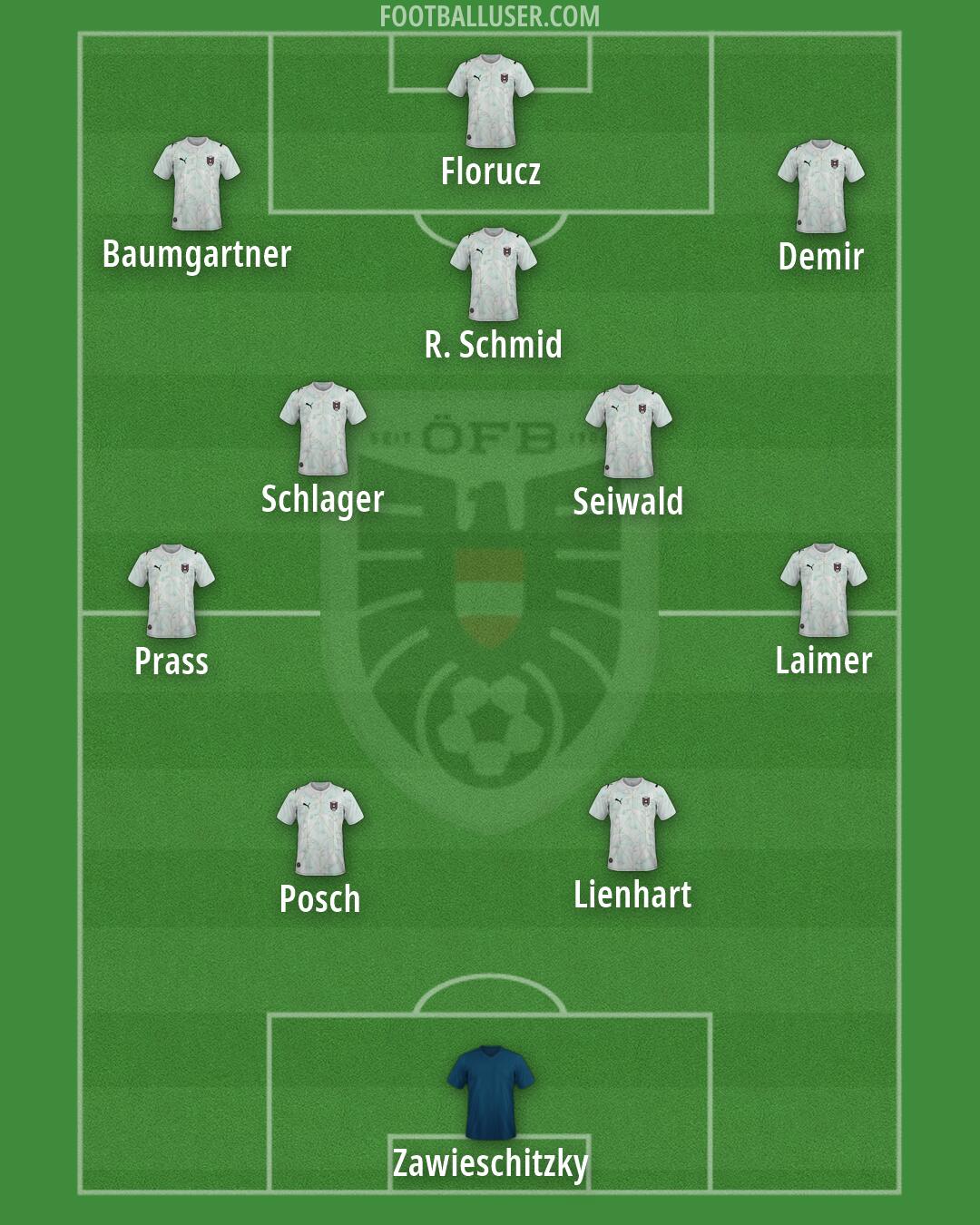

Austria National Football Team Formation
 November 9, 2026


Starting Lineup
Prass · Laimer · Lienhart · Posch · Schlager · Seiwald · Florucz · Baumgartner · R. Schmid · Zawieschitzky · DemirAustria focuses on high pressing and rapid transitions through a 2-5-3 formation. This lineup aims to win the ball high up the pitch and move vertically to catch the opposition out of position. The team wants to squeeze the space and use heavy pressure to force mistakes in the opponent's defensive third.
Zawieschitzky operates between the posts to oversee the defensive unit. The back line is a narrow duo consisting of Posch and Lienhart. Posch acts as a ball playing defender to start attacks, while Lienhart provides cover and strength in the air. Because there are only two central defenders, they must hold the line carefully and step up to trigger a press, relying on the midfield to protect the space behind them.
A crowded five man midfield dominates the center of the pitch. Prass and Laimer form a double pivot to shield the two defenders, with Laimer often driving forward with the ball to add numbers to the attack. Seiwald and Schlager operate as two tens in the half spaces, looking to find pockets of room between the lines and link the defensive and attacking layers. R. Schmid plays as an attacking ten behind the striker to provide final passes and arrive late into the box. This dense middle section makes it hard for opponents to play through the center.
The attacking front three creates constant threat across the width of the pitch. Baumgartner plays as an inverted winger on the left to cut inside and create chances, while Demir stays wide on the right to stretch the defence. Florucz leads the line as a pressing centre-forward, looking to win the second ball and find the feet of the midfielders. The formation creates runs in behind and allows the attackers to combine in tight spaces when the team breaks quickly.
Austria offers significant tactical advantages through their ability to press high in coordinated waves. The massive presence of five midfielders allows for numerical superiority in the center, making it easy to win back possession and recycle possession quickly. This setup also provides great flexibility to shift between shapes when defending in a mid-block.
This 2-5-3 formation relies on intense pressing and central dominance to control matches. It is best suited for games where Austria can pin the opponent back and exploit large spaces left by attacking opposition teams.