Man City Football Formation
 Today, November 10, 2026


Starting Lineup
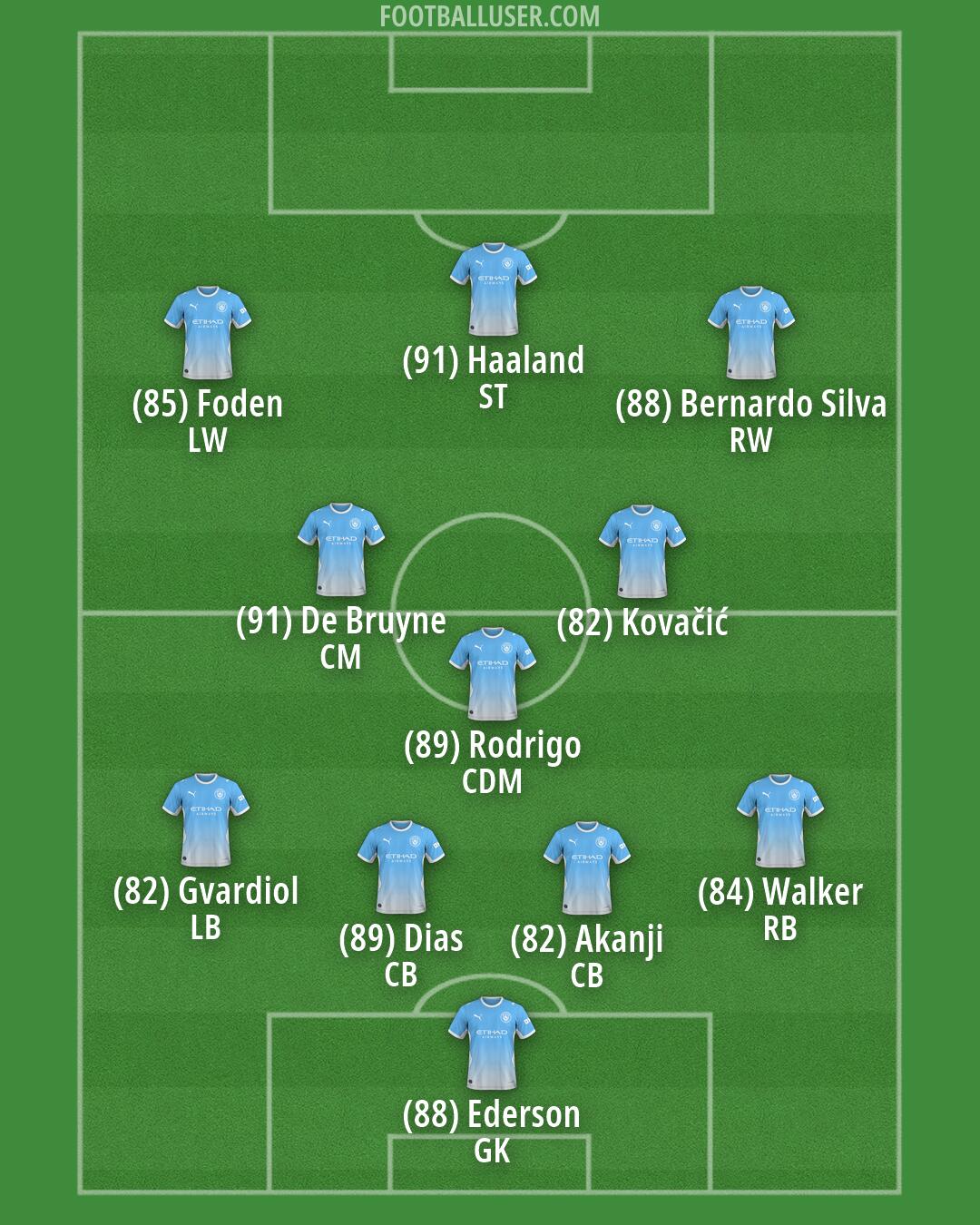
(88) Bernardo Silva (RW) · (89) Dias (CB) · (89) Rodrigo (CDM) · (82) Kovačić · (91) De Bruyne (CM) · (85) Foden (LW) · (91) Haaland (ST) · (88) Ederson (GK) · (82) Akanji (CB) · (82) Gvardiol (LB) · (84) Walker (RB)Man City focuses on controlling the ball and keeping possession through a 4-3-3 formation. This lineup is built to dominate matches by keeping the ball in high areas of the pitch and squeezing the space in the opposition half. The primary goal is to use short passing to move the ball through the thirds and create openings in a dense defensive block.
Ederson plays between the posts as the primary option to play out from the back with his renowned passing range. In front of him, a flat back four keeps a high line to keep the team compact. Walker acts as a defensive right back to provide speed when covering long balls, while Gvardiol plays as a left back who can push up to support the attack. Akanji and Dias form the central pairing, with Dias using his strength to win headers and Akanji acting as a ball playing defender to step up and intercept passes.
The midfield functions as a three man midfield with a single pivot. Rodrigo sits in front of the defense to shield the back line and recycle possession when under pressure. Beside him, De Bruyne operates as an inverted eight, looking to play through the lines with his exceptional passing range and vision. Kovačić connects the defensive and attacking lines by carrying the ball forward into the half spaces. This unit works to win it back high up the pitch and ensure the team stays in control of the tempo.
In the attacking third, Man City uses three attackers to stretch the defence. Haaland acts as a powerful pressing centre-forward who pins the last defender and looks to run in behind. On the wings, Bernardo Silva plays as an inverted winger who cuts inside to create extra passing lanes in tight spaces, while Foden operates on the left, looking to combine in tight spaces and arrive late into the box. This attacking group is designed to create cutbacks from the byline and isolate wide players in one on one situations.
One major advantage for Man City is the ability to create numerical superiority in midfield through the movement of the wide players. The team also benefits from wide overloads when the full backs push up to overlap the winger. Another strength is the speed of transition, allowing the team to hit in behind on the transition if the ball is recovered high up the pitch.
This 4-3-3 formation is built for a team that wants to dictate every moment of the game through ball retention. It is best suited for matches against opponents who sit deep and rely on defensive numbers.