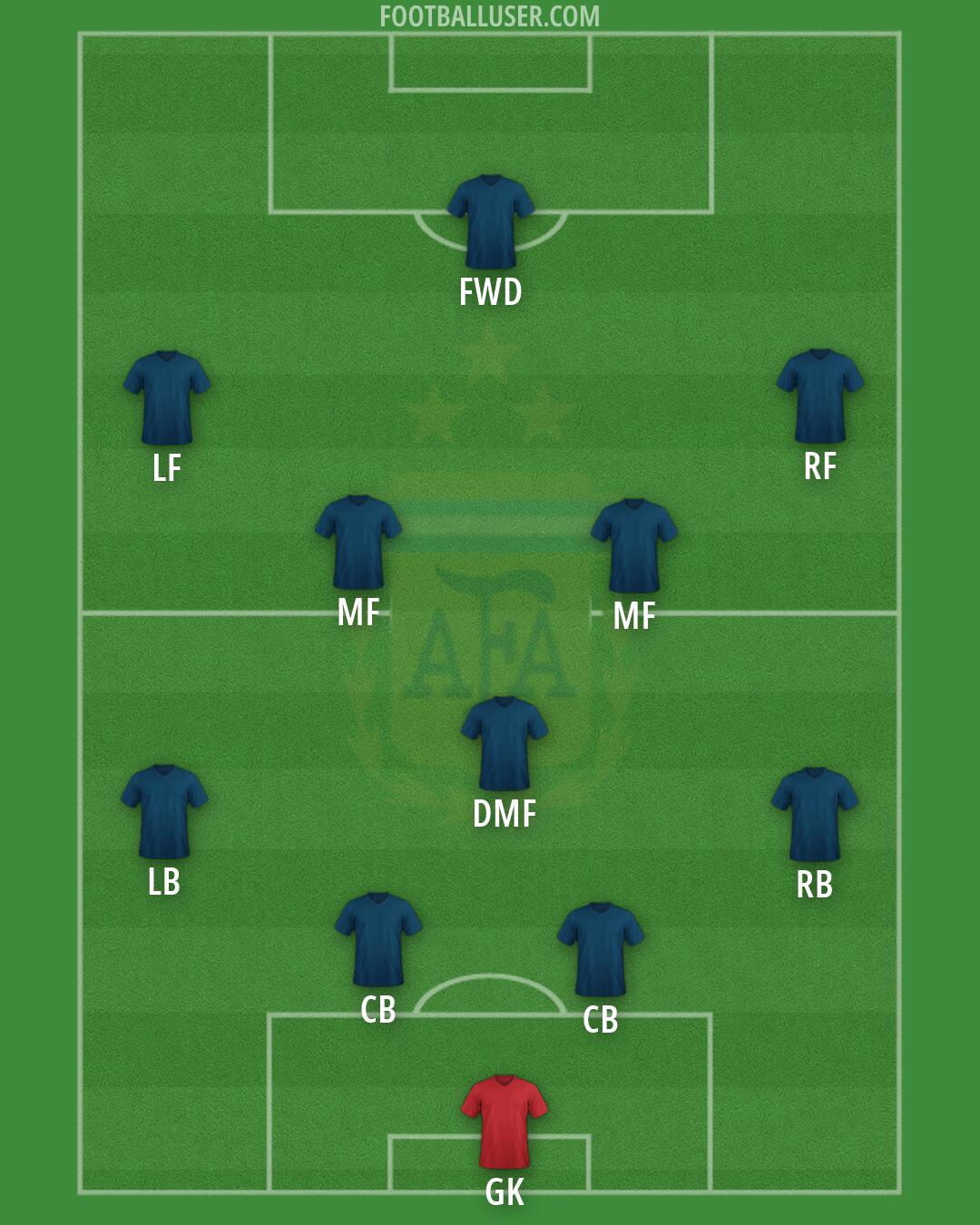

Argentina National Football Team Formation
 Today, November 11, 2026


Starting Lineup
CB · CB · RB · LB · DMF · MF · MF · RF · LF · FWD · GKArgentina aims to sit deep and defend in a compact block using a 5-4-1 formation. This lineup is built to deny space in the middle and hit teams on the transition. The primary goal is to maintain a narrow defensive line that forces the opposition to the flanks before breaking quickly when the ball is won.
The goalkeeper acts as the last line of defense behind a back five. The defensive unit consists of a central trio made of CB, CB, and DMF who hold the line and protect the middle. The RWB and LWB function as attacking wing backs to provide width, but they must track back to form a five man line when defending. The RCB and LCB focus on winning the header and covering space, while the DMF acts as a shield to pick up runners coming from deep.
The midfield operates as a four man block to squeeze the space between the lines. The DM sits in front of the defense to deny the pivot and intercept passes. To his sides, the RCM and LCM work to protect the half spaces and win the second ball. The RF plays in a more advanced role as an attacking ten, looking to link the midfield to the attack. This midfield group works to recycle possession once the ball is recovered to prevent immediate counter attacks.
In the attacking phase, Argentina relies on a lone striker, the FWD, to lead the line. The FWD must hold up the ball and find the feet of the striker to allow others to join the attack. The RF acts as a second striker in the hole to support the FWD, while the RWB and LWB push high to provide width and deliver crosses. The attack is designed to create runs in behind by using the movement of the RF and the FWD to stretch the defense.
Argentina possesses strong tactical advantages through its ability to defend in a narrow defensive block. The formation offers compactness when defending, making it very difficult for opponents to play through the lines. There is also a high potential for speed of transition because the RWB and LWB can quickly turn defense into attack by spreading wide.
This formation is ideal for a team looking to absorb pressure and exploit space on the break. It is best suited for matches against heavy possession sides that struggle to break down a low block.